
B2B Contact Data for ABM: How to Build and Activate Account-Based Lists That Actually Convert
Account-based marketing fails for one reason more than any other: bad contact data. The account selection is right. The messaging is right. The timing is right. But the email bounces, the call hits a dead number, or the LinkedIn ad reaches someone who left six months ago. The campaign runs. Nothing moves.
ABM amplifies both what works and what doesn’t. When the data is accurate, concentrated spend on a small target list produces outsized returns. When the data is stale, that same spend burns budget on contacts who can’t receive the message. So getting B2B contact data right is not a supporting function in ABM. It’s the prerequisite for everything else.
SparkDBI is a global B2B and healthcare contact data provider with 270M+ verified contacts across 200+ countries. This guide covers how to build, verify, and activate B2B contact data for ABM programs – from account list construction through multi-stakeholder mapping to campaign activation.
Direct answer: B2B contact data for ABM requires three things that standard outbound lists don’t deliver: multi-stakeholder coverage per account, verified accuracy at the individual address level, and firmographic attributes that enable persona-level personalization. Generic databases optimized for volume fail ABM because ABM is a precision exercise, not a volume play.
Why Standard Contact Data Fails ABM Programs
Standard outbound and ABM have fundamentally different data requirements. In standard outbound, you optimize for volume. One bad contact in a thousand is noise. In ABM, however, you target 50, 100, or 500 accounts chosen specifically for their revenue potential. So one bad contact per account becomes a real miss rate.
Five ways generic contact data breaks ABM
- Single contact per account: Generic databases surface one or two contacts per company. But ABM buying committees at enterprise accounts average 6-10 stakeholders, according to Gartner. When a database gives you only the VP of Marketing, you have one thread into a multi-stakeholder decision.
- No seniority mapping: ABM requires different personas at different funnel stages – economic buyers early, technical evaluators mid-funnel, end users late. Generic lists give you job titles without context for which titles matter at which stage.
- Stale contact records: Directors and VPs move companies, get promoted, or change scope regularly. A database refreshed annually misses months of personnel changes at your most important accounts. As a result, you waste outreach on contacts who are no longer there.
- Missing firmographic depth: ABM personalization requires more than company name and industry. Revenue tier, headcount growth, technology stack, and recent funding all determine which message is most likely to land. Generic contact data rarely provides these attributes.
- No intent signal integration: The most effective ABM programs layer intent signals on top of contact data. Generic databases are static – they tell you who exists at an account, not who is researching your category right now.
Building Your ABM Contact List: A Four-Step Framework
ABM contact list construction follows a sequential process. Each step builds on the previous one. If you skip a step, the list underperforms – no matter how good your account selection or campaign infrastructure is.
Step 1: Define your account universe with firmographic precision
Before selecting contacts, define the exact firmographic profile of your target accounts. This is your ICP at the account level. It should be specific enough that your data provider can query against it directly – not a broad label like “mid-market SaaS.”
A precise ABM account definition specifies:
- Industry vertical at NAICS or SIC code level – not just “technology”
- Revenue range, for example $50M-$500M, not “mid-market”
- Employee headcount range
- Geographic market by country, region, or metro
- Technology stack signals – what platforms indicate fit or displacement opportunity
- Growth signals – headcount growth, recent funding, hiring in relevant departments
SparkDBI’s TechInstall data cards provide technographic install base data for account selection based on verified technology signals. For example, you can identify all companies in a target vertical currently running a specific CRM or ERP platform. This approach moves account selection beyond firmographic assumptions into verified, signal-based targeting.
Step 2: Map the buying committee per account
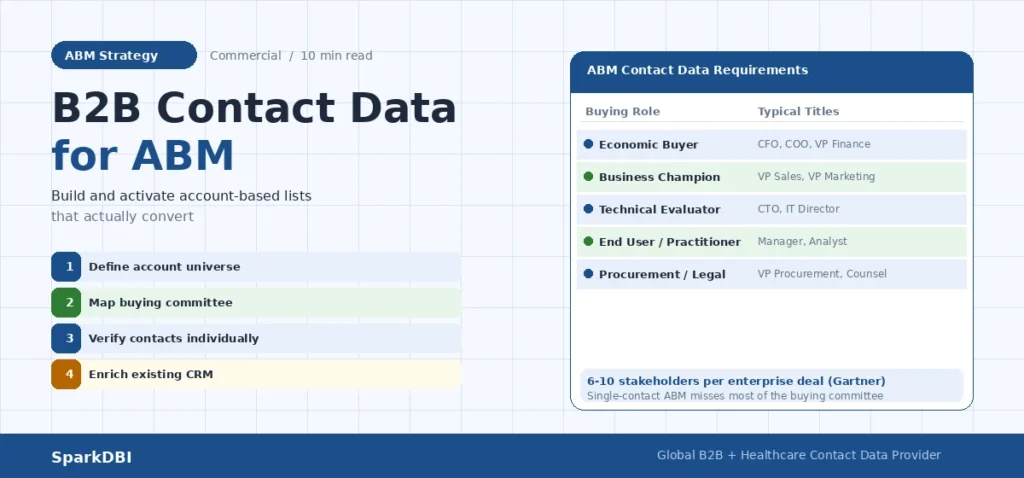
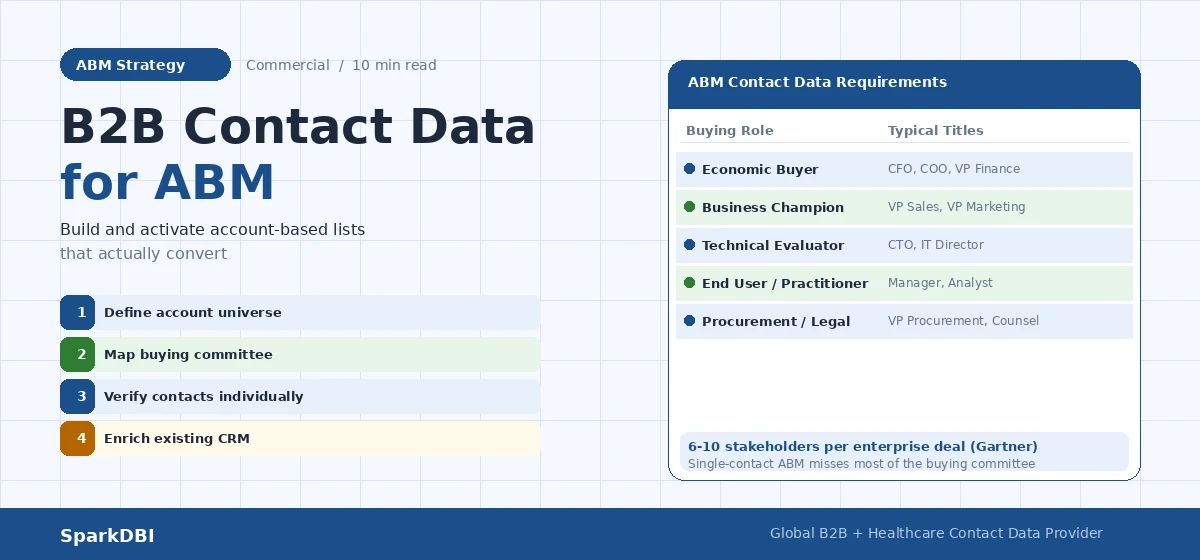
Once your account universe is defined, map multiple contacts per account across the buying committee. For a typical enterprise software sale, the committee includes five distinct roles. Each role requires a different message at a different funnel stage.
| Buying Role | Typical Titles | Funnel Stage | Message Focus |
|---|---|---|---|
| Economic buyer | CFO, COO, VP Finance | Top of funnel | ROI, cost reduction, risk |
| Business champion | VP Sales, VP Marketing, Director Ops | Mid-funnel | Business outcomes, team productivity |
| Technical evaluator | CTO, IT Director, Solutions Architect | Mid to late funnel | Integration, security, scalability |
| End user / practitioner | Manager, Analyst, Specialist | Late funnel | Ease of use, workflow impact |
| Procurement / Legal | VP Procurement, General Counsel | Late funnel | Contract terms, compliance, vendor risk |
SparkDBI’s global B2B email list lets you filter contacts by job title, seniority level, department, and function. So you can pull all relevant buying committee members from a target account in a single data pull – rather than prospecting contact by contact.
Step 3: Verify at the individual contact level before activation
ABM contact data requires individual address-level verification. Domain-level checks are not enough. Enterprise accounts often run catch-all email configurations, which means SMTP verification returns a positive response for any address – even one tied to someone who left six months ago.
SparkDBI verifies contacts through a multi-layer process. It combines active inbox validation, AI-assisted catch-all domain resolution, and cross-source matching across 140+ licensed data partners. The result is a 95%+ accuracy rate on delivered contacts. In other words, the contacts in your ABM list are reachable at the addresses provided – not just format-valid.
The live B2B database dashboard shows current verification status and data freshness in real time – so you can check database scope before licensing, not after.
Step 4: Enrich existing CRM accounts before new data acquisition
Before buying net-new contacts, enrich your existing CRM accounts first. Most CRMs hold useful intelligence about target accounts – past deals, conversation history, existing relationships. However, the contact records are often incomplete or stale. SparkDBI’s data enrichment service appends missing emails, phone numbers, seniority data, and firmographic attributes to existing accounts. That way, your sales team can activate existing relationships with the full buying committee before reaching out cold to anyone new.
Build Your ABM Contact List with SparkDBI
Multi-stakeholder contact mapping, technographic account selection, and 95%+ verified accuracy. Get 50 free verified contacts for your target ICP before committing to a full ABM list build.
Get 50 Free Sample Contacts View Live Database
ABM Contact Data Quality: Four Metrics That Predict Performance
Most data vendors talk about accuracy in vague terms. For ABM specifically, however, four concrete metrics predict whether your campaign will perform or stall.
Contact coverage rate per target account
How many verified contacts does the database surface per account? For enterprise ABM, the minimum viable coverage is 3-5 contacts across different buying roles. A database that returns one contact per account forces your sales team to research the rest manually. That defeats the operational efficiency ABM is supposed to deliver. Before committing, ask any provider: what is your average contact coverage per account for companies in my ICP?
Email deliverability rate on enterprise domains
Enterprise accounts – which form the core of most ABM target lists – run catch-all email configurations at rates above 25%. This means a standard SMTP verification returns positive for addresses where no real inbox exists. So ask for the provider’s verified deliverability rate on enterprise domains specifically. A 95% accuracy claim across a full database can hide significantly worse performance on the enterprise accounts that matter most to your program.
Data refresh frequency and last-verified timestamp
For ABM, contact-level recency matters more than in high-volume outbound. When you send five personalized touches to a VP over six weeks, discovering on touch three that they left the company is a real disruption. Ask for the last-verified timestamp on any contact in your ABM list. Data not verified in the last 90 days carries meaningful decay risk – especially at VP and Director level at growth-stage companies.
Firmographic attribute completeness
ABM personalization at scale requires every contact record to carry the attributes your messaging system needs. For example, if 30% of your contacts are missing revenue tier data, your revenue-segmented sequences break for 30% of the list. Before activating any dataset, check the completeness rate for every attribute your personalization logic depends on. Incomplete attributes cost you just as much as inaccurate ones in an ABM context.
Activating B2B Contact Data Across ABM Channels
A well-structured ABM contact dataset enables coordinated activation across multiple channels at once. This is what separates true ABM from sophisticated outbound email – and it only works when the underlying data is accurate and complete.
Email sequences
Verified email addresses for each buying committee member enable persona-specific sequences in your sales engagement platform. The economic buyer sequence emphasizes ROI. The technical evaluator sequence leads with integration specs and security. Both run simultaneously against the same account. However, this only works when you have accurate email addresses for all buying roles – not just the primary champion.
Paid advertising audiences
Your verified ABM contact list enables matched audience creation on LinkedIn, Google, and programmatic platforms. When you upload a current, verified list as a LinkedIn matched audience, your buying committee sees paid content while your sales team runs outbound sequences. The match rate on verified email addresses is significantly higher than on stale data. As a result, your cost-per-impression against target accounts drops meaningfully.
Direct mail and gifting programs
For enterprise ABM targeting high-value accounts, direct mail and executive gifting require verified mailing addresses alongside email data. SparkDBI’s contact records include business mailing addresses for the majority of enterprise-level contacts. So physical channel activation is possible for programs that combine digital and direct mail touchpoints.
CRM activation and sales routing
SparkDBI delivers contact data directly into Salesforce, HubSpot, or Zoho via flat-file and API with field-level mapping. That means your sales team works from structured account views rather than spreadsheets. Because enriched records update in place, there is no manual data entry or import cleanup required to activate an ABM list.
Frequently Asked Questions
What is B2B contact data for ABM?
B2B contact data for ABM is verified contact information – email addresses, phone numbers, job titles, seniority levels, and firmographic attributes – covering multiple stakeholders across a defined set of target accounts. Unlike standard outbound data, ABM contact data requires multi-stakeholder coverage, individual-level verification, and rich attributes for buying-role-specific personalization. SparkDBI provides ABM-ready contact data with 270M+ verified contacts, 95%+ accuracy, and multi-stakeholder coverage across custom ICP filters.
How many contacts do you need per account for ABM?
Enterprise ABM programs typically require 3-7 contacts per account to cover the key buying committee roles. According to Gartner’s B2B buying research, enterprise buying committees average 6-10 stakeholders. So single-contact-per-account ABM reaches only one thread into a multi-stakeholder decision. The exact number varies by deal size, company size, and product complexity – but fewer than three contacts per account leaves most of the committee unreached.
What firmographic data do you need for ABM targeting?
ABM account targeting requires at minimum: industry vertical at NAICS or SIC code level, revenue range, employee headcount, and geography. For high-precision ABM, technographic data adds a signal layer that firmographics alone cannot provide. Growth signals – headcount growth rate, recent funding, hiring in relevant departments – help identify accounts that are actively expanding and more likely to be in-market for your solution.
How do you enrich existing CRM accounts for ABM?
CRM enrichment for ABM means appending missing contact data, updating stale records, and adding buying committee contacts to existing account records. The process starts with exporting your target account list from CRM. SparkDBI then matches it against a current verified database and delivers enriched records back with field-level mapping directly into Salesforce, HubSpot, or Zoho. Because enriched records update in place, there is no manual import step.
How often should ABM contact data be refreshed?
Refresh ABM contact data at minimum quarterly for active target account lists. Monthly verification is better for top-tier accounts in an active deal cycle. B2B contact data decays at approximately 22-30% annually. However, VP and Director-level contacts at growth-stage companies churn faster than average. For a 200-account ABM list with 5 contacts per account, a 25% decay rate means 250 contacts become inaccurate within 12 months. SparkDBI performs bi-monthly refresh cycles across its 270M+ contact database to maintain accuracy across active ABM lists.
Key Takeaways
- Accurate contact data is the prerequisite for ABM – not a supporting function. ABM amplifies both what works and what fails, so data quality has a direct multiplier effect on results.
- Enterprise buying committees average 6-10 stakeholders. Single-contact-per-account databases miss most of the people who influence the decision.
- Enterprise domains run catch-all email configurations above 25% of the time. Because of this, standard SMTP verification cannot identify undeliverable addresses without AI-level resolution.
- ABM contact list construction follows four steps: firmographic account definition, buying committee mapping, individual-level verification, and CRM enrichment before net-new acquisition.
- Contact coverage per account, enterprise deliverability rate, refresh frequency, and firmographic completeness are the four metrics that predict ABM performance – not overall database size.
- SparkDBI provides 270M+ verified contacts with multi-stakeholder coverage, TechInstall technographic filters, 95%+ accuracy, bi-monthly refresh, and CRM-native delivery for Salesforce, HubSpot, and Zoho.
Build Your ABM Contact List with Verified B2B Data
SparkDBI provides multi-stakeholder ABM contact data with 270M+ verified contacts, technographic account filtering, and 95%+ accuracy – delivered into Salesforce, HubSpot, or Zoho. Get 50 free verified contacts for your ICP before building your full ABM list.
