 SparkDBi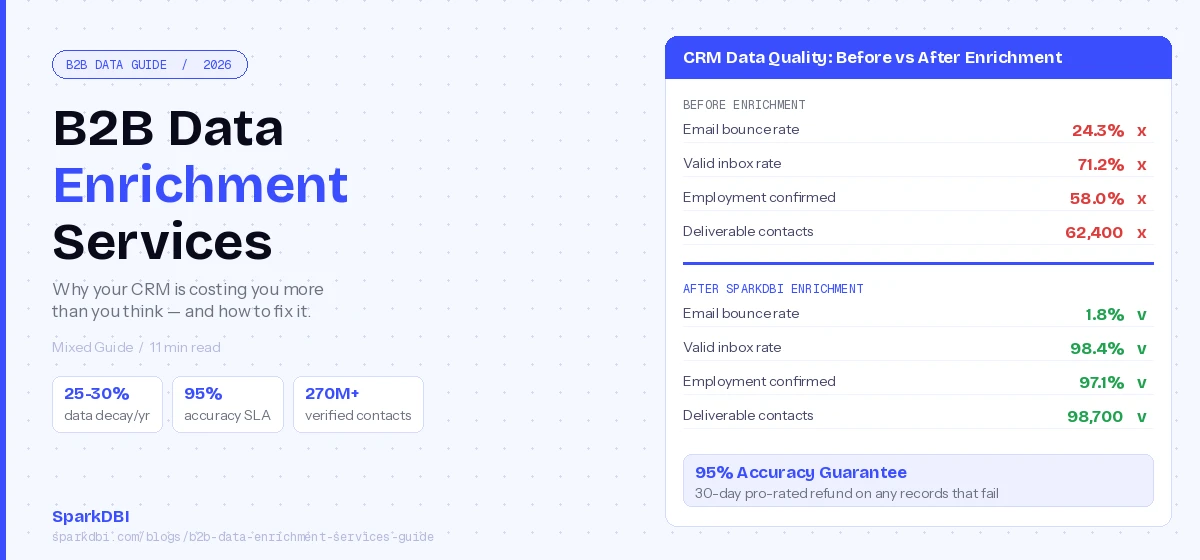
B2B data enrichment services update and complete your existing contact records using verified external data sources, fixing stale emails, wrong job titles, and unconfirmed employment before your campaigns run.
Your sales team is working hard. They’re sending emails, making calls, and running sequences. But the reply rates are low, the bounce rates are climbing, and your CRM is full of contacts that look fine on paper but go nowhere in practice. The problem usually isn’t the messaging. It’s the data underneath it.
B2B data enrichment services fix this. They take your existing contact records and fill in what’s missing, correct what’s wrong, and verify that the people in your database still work where you think they do. This guide covers how it works, what to look for in a provider, and what it should actually cost you.
Quick answer: B2B data enrichment services update and complete your existing contact records using verified external sources. They append missing fields like job titles, emails, phone numbers, and firmographics, then confirm employment status and inbox activity before delivering. The result is a cleaner CRM, lower bounce rates, and outbound that actually reaches real people in real roles.
What Is B2B Data Enrichment and Why Does It Matter?
Data enrichment in B2B means taking a contact record you already have and making it more complete and more accurate. You might have a name and a company but no email. You might have an email that’s two years old and bouncing. You might have a job title that was correct when the person joined but they’ve since been promoted or moved on.
Enrichment addresses all of this. A data enrichment company matches your records against its own verified database, finds the updated or missing information, and returns a cleaner version of what you sent in.
Here’s why it matters in numbers. B2B contact data decays at roughly 25-30% per year. That means if you have 20,000 contacts in your CRM right now and you haven’t enriched them in 12 months, around 5,000-6,000 of those records have some kind of problem. Wrong email, wrong job title, wrong company, or the person simply left. You’re paying for marketing automation, sales tools, and outbound programs that are running on contacts that can’t convert.
The Real Cost of Dirty CRM Data
Gartner research puts the average cost of bad data at $12.9 million per year for large organisations. For smaller B2B teams, the cost is less dramatic but just as damaging; it just shows up differently.
It shows up as email bounce rates above 5% that start triggering spam filters. As sequences that get replies from the wrong person because the contact changed roles. As SDR time wasted calling numbers that go to voicemail because the mobile belongs to someone who left the company six months ago. As lead scores that are wrong because the firmographic data feeding them is stale.
None of these problems announce themselves loudly. They drain performance quietly. Most teams don’t connect falling connect rates to bad data; they assume the messaging is wrong or the product isn’t landing. But when the same message gets a 4% reply rate on freshly enriched contacts and a 0.8% rate on a 24-month-old list, the data is the difference.
How B2B Data Enrichment Services Actually Work
The process varies between providers but the core mechanics are similar. You send a file, a CRM export, a lead list, an event attendee list, whatever you’re working with. The enrichment provider matches each record against their database and external sources. They return a file with the fields you asked for appended or updated.
Where providers differ is in how they validate what they append. There are two fundamentally different approaches:
Syntactic validation only. The provider checks that the email address is formatted correctly and that the domain exists. This is the bare minimum and it’s what a lot of lower-cost providers do. It doesn’t tell you whether the inbox is active, whether the person still works there, or whether anyone reads that email.
Active validation. The provider also checks inbox activity signals and confirms current employment before appending. This costs more and takes longer but the delivered records actually work. SparkDBi uses active inbox verification and employment confirmation on every record before delivery, contacts that fail either check are excluded rather than delivered with a low-confidence flag.
The difference in output quality is significant. Syntactically valid emails can still produce 15-20% bounce rates in the first send. Actively validated emails typically run under 3%.
What Fields Does Data Enrichment Append?
The most commonly requested enrichment fields in B2B are:
- Email append: adding or updating a verified business email address
- Phone append: direct dial and mobile numbers verified against carrier records
- Job title update: correcting or refreshing the contact’s current role and seniority
- Firmographic enrichment: industry classification, company size, revenue range, and headquarters location
- SIC and NAICS codes: standardised industry codes for routing, targeting, and reporting
- LinkedIn profile matching: confirming current employment and role
Most enrichment providers let you choose which fields you want appended. You don’t have to run a full enrichment pass every time, if you only need email and job title updated, you can scope it that way.
CRM Enrichment vs. List Enrichment: Which One Do You Need?
These are two different use cases and they’re worth separating.
CRM enrichment runs against your live Salesforce, HubSpot, or Zoho database on a scheduled basis, quarterly, monthly, or continuously via API. It keeps your whole database clean over time. This is the right approach for sales teams running ongoing outbound programs where data quality directly affects daily performance.
List enrichment runs against a specific export, a trade show attendee list, a purchased contact file, an inbound lead batch missing key fields. You enrich it once before importing it into your CRM or running a campaign. This is the right approach for one-off situations where you have a specific file you need cleaned up fast.
Both use the same validation process. The difference is scope and delivery. CRM enrichment typically integrates via API connector. List enrichment delivers as a flat file you import yourself.
Average Data Decay Rate in B2B: What the Numbers Actually Show
This is a question that comes up a lot, and the answer is more nuanced than the headline 25-30% figure suggests.
The 25-30% annual decay rate is the aggregate. But decay isn’t even across your database. Contacts at companies going through mergers, acquisitions, layoffs, or rapid growth decay much faster. Contacts in high-churn roles like SDRs, account executives, and junior marketing titles turn over faster than VP and C-suite roles. Healthcare contacts, physicians, nurses, pharmacists, tend to have more stable employment but their email infrastructure changes more often as practices merge and hospital systems update their domains.
A practical way to think about it: if you haven’t touched a list in 18 months, assume a third of it has a problem. If it’s been 24 months or more, the number is closer to half. This is why SparkDBi runs a bi-monthly refresh cycle on its B2B database and a monthly cycle on healthcare HCP data. Stale data and enriched data are not the same thing; they just look the same until you start sending to them.
How to Evaluate B2B Data Enrichment Companies
The market for data enrichment is crowded and the quality claims vary widely. Here’s a practical framework for comparing providers before you commit budget.
Ask for a sample enrichment run before you buy
Any serious data enrichment company will run 50-100 of your own records before you commit to a full order. Take them up on it. Verify a sample of the returned emails yourself using a free inbox checker. Check the job titles against LinkedIn. If the provider won’t give you samples, that’s a signal.
Ask specifically about inbox validation
The question to ask: “Do you verify active inbox status or just syntactic validity?” If they don’t know what you mean by active inbox validation, or if they say all emails are validated without explaining how, push harder. Syntactic validation is table stakes. Active inbox checking is what separates providers with 95%+ accuracy from providers who claim high accuracy but deliver high bounce rates.
Check the refresh cadence
How often does the provider update their source database? Monthly? Quarterly? This matters because a record enriched from a database that was last updated eight months ago may already be stale. The provider’s refresh cadence is essentially the maximum freshness of anything they deliver.
Understand the refund or credit policy
What happens if enriched records bounce? Some providers offer credits toward future purchases. Some offer pro-rated refunds. Some offer nothing. SparkDBi backs its 95% accuracy guarantee with a 30-day pro-rated refund on records that fail to meet the standard, not credits, an actual refund. This matters because it aligns the provider’s incentive with your results.
Check whether they handle compliance by region
If you’re enriching contacts in the EU or UK, the provider needs to handle GDPR legitimate interest provisions. For Canadian contacts, CASL applies. For healthcare contacts in the US, HIPAA alignment is non-negotiable. Ask the provider directly what their compliance framework looks like for each geography you’re working in.
B2B Data Enrichment for Specific Use Cases
Data enrichment for outbound sales teams
The most common use case. SDR and AE teams use enrichment to rebuild prospect lists before launching new sequences. If your sequence is targeting director-level and above at companies between 200 and 2,000 employees in a specific industry, enrichment lets you confirm that every contact in the sequence still meets those criteria before you start. The alternative is finding out mid-sequence that 30% of your contacts no longer fit the ICP because their company changed or they moved on.
Data enrichment for demand generation
Marketing teams use enrichment to clean imported lists before putting contacts into nurture flows. A contact scored on incomplete firmographic data gets scored wrong. A contact with the wrong job title gets the wrong nurture track. Enriching imports before they go into automation prevents these problems at the source rather than diagnosing them six months later when the numbers don’t add up.
Data enrichment for ABM programs
Account-based marketing is particularly sensitive to data quality because the whole premise is precise targeting. If your target account list has contacts in the wrong roles or with stale seniority data, your ABM program is reaching the wrong people in the right companies. Enrichment used at the account level confirms you have the right contacts mapped to each account before the program runs.
Data enrichment for healthcare and HCP marketing
Healthcare contact enrichment is a specialist category. Physician, nurse practitioner, and pharmacist contacts require NPI verification, confirming the contact’s NPI number, specialty, and active license status. SparkDBi cross-references every HCP contact against the CMS NPI Registry and active state medical license data before delivery. Standard B2B enrichment providers don’t do this, and the gap shows in bounce rates and compliance risk.
What Does B2B Data Enrichment Cost?
Pricing models vary between providers and there’s no single standard. The most common structures are:
Per-record pricing. You pay a fixed amount per record enriched, typically ranging from $0.05 to $0.50 per record depending on the fields requested and the validation depth. Email-only enrichment costs less than full firmographic enrichment with phone append.
Volume subscription. You pay a monthly or annual fee for a set number of enrichment credits. This works well for teams with consistent enrichment volume who want predictable costs.
CRM integration pricing. Some providers charge based on the size of your CRM database with continuous enrichment included. This typically runs on a tiered monthly fee based on total record count.
The honest answer on cost is that the cheapest option is rarely the cheapest in practice. A provider charging $0.05 per record with syntactic-only validation may deliver records that bounce at 15%, meaning you’ve paid for data you can’t use and you’re now also paying to repair your sender reputation. A provider charging $0.25 per record with active validation may cost five times more per record but deliver records that actually convert.
Key Takeaways
- B2B contact data decays at 25-30% per year. A 20,000-record CRM loses roughly 5,000-6,000 usable contacts every 12 months to job changes, company moves, and email abandonment.
- There are two types of email validation. Syntactic validation checks format. Active inbox validation checks whether a real person actually receives mail there. The difference shows up immediately in your bounce rate.
- Ask for a sample run before you buy anything. Any data enrichment company worth working with will enrich 50-100 of your own records so you can verify quality before committing.
- CRM enrichment and list enrichment solve different problems. Scheduled CRM enrichment keeps your whole database clean over time. List enrichment cleans a specific file before a campaign or import.
- Refund policy reveals incentive alignment. Providers who offer actual refunds on bad records have skin in the game. Providers who only offer credits do not.
- Healthcare contacts need NPI verification. Standard B2B enrichment processes don’t apply to physician and HCP contacts. NPI cross-referencing and active license checks are required for accurate, compliant healthcare data.
- The refresh cadence of the provider’s source database determines the maximum freshness of what you receive. A bi-monthly refresh cycle is meaningfully different from a quarterly or annual one.
Frequently Asked Questions
What is B2B data enrichment?
B2B data enrichment is the process of updating and completing your existing business contact records using verified external sources. It appends missing information like email addresses, job titles, phone numbers, and company details, and confirms that existing data is still accurate. Enrichment is typically used on CRM databases, outbound prospect lists, and imported lead files before campaigns or automations run.
How does data enrichment work for CRM systems?
CRM data enrichment or b2b data enrichment services works by connecting your CRM, Salesforce, HubSpot, Zoho, or others, to an enrichment provider’s database via API or file export. The provider matches your existing records against its verified sources, identifies what’s outdated or missing, and returns updated data. The cleaned records are then synced back into your CRM automatically or imported as a file. Most providers offer scheduled enrichment passes so your CRM stays current on a monthly or quarterly cycle.
What is the average data decay rate for B2B contact databases?
B2B contact data decays at approximately 25-30% per year on average. This means roughly one in four contacts in your database becomes inaccurate within 12 months due to job changes, company moves, domain migrations, and email abandonment. Decay is higher in high-churn roles like sales and junior marketing, and in industries going through consolidation or rapid growth.
How do I choose a B2B data enrichment company?
Evaluate providers on four criteria: validation depth (active inbox verification vs. syntactic-only), refresh cadence of their source database, accuracy guarantee and refund policy, and compliance framework for the regions you’re targeting. Request a sample enrichment run on your own records before committing. Verify a portion of the returned data yourself against LinkedIn and an inbox checker tool to confirm what you’re actually receiving.
How much does B2B data enrichment cost?
B2B data enrichment pricing typically ranges from $0.05 to $0.50 per record depending on the fields requested and the validation depth. Volume subscriptions and CRM integration pricing are also common. The lowest per-record cost is not always the lowest total cost, providers with weaker validation deliver records that bounce, creating sender reputation damage and wasted spend on top of the enrichment fee.
See how SparkDBi’s data enrichment works before you buy.
SparkDBi is rated 4.7/5 for b2b data enrichment services for B2B and HCP contacts with active inbox validation and employment confirmation on every record. Request 50 free enriched samples for your target ICP and verify the quality yourself. See SparkDBi’s data enrichment service or contact the team directly.
For any queries related to b2b email enrichment, b2b data enrichment services or general data hygiene, please feel free to contact us. We do not charge for consultation.