
B2B Data Licensing Explained: What You’re Actually Buying and What It Means for Your Outbound Program
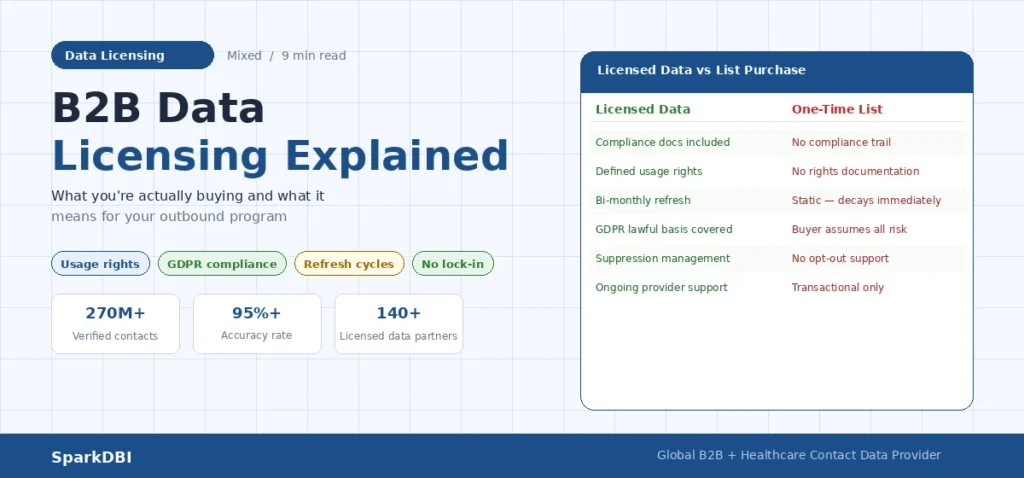

Most B2B teams think they’re buying a contact list. What they’re actually doing is entering into a data licensing agreement – and the difference between those two things determines what you can legally do with the data, how long you can use it, whether you’re covered if a compliance question arises, and what happens when you need a refresh.
The terminology gets buried in vendor contracts and nobody explains it plainly. This guide fixes that. It covers what B2B data licensing actually means, how licensing terms affect your outbound program in practice, what to look for in a data license agreement, and how SparkDBI’s licensing model is structured for teams that need flexibility without compliance exposure.
SparkDBI is a global B2B and healthcare contact data provider with 270M+ verified contacts across 200+ countries, sourced from 140+ licensed data partners. SparkDBI’s data licensing model is designed for demand generation teams, RevOps leaders, and sales operations managers who need verified B2B contact data with clear usage rights and GDPR-ready sourcing documentation.
Quick answer: B2B data licensing is a contractual arrangement that grants your organization the right to access and use contact records for defined purposes over a defined period – subject to compliance requirements, usage restrictions, and refresh obligations. Licensing is different from buying a list outright: it includes ongoing rights, obligations, and compliance coverage that a one-time list purchase does not provide.
What B2B Data Licensing Actually Means
When you license B2B contact data, you’re not buying records to own permanently. You’re acquiring time-limited usage rights to a defined dataset – usually for a specified number of contacts, a specified geography, and specific permitted uses such as email marketing, cold outreach, or CRM enrichment.
The distinction matters for three reasons.
1. Compliance accountability transfers with the license
A properly structured data license includes documentation of how the data was sourced, what lawful basis applies under GDPR, and what opt-out and suppression obligations the licensee takes on. This documentation is what protects your marketing and legal teams if a data subject complaint or regulatory inquiry arrives. A one-time list purchase from a broker gives you records with no compliance paper trail. A licensed dataset from a provider with documented sourcing methodology gives you records you can defend.
2. Usage rights define what you can do with the data
A data license specifies permitted uses. Email marketing campaigns, cold calling, CRM enrichment, and intent-based targeting are common permitted uses – but each is typically defined explicitly. Reselling or sublicensing the data to a third party is almost always prohibited. Re-using records outside the licensed territory – buying a UK dataset and using it for US outreach – is usually a license violation. Understanding exactly what your license permits prevents accidental violations that can trigger contract termination or legal exposure.
3. Refresh obligations are the quality mechanism
B2B contact data decays at approximately 22–30% annually according to Salesforce Research – meaning nearly a quarter of your contact records become inaccurate within 12 months through job changes, company restructuring, and departures. A licensed dataset with defined refresh cycles gives you a mechanism for maintaining data quality over time. A one-time list purchase gives you a static snapshot that degrades from the day you receive it.
Data Licensing vs Buying a List: The Practical Difference
| Factor | Licensed B2B Data | One-Time List Purchase |
|---|---|---|
| Compliance documentation | Included – sourcing methodology, lawful basis, opt-out records | Not provided – buyer assumes all compliance risk |
| Data refresh | Built into the license – defined refresh cycles | None – static snapshot degrades over time |
| Usage rights | Clearly defined – permitted uses stated in contract | Unclear – buyer often has no contractual protection |
| GDPR / CAN-SPAM alignment | Provider documents lawful basis; licensee fulfills opt-out obligations | No documentation – compliance gap is buyer’s problem |
| Data quality over time | Maintained through license refresh cycles | Decays from day one – no quality mechanism |
| Ongoing support | Provider relationship – support for delivery, integration, segmentation | Transactional – no ongoing relationship or support |
See SparkDBI’s B2B Data Licensing Model
270M+ verified contacts, 140+ licensed data partners, GDPR-ready sourcing documentation, and bi-monthly refresh cycles. No multi-year lock-in required.
Explore Data Licensing View Live Database Stats
What to Look for in a B2B Data License Agreement
Most B2B data buyers never read their license agreements carefully. They pay for the data and assume the vendor handles everything compliance-related. That assumption creates real exposure. These are the five clauses that determine whether a data license actually protects your team or just looks like it does.
1. Lawful basis documentation
Under GDPR, processing personal data requires a documented lawful basis. For B2B cold email in the EU and UK, this is typically legitimate interest – the provider or the licensee must be able to demonstrate that the processing serves a legitimate purpose proportionate to the data subject’s rights. A data license should either document the provider’s legitimate interest basis or clearly transfer that responsibility to the licensee with supporting documentation. Vague references to “GDPR compliance” without specifying which lawful basis applies are a red flag. The ICO’s guidance on legitimate interest provides the framework that UK-targeting campaigns must satisfy.
2. Permitted use definitions
The license must clearly specify what you can do with the data. Email marketing, telephone outreach, CRM enrichment, and advertising audience matching are different permitted uses – and each typically requires different data processing documentation. If the agreement says “marketing purposes” without further definition, you’re operating in a legal grey area. Before signing, confirm in writing that your specific use cases – the channels, the geographies, the campaign types – are explicitly covered.
3. Suppression and opt-out obligations
CAN-SPAM requires a functioning opt-out mechanism on every commercial email and honor of opt-out requests within 10 business days. GDPR requires that data subjects can exercise their right to object to processing at any point. Your data license should specify how opt-outs and suppression records are handled – whether the provider maintains a suppression list, how often it’s updated, and how suppression records flow back to your CRM. If the license doesn’t address suppression at all, your team is building that infrastructure from scratch with no contractual support.
4. Data accuracy warranties and refresh commitments
What accuracy rate does the provider warrant, and over what time period? The refresh cycle – monthly, quarterly, annually? What remedy exists if accuracy falls below the warranted level? SparkDBI warrants 95%+ accuracy on its verified B2B contact database with bi-monthly refresh cycles and multi-source validation across 140+ licensed data partners. That level of specificity is what you should expect in any data license from a provider serious about data quality. Vague accuracy claims with no defined refresh cycle are a data quality risk dressed up as a contract.
5. Term, renewal, and exit terms
How long is the license, what triggers auto-renewal, and what is the cancellation window? Enterprise data platform contracts – particularly from vendors like Definitive Healthcare – have become notorious for automatic multi-year renewals with 60-day cancellation windows and aggressive enforcement. Before signing any B2B data license, have legal review the renewal and exit terms explicitly. The data quality may justify the investment. An unexpected three-year auto-renewal you didn’t intend to trigger does not.
How B2B Data Licensing Works for Different Use Cases
The right data licensing structure depends on how you intend to use the data. These are the three most common B2B outbound use cases and what each requires from a licensing perspective.
Outbound email campaigns
For outbound email, you need: verified email addresses with documented sourcing, CAN-SPAM compliant opt-out documentation, and a suppression list management process. The data license should explicitly permit email marketing as a use case. For EU and UK-targeted campaigns, the license must address GDPR legitimate interest or consent basis. SparkDBI’s global B2B email list is specifically verified for outbound email use with GDPR-ready sourcing documentation included.
CRM enrichment
CRM enrichment – adding missing fields, updating stale records, appending contact data to existing accounts – requires a license that explicitly covers data append and enrichment as permitted uses. Some licenses cover outbound email but prohibit enrichment of existing records. Confirm the permitted use language covers both outbound prospecting and CRM enrichment before deploying. SparkDBI’s data enrichment service delivers directly into Salesforce, HubSpot, and Zoho with field-level mapping and API delivery.
Master data file licensing
Some teams need a full flat-file license of a defined contact universe – all verified contacts matching a specific ICP in a specific market – delivered as a master data file for use across CRM, sales engagement, and paid audience targeting simultaneously. This requires the broadest permitted use definition in the license and the most comprehensive sourcing documentation. SparkDBI’s data licensing service covers flat-file master data delivery with API access, custom segmentation by industry, title, company size, and geography, and compliance documentation covering all major outbound use cases.
GDPR and CAN-SPAM: What B2B Data Licensing Compliance Actually Requires
The two compliance frameworks that govern most B2B outbound programs are GDPR (for EU and UK contacts) and CAN-SPAM (for US contacts). Neither prohibits cold outreach – but both impose specific obligations on how data is sourced, used, and how opt-outs are handled.
GDPR and B2B data licensing
GDPR does not prohibit cold email to business contacts. It requires that the processing has a documented lawful basis, that data subjects can exercise their rights, and that the data is not retained longer than necessary. For B2B outbound, legitimate interest is the most commonly applicable lawful basis – but it requires a three-part test: the interest must be legitimate, the processing must be necessary, and the processing must not override the data subject’s rights.
A data license from a provider who has already conducted legitimate interest assessments for their sourcing methodology transfers that documentation to your team. Without that documentation, your legal team is building the legitimate interest case from scratch. The ICO’s legitimate interest guidance is the authoritative reference for UK-targeting campaigns.
CAN-SPAM and B2B data licensing
CAN-SPAM does not require prior consent for commercial email to business contacts. It requires accurate sender identification, a non-deceptive subject line, a physical mailing address in the email, and a functioning opt-out mechanism honored within 10 business days. Your data license should confirm that the provider’s sourcing methodology does not include contacts who have globally opted out of commercial email, and that suppression records are maintained and updated. The FTC’s CAN-SPAM compliance guide is the definitive reference for US outbound requirements.
SparkDBI’s B2B Data Licensing Model: What’s Included
SparkDBI is a global B2B and healthcare contact data provider with 270M+ verified contacts across 200+ countries. The licensing model is structured for demand generation teams and RevOps leaders who need verified contact data with clear usage rights – without multi-year commitment requirements or opaque compliance documentation.
- 270M+ verified contacts spanning 200+ countries, sourced from 140+ licensed data partners with documented provenance
- 95%+ accuracy warranted with bi-monthly refresh cycles – not a point-in-time claim that degrades the day you receive the file
- GDPR-ready sourcing documentation covering legitimate interest basis for EU and UK contacts – transferable to your legal team on request
- CAN-SPAM compliant sourcing with suppression list management for US-targeted outbound programs
- HIPAA-aligned sourcing for healthcare HCP contact data – documented sourcing methodology for pharma and medical device marketing teams
- Flat-file and API delivery compatible with Salesforce, HubSpot, Zoho, and custom CRM environments – no proprietary platform dependency
- Custom segmentation by industry vertical, job title, company size, geography, technographic install base, and HCP specialty
- No multi-year lock-in – licensing structured around your actual campaign and program needs
The live B2B database dashboard shows current contact counts, geographic coverage, and data freshness metrics in real time – so you can verify database scope before licensing, not after.
Frequently Asked Questions
What is B2B data licensing?
B2B data licensing is a contractual arrangement granting an organization the right to access and use business contact records for defined purposes over a defined period. Unlike a one-time list purchase, a data license includes compliance documentation, defined usage rights, refresh obligations, and suppression management. B2B data licensing is the appropriate procurement model for outbound email, CRM enrichment, and demand generation programs that require ongoing data quality and compliance defensibility.
What is the difference between data licensing and buying a contact list?
Buying a contact list is a one-time transaction that gives you a static file of records with no compliance documentation, no defined usage rights, and no refresh mechanism. Data licensing provides time-limited usage rights with sourcing documentation, defined permitted uses, compliance coverage for GDPR and CAN-SPAM, and refresh cycles that maintain data quality over time. For any team with legal or compliance review requirements, licensed B2B data is the only defensible procurement model.
Is B2B data licensing GDPR compliant?
B2B data licensing can be GDPR compliant when the provider documents the lawful basis for processing – typically legitimate interest for B2B outbound – and the licensee fulfills their obligations around opt-out management, data minimization, and retention limits. GDPR does not prohibit cold email to business contacts. It requires documented lawful basis and functioning data subject rights mechanisms. A properly structured data license from a provider like SparkDBI includes GDPR-ready sourcing documentation that transfers the compliance framework to your team.
How often should licensed B2B data be refreshed?
Licensed B2B data should be refreshed at minimum quarterly, with monthly or bi-monthly refresh preferred for active outbound programs. B2B contact data decays at approximately 22–30% annually – a 10,000-record database loses 2,000–3,000 accurate records per year without refresh. SparkDBI performs bi-monthly refresh cycles across its 270M+ contact database with multi-source validation, ensuring that licensed records maintain warranted accuracy levels throughout the license term.
What should a B2B data license agreement include?
A B2B data license agreement should include: documented lawful basis for processing under GDPR, explicit permitted use definitions covering your specific outbound channels, suppression and opt-out management obligations, data accuracy warranties with defined refresh cycles, delivery format and integration specifications, and clear term, renewal, and exit terms. Any license missing sourcing documentation or lawful basis language leaves your compliance team without the documentation they need to defend the program if a regulatory inquiry arises.
Key Takeaways
- B2B data licensing grants usage rights with compliance documentation – it is not the same as buying a contact list outright
- Compliance documentation – lawful basis, suppression records, sourcing methodology – is the practical difference between licensed data and a broker file
- B2B contact data decays at 22–30% annually; a license with defined refresh cycles is the only mechanism for maintaining data quality in an active outbound program
- GDPR does not prohibit cold email to business contacts – it requires documented lawful basis, typically legitimate interest, and functioning opt-out mechanisms
- Before signing any data license, confirm: permitted use definitions cover your specific channels, renewal and exit terms are clearly stated, and accuracy warranties include defined refresh commitments
- SparkDBI provides 270M+ verified contacts with GDPR-ready sourcing documentation, 95%+ accuracy, bi-monthly refresh, and flat-file or API delivery – structured for demand generation teams that need compliance-defensible outbound data without multi-year lock-in
License Verified B2B Contact Data for Your Outbound Program
SparkDBI’s data licensing covers outbound email, CRM enrichment, and master data file delivery – with GDPR-ready documentation, 95%+ accuracy, and no multi-year commitment required. Get 50 free verified contacts for your ICP before licensing.
