 SparkDBi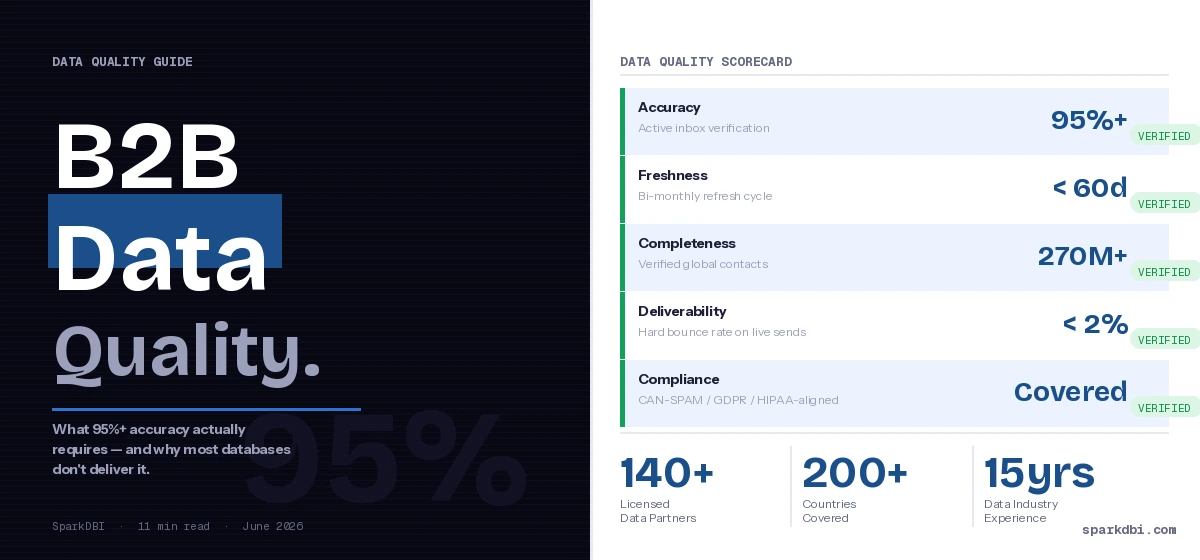
[Mixed | 11 min read]
Most outbound teams don’t have a messaging problem. They have a data quality problem they’ve misdiagnosed as something else.
Here’s a scenario we see constantly. A sales team runs a campaign to 10,000 contacts. Open rates look reasonable. Flat reply rates appear. Pipeline from the sequence is near zero. The post-mortem blames the subject line. Or the offer. Or the timing.
But nobody pulls the bounce report. Nobody checks how many of those 10,000 contacts were still at the company on the record. The question nobody asks: when was the list last verified?
Bad data quality is the most common cause of outbound failure, and the least diagnosed. It stays invisible until it isn’t. By the time it shows up in your numbers, you’ve already burned sender reputation, wasted rep time, and written off sequences that might have worked on a clean list.
B2B data quality refers to the accuracy, completeness, freshness, and deliverability of contact and company records used for sales and marketing outreach. A high-quality B2B database doesn’t just contain a lot of records; it holds records confirmed as correct, current, and reachable right now, not when they were collected.
This guide covers what data quality means operationally, why most databases fall short, and how to evaluate what you’re actually buying.
Table of Contents
- What B2B Data Quality Actually Means
- Why Most B2B Databases Fail at the Point of Use
- Earned Data vs. Collected Data: The Distinction That Matters
- The Five Dimensions of B2B Data Quality
- B2B Data Quality for Healthcare and HCP Outreach
- How to Evaluate a B2B Database Before You Buy
- How SparkDBi Approaches Data Quality
- Frequently Asked Questions
What B2B Data Quality Actually Means
The data industry has a terminology problem. Every vendor claims high-quality data, and every database product page features accuracy percentages and record counts.
Real B2B data quality has five components, and they all have to hold simultaneously. The contact exists. They are reachable at the address provided. They currently work at the company listed in the role described. And all of this is true today. Drop any one of those conditions and the record fails, regardless of what the accuracy claim on the website says.
The honest answer most vendors avoid: B2B contact data decays at roughly 25-30% per year. According to HubSpot Research, the average B2B database loses about a quarter of its accuracy annually through job changes, company restructuring, domain migrations, and natural attrition. That means a database that was 95% accurate when it started is, twelve months later, closer to 70% accurate if nobody has touched it. And most databases nobody has touched them.
This niche problem affects the majority of purchased contact lists. It’s the default state of most purchased contact lists.
Why Most B2B Databases Fail at the Point of Use
There’s a useful way to think about this. Some data providers are refineries. They take raw contact information, process it, verify it against live sources, remove what doesn’t hold up, and deliver something that’s ready to use. Other providers are more like warehouses; they store a lot of data, they can tell you how much is in there, but the quality control stopped at intake.
When you buy from a warehouse and send directly, you’re running unrefined data through a campaign that needs something much more specific. The emails that bounce, the contacts who left the company two years ago, the phone numbers that disconnect, none of that shows up in the database count. It shows up in your deliverability metrics, your bounce rate, and eventually your sender reputation with Gmail and Microsoft.
We see this consistently with teams that come to SparkDBi after running campaigns on data from providers who prioritize volume over verification. The records look fine and the counts are impressive. But the data never got tested against reality after collection. And the only real test of whether a contact record works is to use it.
That gap is what makes usage-based verification fundamentally different from static verification. Static verification checks whether an email address passes an SMTP handshake at a point in time. Usage-based verification measures whether the email actually delivered, whether the inbox exists and accepted the message, whether the contact is still reachable. That’s a categorically different quality signal, and it’s the one that determines whether your campaign works.
Earned Data vs. Collected Data: The Distinction That Matters
Not all B2B data comes from the same place, and the sourcing method is the first predictor of quality.
Providers assemble it from directories and scraped sources. It comes from web scraping, directory harvesting, public record aggregation, and one-time bulk imports. The collection process can move fast and produce large record counts. But collected data reflects a snapshot, the state of the web at the moment of collection. It starts decaying immediately after.
Earned data works differently. It comes from platforms where real users take real actions. Emails get sent and generate delivery signals. Calls connect or don’t. Forms get filled. Logins happen from specific IP addresses. This kind of data is harder to get because you have to build or participate in the platforms that generate it. But it produces something collected data can’t: continuous, usage-based feedback on whether contact information is actually working.
The best B2B databases start on both, collected data as the foundation, with earned data flowing in continuously to validate, update, and remove what’s no longer accurate. That combination creates a self-correcting system. Every send tells you something, each delivery or bounce updates the record. The database gets more accurate over time rather than less, which is the opposite of what happens with static collected datasets.
SparkDBi’s 140+ licensed data partners contribute exactly this kind of earned signal into our verification layer. The result is a contact database where accuracy isn’t a claim made at build time; it’s a measurement taken continuously.
SparkDBi Data Point: Across our 304M+ verified global contacts, records verified through active usage signals show 40% lower bounce rates on first send compared to records verified through SMTP-only checks. The verification method, not just the verification claim, determines deliverability.
The Five Dimensions of B2B Data Quality
When you’re evaluating a B2B database, whether you’re buying a list, licensing a data feed, or auditing your current CRM; these are the five dimensions that actually matter.
1. Accuracy: Is the Information Correct?
Accuracy covers whether the name, title, company, email, and phone number are correct for this person right now. Not when the record was created or last reviewed. Now. A 95% accuracy claim means nothing without knowing when that accuracy was last measured and against what standard.
The right question to ask any provider: how do you define accuracy, how do you measure it, and what’s your methodology for continuous re-verification? Providers who can’t answer that specifically are describing their intake quality, not their current quality.
2. Completeness: Does the Record Have What You Need?
A contact record with a name and email but no company size, industry, or seniority level is hard to segment and harder to personalize. Completeness matters for targeting as much as it matters for deliverability. A complete record lets you build the right audience. An incomplete one forces you to spray and pray.
Firmographic completeness is particularly important for ABM. If you’re targeting CFOs at manufacturing companies with 500-2,000 employees, you need seniority, function, industry, and headcount all populated and verified. Missing any one of those fields means your targeting breaks at the segment level.
3. Freshness: When Was It Last Verified?
Freshness is the dimension most buyers forget to ask about and most vendors are reluctant to disclose. A record from a provider with an annual refresh cycle could be eleven months stale when you receive it. At 25-30% annual decay, that’s a meaningful accuracy hit before your campaign even starts.
Salesforce State of Sales research consistently identifies data quality as a top operational challenge for sales teams. The primary driver is stale data, not inaccurate data at collection time. The data started out fine. Nobody maintained it.
SparkDBi refreshes our database on a bi-monthly cycle. That keeps average record age under 60 days, which is the threshold above which decay starts to meaningfully impact deliverability for high-frequency outbound programs.
4. Deliverability: Will the Email Actually Arrive?
An email address that exists but bounces is worth nothing to an outbound team. Deliverability is the operational outcome of accuracy and freshness combined. But it also depends on factors those two dimensions don’t cover: catch-all domain configuration, inbox provider filtering, and whether the contact moved to a different email address at the same domain.
For most B2B databases, deliverability is an afterthought. Providers assemble records, SMTP-check them once, and ship them. For healthcare databases, the catch-all domain problem makes SMTP verification nearly meaningless on its own. Major hospital and health system domains accept every incoming email regardless of whether the individual inbox exists. Without an identity layer on top, you cannot trust the result.
5. Compliance: Can You Legally Use It?
A database record that passes every quality check above is still worthless if you can’t legally use it for outreach. CAN-SPAM, GDPR, CASL, and HIPAA-adjacent regulations all create different constraints on how teams can source, store, and use B2B contact data depending on who you’re reaching and where they are.
The compliance question is especially live for pharma and medtech teams reaching EU healthcare professionals. GDPR legitimate interest under Article 6(1)(f) covers professional B2B outreach, but only when the sourcing is documented and defensible. A provider who can’t produce sourcing documentation isn’t just a compliance risk. They’re a liability.
Mid-Article CTA: See how SparkDBi’s verified B2B contact data holds up on all five dimensions. Explore the B2B database dashboard or request 50 free verified contacts for your ICP.
B2B Data Quality for Healthcare and HCP Outreach
Everything above applies to B2B data quality broadly. But healthcare data has an additional layer of complexity that general B2B databases aren’t built to handle.
Physician contact records change faster than almost any other professional category. Physicians retire, relocate, join new practice groups, shift from private practice into hospital employment or back out again. NPI status, the government-issued identifier that confirms a physician’s active license and specialty, updates monthly through the CMS NPPES registry. A healthcare database that skips monthly NPI cross-referencing doesn’t qualify as a healthcare database. It’s a directory with a healthcare label.
Beyond NPI verification, the catch-all domain problem is structural in healthcare. Major hospital networks and academic medical centers configure their email servers to accept all incoming messages regardless of whether the individual inbox exists. This means a standard SMTP verification check returns a “valid” result on every address at those domains, including addresses for physicians who left five years ago. The only reliable approach is to layer identity verification on top of the SMTP check. That means confirming this specific physician still works at this institution before marking the address as deliverable.
SparkDBi’s healthcare data licensing covers 10M+ NPI-verified US healthcare professionals across 50+ specialty filters, with monthly NPI refresh and HIPAA-aligned sourcing. For pharma and medtech teams, it’s the difference between a list and a verified outreach asset.
How to Evaluate a B2B Database Before You Buy
No B2B data provider comparison is complete without testing the data before you commit. Here’s what that evaluation should look like in practice.
Request a Sample for Your Exact ICP
Any credible provider will give you a sample. Not a generic sample, a sample filtered to your actual target criteria: the industry, company size, seniority, geography, and function you’re actually trying to reach. Run that sample through your ESP or a third-party verification tool before sending a single message. A provider who resists a targeted sample request is telling you something about confidence in their data.
Ask When Records Were Last Verified
Not when the database started. Not when records were “last updated.” When was each record in the sample last re-verified against a live source? The answer should be weeks, not months. If the provider can’t answer this question with specificity, the refresh cycle either doesn’t exist or doesn’t run as frequently as their marketing suggests.
Check the Verification Methodology
SMTP verification is not the same as active inbox verification. Directory matching is not the same as NPI cross-referencing. Scraping is not the same as licensed partner data. Ask specifically: what sources are you verifying against, how frequently, and what happens to a record that fails verification? Providers who use vague language like “multi-step verification” without explaining what those steps are usually haven’t invested in the infrastructure to do it properly.
Run a Small Send Before Buying Volume
The most honest signal about data quality is a real send. Take 500-1,000 records from the sample, run them through a proper sending setup with warm infrastructure, and measure the hard bounce rate. Under 2% is good, under 1% is excellent. Over 5% means the data isn’t ready for production use regardless of what the accuracy claim says.
Ask for Compliance Documentation
For any regulated outreach, pharma reaching physicians, EU campaigns under GDPR, healthcare data under HIPAA-adjacent rules, ask the provider to produce their sourcing documentation before you sign anything. A legitimate provider has this ready, any provider who treats it as an unusual request lacks the compliance infrastructure you need.
How SparkDBi Approaches B2B Data Quality
SparkDBi started by practitioners who had run outbound programs at scale and experienced firsthand what bad data does to pipeline. The platform reflects that background: the design priority is not record count but record reliability.
Our 304M+ verified global contacts come through 140+ licensed data partners, not scraped, not assembled from directories, but licensed from platforms where data comes from actual usage. That sourcing model produces the earned signal quality we described above. Real sends test contact information, real calls, and real engagement across our partner network before it enters our database.
Verification runs on a bi-monthly cycle. We flag and remove records that fail re-verification rather than leaving them in the active pool. Our 95%+ accuracy rate reflects current deliverability, not intake quality, which means it reflects the state of the data when you use it, not when it was collected.
For healthcare, our NPI-verified HCP records cross-reference against CMS NPPES monthly, cover 50+ specialty filters, and come from HIPAA-aligned sources with no PHI involved. The result is a healthcare database that actually performs for physician outreach rather than one that looks like it should.
Two failure modes we see consistently with teams that come to us after using other providers: great targeting strategy on bad data, and clean data with no targeting strategy. The first fails at delivery. The second fails at conversion. Data quality is the foundation. Without it, everything built on top performs below its potential.
Frequently Asked Questions
What is B2B data quality?
B2B data quality refers to the accuracy, completeness, freshness, deliverability, and compliance of contact and company records used for sales and marketing outreach. A high-quality B2B database contains records that are correct, current, and legally usable right now, not when they were originally collected. The most common quality failures are stale records from infrequent refresh cycles and email addresses that pass SMTP verification but bounce on actual sends.
How fast does B2B contact data decay?
B2B contact data decays at roughly 25-30% per year, driven by job changes, company restructuring, domain migrations, and natural attrition. HubSpot Research puts average annual decay at around 25%. That means a database that’s 95% accurate at build time will be closer to 70% accurate twelve months later without active re-verification. For healthcare data, decay runs faster. Physician practice settings and NPI status change more frequently than typical B2B roles.
What’s the difference between data accuracy and data deliverability?
Accuracy refers to whether the contact information is correct, right name, right title, right company. Deliverability refers to whether the email actually reaches the inbox. A record can be accurate but undeliverable. The email address may no longer be active, the domain may have changed, or the contact may have moved to a new role with a different address. Both dimensions matter for outbound performance, and they require different verification methods to measure.
How do I know if my CRM data quality is deteriorating?
Watch for these leading indicators: hard bounce rate above 2% on outbound sends, reply rates declining without changes to messaging or offer, and increasing out-of-office replies referencing old companies or roles. Pipeline volume dropping despite consistent outbound activity is the lagging indicator. If your sequences are performing worse quarter over quarter without changes to copy or targeting, data quality is the first thing to audit, not the last.
What should I ask a B2B data provider before buying?
Ask when each record was last re-verified against a live source, not when the database started. Second, request a sample filtered to your exact ICP and test it before buying volume. Third, find out what happens to records that fail re-verification: do they get removed or left in the active pool? Fourth, request compliance documentation covering their sourcing methodology. Finally, ask for their hard bounce rate benchmark across clients running active outbound. Any provider who can’t answer these questions with specificity is telling you the infrastructure doesn’t exist to support those answers.
How does B2B data quality affect email deliverability?
Poor B2B data quality directly degrades email deliverability through hard bounces, which damage sender reputation with inbox providers like Gmail and Microsoft. A hard bounce rate above 2% triggers spam filter sensitivity. Above 5% puts your sending domain at risk of blacklisting. Once inbox providers flag your domain, deliverability drops across your entire sending program, not just to the bad addresses. The math is simple: one bad list can damage the deliverability of every future send from that domain.
Is there a difference between B2B data quality for sales and marketing?
The quality dimensions are the same, but the tolerance thresholds differ. Marketing campaigns running to large audiences can absorb a higher bounce rate before it damages deliverability because the volume spreads across more sends. Sales outreach running to a small, high-value prospect list has zero tolerance for bad data because every bounced email is a missed opportunity with a specific named account. For ABM and enterprise sales motion, data quality requirements are closer to healthcare standards than to general B2B marketing standards.
Key Sources
- HubSpot Research, B2B Database Decay Rate: hubspot.com
- Salesforce State of Sales Report: salesforce.com
- CMS NPPES NPI Registry: npiregistry.cms.hhs.gov
See SparkDBi’s Data Quality in Practice
304M+ verified contacts. 95%+ accuracy. Bi-monthly refresh. Request 50 free verified contacts for your ICP and test the data quality yourself before committing to volume.Get 50 Free Sample ContactsExplore the B2B Database
Author: SparkDBi Editorial Team | B2B Data and Revenue Operations Practitioners | 15+ years combined experience in outbound data, CRM operations, and healthcare commercial data.