
B2B Email List Accuracy: How to Evaluate Any Data Provider Objectively
You paid for a “verified” B2B email list. You ran your first campaign. Your bounce rate came back at 38%. Your sending domain is now flagged. The provider says the data was accurate at time of delivery. You have no way to prove otherwise — because you never tested it before you sent.
8 min read | Last updated: March 2026
What is B2B email list accuracy? B2B email list accuracy is the percentage of email addresses in a contact database that are valid, active, and deliverable at the time of use. A 95% accuracy rate means 95 out of every 100 email addresses in that list will successfully reach a live inbox. Accuracy is not a fixed property — it degrades over time as professionals change jobs, update email addresses, and leave companies. Any provider claiming permanent accuracy is not being honest about how B2B data works.
This guide gives you a practical framework to test B2B email list accuracy before you buy, after you receive a sample, and on an ongoing basis with any provider you work with.
Why B2B Email List Accuracy Matters More Than List Size
Most data buyers compare providers on volume first. How many contacts do you have? How many in my industry? This is the wrong starting point.
A list of 100,000 contacts at 60% accuracy gives you 60,000 reachable contacts. A list of 50,000 contacts at 95% accuracy gives you 47,500 reachable contacts. The larger list costs more, performs worse, and puts your sending domain at risk. Size without accuracy is not an asset — it is a liability.
What High Bounce Rates Actually Cost You
Hard bounces signal to inbox providers that your sending domain is unreliable. Gmail, Outlook, and corporate mail servers use bounce rate as a trust signal. A bounce rate above 2% starts to affect deliverability. Above 5%, inbox placement rates drop sharply. Above 10%, you risk domain blacklisting.
According to Validity’s email deliverability research, senders with bounce rates above 5% see inbox placement rates drop by an average of 20 percentage points. That means your good contacts — the ones with valid emails — stop receiving your messages too. The bad data poisons the entire campaign.
The 30% Annual Decay Problem
B2B contact data decays at roughly 22-30% per year. People change jobs. Companies restructure. Email addresses get deactivated. A list that was 95% accurate when you bought it 12 months ago could be sitting at 65-70% accuracy today — without a single update from your provider.
This decay is why accuracy at time of purchase is only half the question. The other half is: how often does the provider refresh their data? A provider who validates once and never updates is selling you a depreciating asset.
The 5-Point Framework for Evaluating B2B Email List Accuracy
Apply this framework to any provider before you sign a contract. It takes under two hours and will tell you more than any vendor presentation.
Step 1 — Request a Free Sample Before Any Contract
Any credible data provider will give you a free sample. Request 50-100 records that match your ideal customer profile — specific industry, company size range, and job title. If a provider refuses to provide a sample, walk away. Reluctance to share sample data almost always means low confidence in their own accuracy.
SparkDBI provides 50 free verified B2B contacts matched to your target profile before any contract discussion.
Step 2 — Run the Sample Through an Independent Email Validation Tool
Do not rely on the provider’s own accuracy claims. Run the sample through an independent inbox validation tool — NeverBounce, ZeroBounce, or Hunter.io’s verification API are all widely used options. These tools check whether each email address has an active, accepting mailbox.
Look for three results from the validation tool. “Valid” means the mailbox is confirmed active. “Risky” means the address exists but shows unusual patterns. “Invalid” means the address is dead, deactivated, or non-existent. Count only the “Valid” results as your accuracy baseline.
A reliable B2B data provider should hit 90%+ valid on a fresh sample. Below 85% is a clear warning sign. Below 75% means you will have deliverability problems from day one.
Step 3 — Cross-Reference a Subset Against LinkedIn
Take 10-15 records from the sample and manually check them on LinkedIn. Verify that the person still works at the company listed in the record and that their job title matches. This check catches a different type of inaccuracy — contact-level staleness rather than purely email validity.
A record can pass email validation and still be wrong. The email address may still route to the same inbox even after a person has changed roles or left the company. LinkedIn verification catches these ghost records that email validation misses.
Step 4 — Ask Specific Questions About Verification Method
Ask the provider exactly how they verify email accuracy. The answer reveals a lot about their data quality. Push for specifics on each of these points.
Do they use syntax checking or active inbox validation? Syntax checking confirms an address is formatted correctly. Active inbox validation confirms the mailbox is live. These are not the same thing — and the gap between them shows up directly in your bounce rate.
Do they use AI-driven validation, human verification, or both? AI validation processes at scale but misses edge cases. Human verification catches unusual corporate email formats, role-based addresses, and recently deactivated accounts that automated tools flag incorrectly.
How do they handle role-based addresses? Addresses like info@, sales@, and admin@ are technically valid but produce low engagement and high spam complaints. A quality provider filters these out or flags them separately.
Step 5 — Ask About Refresh Frequency and Data Age
Ask when the records in your sample were last verified. A provider with a monthly refresh cycle gives you a clear, honest answer. A provider who hedges or gives a range measured in quarters is telling you something important.
According to Litmus email marketing benchmarks, B2B email lists that are not refreshed at least quarterly show significantly higher bounce rates than freshly verified lists. For outbound-active teams sending weekly sequences, monthly verification is the minimum acceptable standard.
SparkDBI refreshes its contact database every two months. Every email address in the database passes active inbox validation before the refresh cycle publishes it. This means the data you receive is never more than eight weeks old at point of delivery.
What Good B2B Email List Accuracy Actually Looks Like
Here is a straightforward benchmark table to evaluate any provider’s accuracy claims against industry standards.
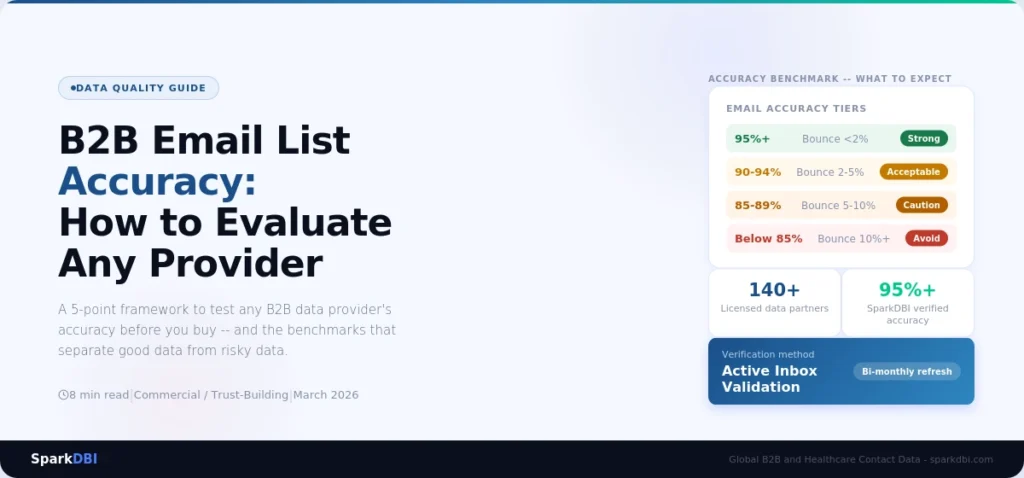
| Accuracy Rate | What It Means | Expected Bounce Rate | Verdict |
|---|---|---|---|
| 95%+ | Industry-leading. Active inbox validation with multi-source verification. | Under 2% | Strong |
| 90 – 94% | Solid. Acceptable for most outbound programmes with good list hygiene. | 2 – 5% | Acceptable |
| 85 – 89% | Below standard. Expect deliverability issues without pre-send validation. | 5 – 10% | Caution |
| Below 85% | Unacceptable. High bounce risk. Domain reputation damage likely. | 10%+ | Do Not Use |
SparkDBI’s verified B2B contact database maintains a 95%+ accuracy rate across all delivered records. This rate is measured against active inbox validation — not syntax checking or list washing.
Want to test SparkDBI’s accuracy yourself before committing to anything?
Request 50 free sample contacts matched to your target profile. Run them through any validation tool you choose.
Request 50 Free Sample Contacts — Verify Them Yourself
Red Flags That Signal Low-Quality B2B Data
These warning signs appear before you run any validation test. They indicate a provider that prioritises volume over accuracy.
Accuracy Claims Without a Verification Method
Any provider can claim 95% accuracy. Ask how they measure it. If the answer references list washing, syntax filtering, or “proprietary scoring” without mentioning active inbox validation, treat the claim with scepticism. Accuracy claims without a verifiable methodology are marketing language, not data quality standards.
Prices That Seem Too Low for the Volume
Quality B2B data costs money to produce. Active inbox validation, multi-source cross-referencing, and regular refresh cycles all require real infrastructure and human oversight. A provider selling 100,000 verified B2B contacts for $99 is not running those processes. They are reselling an old database with no fresh verification.
No Free Sample Offer
Providers who are confident in their data offer samples freely. Providers who deflect the sample request with “pricing discussions first” are protecting data that would not survive independent validation.
Static Databases With No Refresh Schedule
Ask directly: “When was this data last verified and when will it be verified again?” A provider who cannot give a specific answer — or who describes annual refresh as their standard — is selling you data that degrades faster than they update it.
No NPI Coverage on Healthcare Records
For any provider selling healthcare or HCP contact data, the absence of NPI numbers on US records is an immediate disqualifier. NPI numbers are publicly verifiable. A healthcare data provider without NPI coverage cannot independently verify the identity of the practitioners in their database.
How SparkDBI Achieves and Maintains 95%+ Accuracy
SparkDBI applies a four-layer accuracy process to every contact record in the database.
Layer 1 — Multi-Source Aggregation
SparkDBI aggregates contact data from 140+ licensed data partners — including professional directories, company registries, CME platforms, and publisher networks. No single source holds more than a fraction of total records. This multi-source approach means any single source’s errors get caught during cross-validation.
Layer 2 — Active Inbox Validation
Every email address passes active inbox validation before inclusion in the database. SparkDBI checks that the mailbox is live and accepting mail — not just that the address is syntactically correct. Role-based addresses are flagged and excluded from standard delivery.
Layer 3 — AI and Human Verification
AI-driven validation processes the database at scale. Human verification handles edge cases — unusual corporate email formats, recently restructured domains, and records where automated tools produce conflicting results. The combination catches errors that either method misses alone.
Layer 4 — Bi-Monthly Refresh
The entire database refreshes every two months. Records that fail re-validation are removed or updated. This means no record in the SparkDBI database goes more than eight weeks without an accuracy check. For clients on active outbound programmes, this refresh cycle keeps bounce rates consistently below 2%.
The SparkDBI email enrichment service applies the same four-layer process to existing CRM records — so your current database benefits from the same accuracy standards as a new list purchase.
Key Takeaways
B2B email list accuracy is the percentage of addresses that reach a live inbox. Size without accuracy is a liability, not an asset. High bounce rates damage your sending domain and reduce deliverability for your entire list — including the good contacts.
Test every provider with the five-point framework: request a free sample, run it through independent validation, cross-reference on LinkedIn, ask specific questions about verification method, and confirm refresh frequency before signing anything.
The accuracy benchmark to hold providers to: 95%+ on active inbox validation, monthly or bi-monthly refresh cycle, multi-source data with NPI coverage for healthcare records.
Frequently Asked Questions
How accurate are B2B email lists?
Accuracy varies significantly by provider and data age. High-quality providers who use active inbox validation and monthly refresh cycles can maintain 90-95%+ accuracy. Lower-quality providers who rely on syntax checking and annual updates often deliver 70-80% accuracy or below. B2B contact data also decays at roughly 22-30% per year regardless of initial quality — so accuracy at purchase is only part of the picture. Ask every provider for their current verified accuracy rate and their methodology for measuring it.
What is a good bounce rate for B2B email?
A hard bounce rate below 2% is the standard for healthy B2B outbound email. Between 2% and 5% is a caution zone — deliverability starts to suffer and you should clean your list before continuing. Above 5% causes measurable inbox placement decline. Above 10% puts your sending domain at risk of blacklisting. According to Validity’s research, bounce rates above 5% reduce inbox placement rates by an average of 20 percentage points — meaning your good contacts stop receiving your messages too.
How do you verify a business email list?
The most reliable method combines three steps. First, run the list through an independent active inbox validation tool — NeverBounce, ZeroBounce, or Hunter.io all work well. Second, manually cross-reference a sample of records on LinkedIn to check that the person still works at the listed company. Third, ask the data provider for their verification methodology and refresh schedule before purchase. Never rely solely on the provider’s own accuracy claims — independent validation is the only way to get an honest picture of data quality before you send.
What percentage of B2B contacts go bad per year?
B2B contact data decays at roughly 22-30% per year. This means that in a database of 10,000 contacts, between 2,200 and 3,000 records become inaccurate within 12 months through job changes, company restructures, and email address updates. At that rate, a database that is not refreshed quarterly loses a meaningful portion of its accuracy before most teams even complete their first outbound cycle. Monthly or bi-monthly refresh cycles are the only way to stay ahead of natural data decay.
How does email validation work?
Email validation works by checking whether an email address can receive mail. There are two levels of validation. Syntax checking confirms the address follows the correct format — it checks for an @ symbol, a valid domain, and proper structure. Active inbox validation goes further — it connects to the mail server and confirms that the specific mailbox is live, active, and currently accepting messages. Active inbox validation is the only method that reliably predicts deliverability. Syntax checking alone misses deactivated accounts, expired domains, and abandoned mailboxes that are correctly formatted but no longer functional.
How often should B2B data be verified?
At minimum, quarterly. For teams running active outbound sequences with weekly send volumes, monthly verification is the right standard. B2B data decays at roughly 30% per year — which works out to about 2.5% per month. A database that goes three months without verification has likely lost 7-8% of its accuracy. SparkDBI refreshes its entire contact database every two months, so delivered records are never more than eight weeks old at point of use.
Written by the SparkDBI Revenue Data Team
Our contributors have 5+ years of hands-on experience in B2B demand generation, outbound sales operations, and contact data quality management. SparkDBI works with 1,200+ sales and marketing teams across global markets. All accuracy benchmarks in this article reflect SparkDBI’s verified dataset as of Q1 2026.
