
Healthcare HCP Data: The Complete Guide for Pharma Marketers (2026)
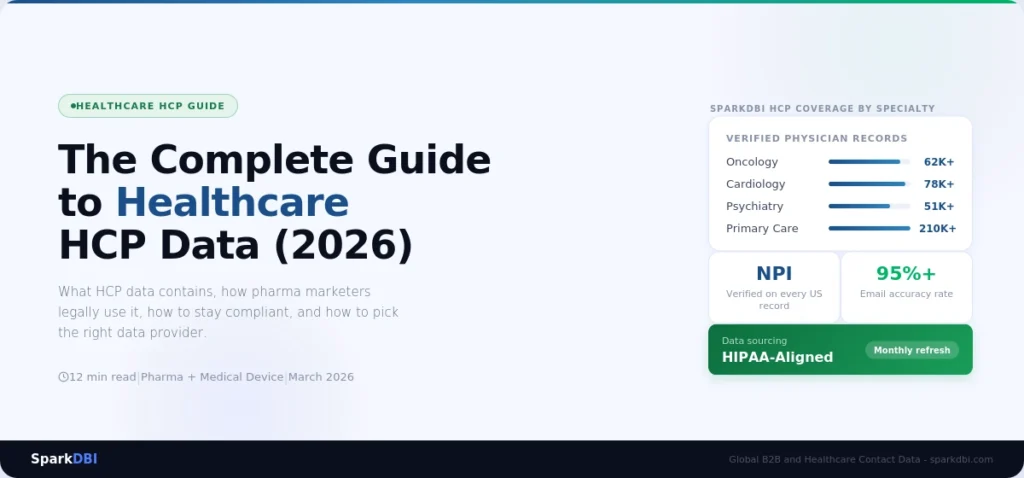
Pharmaceutical sales reps visited physicians over 700 million times a year before 2020. Today, many physicians have closed their doors to in-person visits entirely. The access model broke. Healthcare HCP data is how pharma and medical device marketers reach physicians now.
12 min read | Last updated: March 2026
What is healthcare HCP data? Healthcare HCP data is verified contact and professional information for healthcare professionals — physicians, nurses, pharmacists, dentists, and other licensed practitioners. It includes direct contact details such as email addresses and phone numbers, professional credentials like NPI numbers and DEA registration, specialty classifications, and practice location data. Pharma marketers, medical device companies, and healthcare technology firms use HCP data to reach the right clinicians with relevant, compliant outreach.
This guide covers what HCP data contains, how pharmaceutical companies legally obtain and use it, what HIPAA compliance means in this context, and how to evaluate an HCP data provider before committing to a contract.
What Is HCP Data and What Does It Contain?
HCP stands for Healthcare Professional. HCP data is a structured database of verified information about licensed healthcare practitioners in a defined geography.
A complete HCP record contains several types of information. Contact data includes direct email addresses, direct phone numbers, and mailing addresses for the practice or institution. Professional identity data includes the practitioner’s NPI number, medical license number, DEA number where applicable, and board certification status. Classification data includes medical specialty, sub-specialty, practice setting (hospital, private practice, academic medical centre, or group practice), and years in practice. Geographic data includes practice state, county, metro area, and zip code. Prescribing behaviour data, where available, covers therapeutic category preferences and prescribing volume tiers.
Why NPI Numbers Matter for HCP Targeting
The National Provider Identifier (NPI) is a unique 10-digit number assigned to every licensed healthcare provider in the United States by the CMS NPI Registry. It is public, permanent, and provider-specific. No two providers share the same NPI.
NPI numbers matter for three reasons in HCP marketing. First, they let you deduplicate records. A physician who holds privileges at three hospitals will appear in multiple institutional directories. The NPI ties all those appearances to one person. Second, they let you verify identity. A record that includes an NPI is verifiable against the federal registry. Third, they enable prescribing data linkage. Prescription analytics platforms use NPI numbers to connect a physician identity to their prescribing behaviour at the therapeutic category level.
Any HCP data provider worth evaluating should include NPI numbers on every US physician record. If they do not, their data cannot be independently verified.
Is It Legal to Email Physicians for Marketing?
Yes — with conditions. This is the question most pharma marketers search for first, and the answer is more nuanced than most legal summaries suggest.
What HIPAA Actually Covers (And What It Does Not)
HIPAA regulates the use of patient health information. It does not regulate marketing communications sent to healthcare professionals in their professional capacity. A pharmaceutical company emailing a cardiologist about a new heart failure medication is not sending patient data. It is sending a professional communication to a licensed practitioner.
HIPAA becomes relevant when the data itself contains protected health information (PHI) — for example, if you were targeting physicians based on their patients’ diagnoses. Standard HCP contact databases do not contain PHI. They contain professional identity and contact information, which is not covered by HIPAA’s privacy protections.
For a full breakdown of what HIPAA covers in the context of healthcare data handling, the HHS HIPAA Privacy Rule guidance is the authoritative reference.
CAN-SPAM Applies to HCP Email Outreach
Federal CAN-SPAM rules apply to all commercial email in the United States, including emails sent to physicians. The rules are straightforward. Your message must include a physical mailing address. It must contain a clear, working opt-out mechanism. The subject line must not be deceptive. You must honour opt-out requests within 10 business days.
CAN-SPAM does not require prior consent for B2B email in the US. You can email a physician at their professional address without prior permission, provided your message is relevant to their professional role and your email follows the CAN-SPAM rules above.
State-Level Privacy Laws Add Complexity
Several US states have enacted privacy laws that go further than federal CAN-SPAM. California’s CCPA gives consumers — including physicians — the right to opt out of data sales. Vermont, Virginia, Colorado, and Connecticut have similar frameworks. If you are targeting physicians in these states, your data provider should be able to confirm their data sourcing and opt-out compliance at the state level.
Outside the US, the picture changes significantly. GDPR applies to outreach to healthcare professionals in the EU. The rules on legitimate interest for B2B marketing vary by member state. Always consult legal counsel before running HCP email campaigns in EU markets.
How Pharmaceutical Companies Get Physician Data
This is one of the most common PAA questions on this topic, and the answer surprises many marketers.
Source 1 – Public Registry Data
The CMS NPI Registry is publicly available and contains basic identity and practice information for every licensed US provider. State medical boards publish their own physician licence databases. Many are publicly searchable. These registries form the foundation of most legitimate HCP contact databases.
Source 2 – Licensed Data Partnerships
Specialised data providers aggregate registry data with contact information sourced through licensed partnerships. These partnerships include medical association member directories, continuing medical education (CME) platforms, healthcare publisher networks, and medical conference registrant databases. Physicians voluntarily participate in these networks and agree to data sharing as part of their membership or registration terms.
Source 3 – Verified Direct Research
Some data providers supplement registry and partnership data with direct verification. This involves contacting practices to confirm email addresses, update direct dial numbers, and verify current specialty and practice location. This step is what separates a 95%+ accuracy database from one that delivers high bounce rates.
What Good Sourcing Looks Like
A credible HCP data provider sources from multiple independent channels and cross-validates records across sources before publishing them. SparkDBI’s healthcare contact database draws from 140+ licensed data partners and runs active inbox validation on every email address before delivery. Records are refreshed monthly to capture specialty changes, practice relocations, and new licence registrations.
A provider that cannot explain their sourcing methodology in detail is a risk. Good sourcing is what determines whether a physician email list produces results or generates complaints.
Want to see SparkDBI’s HCP coverage for your target specialty?
Browse verified physician counts by specialty, state, and practice setting — before you buy anything.
See SparkDBI’s HCP Data by Specialty
Medical Specialties Available in HCP Databases
Not all HCP databases cover all specialties equally. The most common specialties in any US HCP database reflect the distribution of licensed practitioners. Primary care physicians (family medicine, internal medicine, general practice) represent the largest segment. Behind them come specialists in cardiology, oncology, psychiatry, neurology, orthopaedics, and dermatology.
High-Value Specialties for Pharma and Medical Device Marketing
Pharma marketers targeting branded medications focus on the specialties most likely to prescribe in their therapeutic category. Oncology is one of the most competitive HCP targeting segments — oncologists control high-value prescribing decisions for biologics and specialty drugs. Cardiology follows closely, driven by the volume of cardiovascular drugs in the market. Psychiatry and neurology are significant targets for CNS drugs.
Medical device companies tend to focus on surgical specialties. Orthopaedic surgeons, cardiovascular surgeons, and interventional radiologists make high-value capital equipment decisions. These practitioners are harder to reach through traditional channels and respond well to targeted digital outreach when the messaging addresses a specific clinical problem.
Nursing and Allied Health Professionals
Nurse practitioners (NPs) and physician assistants (PAs) now hold independent prescribing authority in most US states. This makes them a growing target for pharma outreach. Many HCP databases historically underrepresented NPs and PAs. A modern HCP dataset should include full coverage of these practitioner types alongside physicians.
SparkDBI’s healthcare email lists cover physicians, NPs, PAs, nurses, pharmacists, dentists, and other allied health professionals across all 50 US states and key international markets.
How to Evaluate an HCP Data Provider
The HCP data market contains a wide range of provider quality. Evaluating providers before committing saves significant budget and reputation risk.
Accuracy Rate and Verification Method
Ask every provider for their verified email accuracy rate, and ask how they measure it. The answer should reference active inbox validation — not just syntax checking or list washing. Syntax checking confirms an email address is formatted correctly. Inbox validation confirms the mailbox is live and accepting mail. The difference in deliverability between these two verification methods is significant.
A credible provider should deliver 90%+ email accuracy on verified records. Anything below 85% is likely to generate bounce rates that damage your sending domain reputation.
NPI Coverage and Verification
Confirm that the provider includes NPI numbers on US physician records and that those NPI numbers are cross-referenced against the CMS registry. This is a simple quality check that eliminates fabricated or outdated records.
Refresh Frequency
Physician contact data changes faster than most marketers expect. Physicians relocate, retire, change practice settings, and update their institutional email addresses regularly. The American Medical Association’s workforce research shows that physician career transitions have accelerated since 2020. A database refreshed annually is not sufficient for high-quality HCP outreach. Monthly refresh is the minimum standard for outbound-active teams.
Specialty Depth and Sub-Specialty Coverage
Generic specialty labels are not enough for most pharma targeting. An oncologist label does not distinguish between a breast oncologist, a haematologic oncologist, and an interventional oncologist. Ask your provider whether they support sub-specialty filtering and whether those sub-specialty classifications come from verified credentialing sources or from self-reported fields.
Delivery Format and CRM Integration
HCP data delivered as a flat CSV file requires manual cleaning, deduplication, and import. Providers who offer direct CRM integration or API delivery reduce the time between data purchase and first outreach. SparkDBI delivers HCP data via direct Salesforce, HubSpot, and Veeva CRM integration, flat-file, or API — depending on the client’s technical setup.
Sample Before You Buy
Any credible HCP data provider will provide a sample before contract. Request 50-100 records for your target specialty and state. Validate a sample of those records against the CMS NPI Registry. Check the email addresses against an inbox validation tool. This five-minute check tells you more about data quality than any vendor presentation.
SparkDBI’s Healthcare HCP Database
SparkDBI’s healthcare data license covers verified HCP contacts across the US and international markets. The database includes physicians, NPs, PAs, nurses, pharmacists, and allied health professionals with NPI-verified records for all US-licensed practitioners.
What Sets SparkDBI’s HCP Data Apart
SparkDBI builds its healthcare database from 140+ licensed data partners, including medical association directories, CME platform partnerships, and healthcare publisher networks. Every email address passes active inbox validation before inclusion. The database refreshes monthly to capture practice changes, specialty updates, and new licence registrations.
The SparkDBI healthcare data dashboard lets you verify coverage for your target specialty and geography before purchase. You can see physician counts by specialty, state, practice setting, and prescribing tier without submitting a request or speaking to a sales team.
Specialty Filtering Depth
SparkDBI supports sub-specialty filtering across all major therapeutic categories. Oncology sub-specialties include medical oncology, surgical oncology, radiation oncology, haematologic oncology, and paediatric oncology. Cardiology sub-specialties include interventional cardiology, electrophysiology, heart failure, and preventive cardiology. This depth of classification lets pharma marketers build precisely targeted lists rather than broad specialty buckets.
HIPAA-Aligned Data Sourcing
SparkDBI sources all healthcare contact data through licensed partnerships and public registry channels. The database does not contain patient health information and is not subject to HIPAA’s Privacy Rule restrictions. All data sourcing agreements include explicit data sharing consent from practitioners or comply with public registry terms of use. Clients receive a data use agreement that documents the sourcing methodology and compliance framework for their legal and compliance teams.
See current coverage numbers on the SparkDBI healthcare data dashboard.
Ready to test SparkDBI’s HCP data for your target specialty?
Get 50 free verified physician contacts for the specialty and state you are targeting — no contract, no commitment.
Get 50 Free Verified Physician Contacts
Key Takeaways
Healthcare HCP data is verified professional contact and credentialing information for licensed healthcare practitioners. It is the foundation of modern pharma and medical device marketing now that in-person physician access has declined sharply.
Emailing physicians for marketing is legal in the US. CAN-SPAM rules apply. HIPAA does not restrict professional marketing communications unless you are using patient health data. State-level privacy laws add complexity in California, Virginia, and other states with consumer privacy frameworks.
Pharmaceutical companies access physician data through public registries like the CMS NPI database, licensed data partnerships, and verified direct research. A good HCP data provider draws from multiple independent sources and cross-validates records before delivery.
When evaluating providers: ask about email accuracy rates and verification method, confirm NPI coverage on US records, ask about refresh frequency, test with a free sample before any contract.
Frequently Asked Questions
What is HCP data?
HCP data is verified contact and professional information for licensed healthcare professionals — including physicians, nurses, nurse practitioners, pharmacists, and allied health practitioners. A complete HCP record includes direct email and phone contact details, NPI number, medical specialty, practice location, and prescribing or credentialing information where available. Pharma marketers, medical device companies, and healthcare technology firms use HCP data to run targeted outreach campaigns to clinicians in specific specialties or practice settings.
How do pharmaceutical companies get physician data?
Pharmaceutical companies access physician data through three main channels. First, public registries: the CMS NPI Registry publishes basic identity and practice information for every licensed US provider. State medical boards publish their own licence databases. Second, licensed data partnerships: data providers aggregate registry data with contact information from medical association directories, CME platforms, and healthcare publisher networks. Third, verified direct research: some providers contact practices directly to confirm and update email addresses, phone numbers, and practice details. Reputable HCP data providers use all three sources and cross-validate records before delivery.
Is it legal to email physicians for marketing?
Yes, with conditions. In the United States, emailing physicians for marketing purposes is legal under CAN-SPAM rules. Your message must include a physical mailing address, a working opt-out mechanism, and a non-deceptive subject line. You must honour opt-out requests within 10 business days. HIPAA does not restrict professional marketing communications to physicians unless you are using patient health data in your targeting. State-level privacy laws in California, Virginia, Colorado, and others add additional requirements that vary by state. Always check state-specific rules for your target markets before launching a campaign.
What is NPI data used for in healthcare marketing?
NPI data serves three purposes in healthcare marketing. First, deduplication: a physician who appears in multiple institutional directories has one NPI, so NPI matching eliminates duplicate records across data sources. Second, identity verification: any NPI number can be cross-referenced against the federal CMS NPI Registry to confirm the practitioner is real, licensed, and currently active. Third, prescribing data linkage: prescription analytics platforms use NPI numbers to connect physician identity to their prescribing behaviour at the therapeutic category level, which helps pharma marketers build prescribing tier segments for targeted outreach.
How do I find a verified physician email list?
The most reliable method is to request a sample from an HCP data provider and validate it before purchase. Ask the provider for their email accuracy rate and verification methodology. A credible provider will confirm that addresses pass active inbox validation — not just syntax checking. Cross-reference a sample of NPI numbers against the CMS NPI Registry to verify record accuracy. SparkDBI provides 50 free verified physician contacts for your target specialty before any contract, so you can test accuracy independently.
What is the difference between HCP data and patient data?
HCP data contains professional contact and credentialing information about licensed healthcare practitioners. It does not contain any information about patients. Patient data — governed by HIPAA — includes health records, diagnoses, treatments, and any information that identifies a patient. HCP data and patient data are entirely separate categories. Standard HCP contact databases used for pharma and medical device marketing do not contain PHI and are not subject to HIPAA’s Privacy Rule restrictions on data use.
Written by the SparkDBI Healthcare Data Team
Our contributors have 7+ years of experience in healthcare data, pharma marketing operations, and HCP engagement strategy. SparkDBI provides verified HCP contact data to pharma brands, medical device companies, and healthcare technology firms across global markets. All coverage data in this article reflects SparkDBI’s verified dataset as of Q1 2026.
