 SparkDBi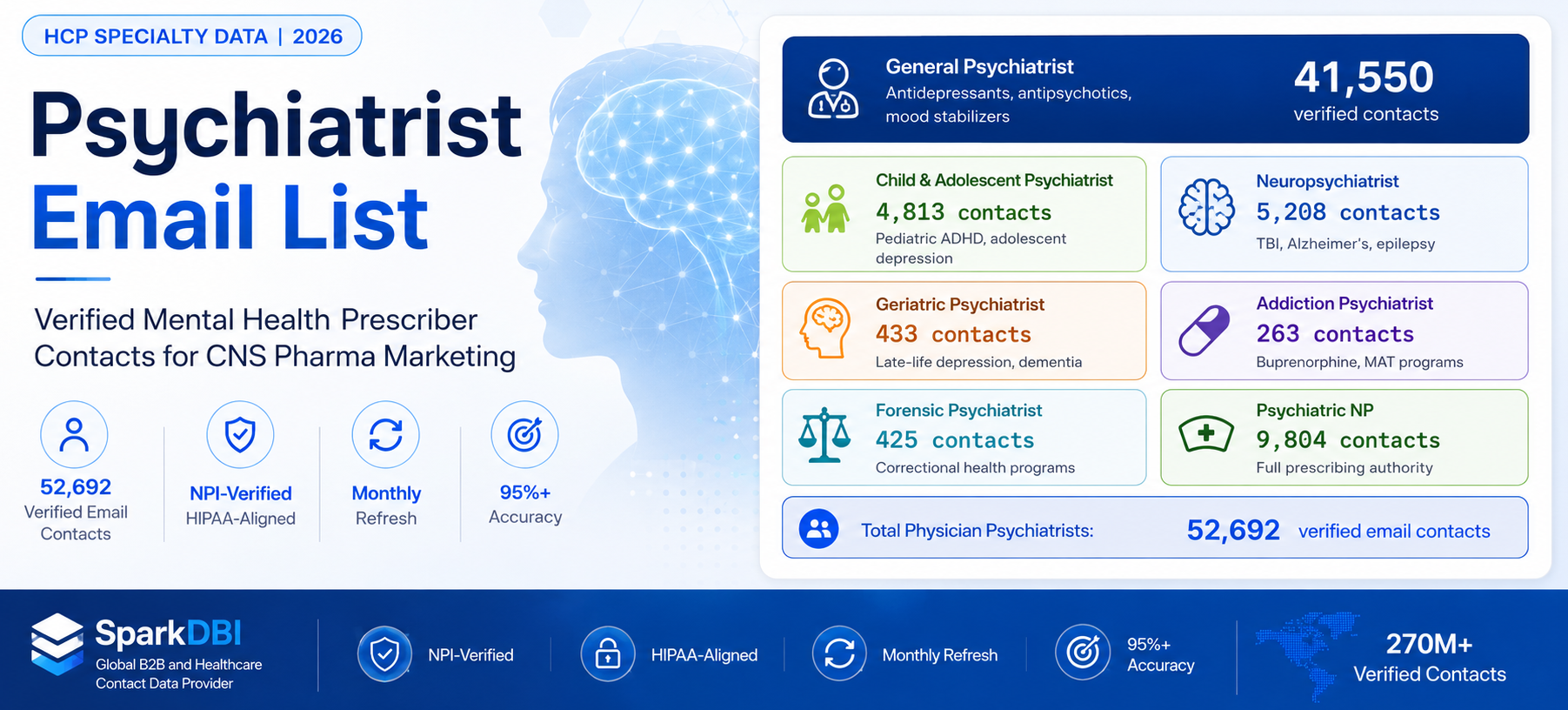
11 min read | Last Updated: May 2026
Psychiatry is one of the hardest specialties to reach by traditional sales channels. Office access has tightened more sharply in behavioral health than in almost any other specialty. Telehealth adoption shifted patient care – but not vendor access. The prescribers who matter most for CNS drug launches are spread across private practices, community mental health centers, hospital inpatient units, and academic medical centers. Each setting has different access protocols and email domains.
A verified psychiatrist email list gives pharma and CNS marketing teams a direct channel when in-person rep access fails. The quality gap between providers is wide, however. This guide covers what a psychiatrist email list should include, how to evaluate data quality for behavioral health targeting, the compliance framework for physician email outreach, and what SparkDBi’s psychiatric prescriber database covers across all six physician sub-specialties.
Quick answer: A psychiatrist email list is a verified database of email addresses and professional contact records for psychiatrist physicians, segmented by sub-specialty, practice setting, state, and NPI identifier. SparkDBi provides 52,692 verified psychiatrist physician contacts across six behavioral health sub-specialties, NPI-verified, with 95%+ accuracy and monthly refresh. HIPAA-aligned sourcing. No prior consent required for professional B2B email outreach under CAN-SPAM.
What a Psychiatrist Email List Is and Who Uses One
A psychiatrist email list is a compiled dataset of verified professional contact records for psychiatrist physicians. Each record covers a single licensed prescriber. It typically includes direct email address, full name, NPI number, sub-specialty classification, primary practice location, state license status, hospital or health system affiliation, and DEA registration status where relevant.
The primary buyers of psychiatrist contact data are pharma companies launching or maintaining CNS drug portfolios. These include:
- Antidepressant and antipsychotic brands targeting general psychiatrists and child and adolescent psychiatrists as the core prescribing audience
- ADHD medication companies targeting both psychiatrists and psychiatric NPs who manage adult and pediatric ADHD
- Addiction medicine programs targeting addiction psychiatry specialists and addiction medicine physicians for MAT-related outreach
- Mood disorder and bipolar treatment brands targeting general psychiatrists with high-volume lithium and mood stabilizer prescribing histories
- Medical device companies in transcranial magnetic stimulation (TMS) and electroconvulsive therapy (ECT) targeting psychiatrists who perform or refer for these procedures
- Healthcare marketing agencies running HCP engagement programs for multiple CNS clients simultaneously
According to the American Medical Association’s physician workforce data, psychiatry remains among the most undersupplied specialties relative to patient demand in the United States. That supply-demand gap means psychiatrists carry large patient panels. They have less availability for vendor contact. Email outreach, when the list is accurate and the message is relevant, is often the only scalable channel available to pharma commercial teams.
Psychiatry Sub-Specialties: Which Ones Your Campaign Actually Needs
Not all psychiatrist email lists are the same at the sub-specialty level. General “psychiatrist” queries return a broad pool. But CNS drug campaigns require filtering by sub-specialty. Specialty pharma launches targeting specific disease states need this precision before any campaign can be built.
SparkDBi’s behavioral health physician database covers six core psychiatrist sub-specialty categories with verified email contacts:
General Psychiatrist
SparkDBi holds 41,550 verified email contacts for general psychiatrists in the United States. These are the broadest prescribers in the behavioral health space – treating depression, anxiety, schizophrenia, bipolar disorder, and co-morbid conditions. General psychiatrists are the primary target for antidepressant, antipsychotic, and mood stabilizer campaigns. They practice across private offices, community mental health centers, hospital outpatient departments, and academic medical centers.
Child and Adolescent Psychiatrist
SparkDBi holds 4,813 verified email contacts for child and adolescent psychiatrists. This sub-specialty is the target audience for pediatric ADHD medications, antidepressants approved for adolescent use, and early-onset psychosis treatments. Child psychiatry is one of the most supply-constrained specialties in the country. Field rep access is particularly limited here. That makes email the dominant reachable channel for this prescriber segment.
Neuropsychiatrist
SparkDBi holds 5,208 verified email contacts for neuropsychiatrists and behavioral neurologists. This crossover specialty sits between neurology and psychiatry. It is relevant for campaigns targeting traumatic brain injury sequelae, Alzheimer’s-related behavioral symptoms, epilepsy-related psychiatric comorbidities, and Parkinson’s neuropsychiatric symptoms.
Geriatric Psychiatrist
SparkDBi holds 433 verified email contacts for geriatric psychiatrists. While small in absolute number, this sub-specialty carries significant prescribing weight. It covers late-life depression, dementia-related behavioral symptoms, and antipsychotic use in older adults. Geriatric psychiatrists are frequently the decision-makers for long-term care facility formularies and senior housing psychiatric protocols.
Forensic Psychiatrist
SparkDBi holds 425 verified email contacts for forensic psychiatrists. Campaigns targeting this sub-specialty are most relevant for correctional health vendors, court-ordered treatment programs, and behavioral health technology platforms serving justice-involved populations.
Addiction Psychiatrist
SparkDBi holds 263 verified email contacts for addiction psychiatry specialists. These are the clinical leadership targets for buprenorphine, naltrexone, and extended-release opioid antagonist campaigns. Alcohol use disorder treatments and co-occurring disorder programs also target this group. Separate from general addiction medicine physicians (1,416 verified contacts in SparkDBi’s database), addiction psychiatrists hold DEA X-waivers. They are the highest-prescribing segment for MAT medications.
Beyond physician psychiatrists, SparkDBi’s behavioral health cluster also covers 9,804 verified psychiatric nurse practitioner contacts. Psychiatric NPs hold full prescribing authority in most US states and are an increasingly primary campaign target for CNS brands. The full behavioral health specialty coverage is available through SparkDBi’s healthcare data dashboard.
How Psychiatrist Contact Data Is Sourced and What Accuracy Actually Means
Psychiatrist email lists fail for one of three reasons: outdated records, incorrect specialty classification, or unverified email addresses. Each failure mode has a different cause and a different fix at the data sourcing layer.
Why Psychiatrist Data Goes Stale Faster Than Other Specialties
Psychiatrists relocate between practice settings more frequently than most other physician specialties. The move from private practice to community mental health center changes the institutional email domain entirely. So does a move from academic appointment to telehealth-only practice, or from inpatient to outpatient setting. A psychiatrist who practiced at a hospital system in 2023 and moved to a private group practice in 2024 now has a completely different email address. That record, if not refreshed, generates a hard bounce.
SparkDBi refreshes its psychiatrist records monthly. As a result, the average record age at point of delivery is under 30 days. NPI status changes – license suspensions, DEA registration lapses, retirement – are monitored continuously against the CMS NPPES registry between monthly batch refreshes. This means the list a pharma brand team receives from SparkDBi reflects the psychiatrist’s current practice status, not their status from six months ago.
NPI Verification and What It Actually Covers
Every psychiatrist record in SparkDBi’s database is verified against the CMS National Provider Identifier registry. NPI verification confirms that the physician holds an active license. It also confirms they are classified under the correct taxonomy code for their sub-specialty. And it confirms their primary practice location matches the address on record. SparkDBi cross-references NPI data against state medical board records and DEA registration data for all behavioral health physicians where DEA registration is clinically relevant.
SparkDBi maintains 95%+ verified accuracy across its psychiatrist contact data, with bi-monthly validation runs supplementing the monthly refresh cycle. The live healthcare data dashboard shows current psychiatrist record counts by state, sub-specialty, and practice setting before any purchase.
Email Verification for Behavioral Health Contacts
Psychiatric practice settings create specific email verification challenges. Community mental health centers often run shared domain configurations. Hospital-employed psychiatrists use institutional emails that may be catch-all. Private practice psychiatrists increasingly use personal professional domains that are not immediately recognizable as medical contacts.
SparkDBi runs SMTP-level inbox verification on all psychiatrist email records before delivery. This confirms the address routes to a live, monitored inbox. It filters out defunct domains, shared department mailboxes, and addresses deactivated when the physician left an institution. The verified delivery rate across SparkDBi’s behavioral health physician data runs at 95%+ on first send for campaigns following standard CAN-SPAM protocols.
Compliance Framework for Psychiatrist Email Outreach
Two compliance questions come up in every pharma commercial team’s discussion of psychiatric prescriber outreach: does HIPAA restrict who can be contacted, and what does CAN-SPAM actually require? Both have straightforward answers, although many pharma marketers still operate on outdated assumptions about both.
HIPAA Does Not Restrict Outreach to Psychiatrists
HIPAA’s Privacy Rule governs the handling of protected health information – patient data. It does not restrict pharmaceutical companies or healthcare marketing agencies from contacting psychiatrists using professional contact information for marketing purposes. A pharma company emailing a psychiatrist about a new antidepressant is not handling patient data. There is no HIPAA barrier to professional B2B outreach using a licensed HCP contact database.
According to HHS HIPAA guidance, the covered entity rules apply to entities that handle protected health information in clinical transactions. They do not apply to pharmaceutical or medical device companies conducting commercial outreach to physicians using professional contact data sourced from licensed HCP databases.
SparkDBi sources all psychiatrist contact data through licensed data partnerships, NPI registry cross-referencing, and professional directory agreements. No patient health information is used in the sourcing or verification process. HIPAA-aligned sourcing is a standard component of SparkDBi’s data licensing terms.
CAN-SPAM Requirements for Physician Email Campaigns
The FTC’s CAN-SPAM Act governs commercial email in the United States. For pharma and CNS marketing teams emailing psychiatrists, the requirements are specific and non-negotiable:
- A functioning, monitored opt-out mechanism in every message. Opt-out requests must be honored within 10 business days.
- Accurate “From” name and email address identifying the actual sender
- A physical postal address for the sending organization
- Non-deceptive subject lines that accurately reflect the email content
- No false or misleading header information
No prior consent is required under CAN-SPAM for B2B commercial email. A pharma company can email a psychiatrist about a new CNS drug without any prior opt-in. All five requirements above must be met in every message sent. The SparkDBi data licensing terms include full CAN-SPAM compliance documentation for all HCP datasets.
What to Look for in a Psychiatrist Email List Provider
Most data vendors that offer “psychiatrist email lists” are list brokers. They aggregate records from third-party sources without owning the verification or refresh process. The result is data of unknown vintage, uncertain accuracy, and no accountability for bounce rates. Before purchasing any psychiatrist contact list, evaluate any vendor on these specific criteria:
Specialty Granularity
A provider that lists “psychiatrist” as a single category cannot distinguish between a general psychiatrist, a child and adolescent psychiatrist, and an addiction psychiatry specialist. For CNS campaigns targeting specific disease states, however, that granularity is not optional. Ask specifically which psychiatry sub-specialties are filterable in the dataset before committing.
Refresh Cadence
Quarterly refresh is inadequate for psychiatrist data given the practice setting mobility of behavioral health physicians. Monthly refresh with continuous NPI monitoring is the standard that prevents hard bounce rates from climbing above 5% on the first campaign send. Request the average record age at point of delivery from any vendor you evaluate.
NPI Verification Methodology
Ask specifically whether the vendor cross-references against NPPES taxonomy codes (not just NPI numbers). A record can have a valid NPI and still be misclassified if the taxonomy code was never verified. SparkDBi cross-references NPI numbers, taxonomy codes, and state medical board records for all physician psychiatrist records.
Sample Data Before Purchase
Any reputable psychiatrist data provider should offer a sample of 50-100 records for your target sub-specialty and state before any contract. Run those records through an independent email validation tool. Then cross-reference five to ten records against the CMS NPI registry. That check tells you more about actual data quality than any vendor accuracy claim.
SparkDBi provides sample psychiatrist data before any commercial commitment. Request a free sample of 50 verified psychiatrist contacts for your target sub-specialty through the SparkDBi contact page.
SparkDBi’s Psychiatrist Email List: Coverage and Specifications
SparkDBi is a global B2B and healthcare contact data provider with 270M+ verified contacts across 200+ countries, 140+ licensed data partners, and 95%+ verified accuracy. The behavioral health and psychiatry dataset is one of the most granular HCP specialty segments in SparkDBi’s healthcare data offering.
Current psychiatrist physician coverage in SparkDBi’s database:
| Psychiatry Sub-Specialty | Verified Email Contacts | Campaign Use Case |
|---|---|---|
| General Psychiatrist | 41,550 | Antidepressants, antipsychotics, mood stabilizers, bipolar treatments |
| Child and Adolescent Psychiatrist | 4,813 | Pediatric ADHD, adolescent depression, early-onset psychosis |
| Neuropsychiatrist | 5,208 | TBI sequelae, Alzheimer’s behavioral symptoms, epilepsy comorbidities |
| Geriatric Psychiatrist | 433 | Late-life depression, dementia behavioral symptoms, long-term care formularies |
| Forensic Psychiatrist | 425 | Correctional health, court-ordered treatment programs |
| Addiction Psychiatrist | 263 | Buprenorphine, naltrexone, MAT programs, alcohol use disorder treatments |
| Total Physician Psychiatrists | 52,692 | |
| Psychiatric Nurse Practitioner | 9,804 | Full prescribing authority in most states – increasingly primary CNS target |
All SparkDBi psychiatrist records are NPI-verified, SMTP-validated, and refreshed monthly. Data is delivered in standard flat-file or API format compatible with Salesforce, HubSpot, Zoho, Veeva, and custom CRM environments. State-level filtering, hospital affiliation filtering, and practice setting filtering (private practice vs. hospital-employed vs. academic) are all available at the record level.
For campaigns requiring broader behavioral health coverage beyond physician psychiatrists, SparkDBi also holds verified contacts for 62,192 psychologists, 42,875 licensed clinical social workers, 210,727 mental health counselors, and 128,212 mental health-specialized counselors. The full healthcare email lists data cards cover all specialty and sub-specialty counts with state-level breakdowns.
SparkDBi’s psychiatrist data integrates directly into pharma commercial operations workflows. See current record counts, filter options, and sample data through the SparkDBi healthcare database dashboard, or request a custom psychiatrist list for your target therapeutic area and geography through the contact page.
Frequently Asked Questions
What is a psychiatrist email list?
A psychiatrist email list is a verified database of professional contact records for licensed psychiatrist physicians. Records are organized by sub-specialty, state, practice setting, and NPI identifier. Quality lists include direct email addresses, full names, NPI numbers, specialty classifications, practice locations, and hospital affiliations. They are used by pharmaceutical companies, medical device vendors, CME providers, and healthcare marketing agencies for professional outreach to psychiatric prescribers. Verified accuracy and monthly refresh are the two most important quality indicators when evaluating any psychiatrist contact database.
Is it legal to email psychiatrists for pharmaceutical marketing?
Yes. HIPAA’s Privacy Rule applies to the handling of patient health information. It does not restrict B2B marketing outreach to physicians using professional contact data. The applicable regulation for pharmaceutical email outreach to psychiatrists is CAN-SPAM. It requires a functioning opt-out mechanism, accurate sender identification, and a physical postal address in every commercial message. No prior consent from the physician is required under CAN-SPAM. SparkDBi’s psychiatrist data is sourced through HIPAA-aligned licensing agreements using professional contact data only. No patient health information is involved.
How many psychiatrists are in the United States?
There are approximately 52,000 to 60,000 actively licensed psychiatrist physicians in the United States. The exact count depends on the data source and whether inactive or limited licenses are included. SparkDBi holds 52,692 verified email contacts for physician psychiatrists across six sub-specialties. All are cross-referenced against the CMS NPPES registry and state medical board records. The psychiatrist workforce is heavily concentrated in metropolitan areas and academic medical center regions, with significant access gaps in rural states.
What psychiatry sub-specialties does SparkDBi cover?
SparkDBi’s psychiatrist database covers six physician sub-specialty categories: general psychiatrist (41,550 verified contacts), child and adolescent psychiatrist (4,813), neuropsychiatrist (5,208), geriatric psychiatrist (433), forensic psychiatrist (425), and addiction psychiatrist (263). SparkDBi also covers 9,804 psychiatric nurse practitioners. Psychiatric NPs hold full prescribing authority in most US states and are an increasingly primary target for CNS drug campaigns. All records are NPI-verified and refreshed monthly.
How often should a psychiatrist email list be refreshed?
Monthly refresh is the minimum standard for active pharma outreach campaigns. Psychiatrists change practice settings more frequently than most physician specialties. They move between private practice, community mental health centers, academic appointments, and telehealth-only practices. Each practice setting change typically involves a new institutional email domain. Quarterly refresh cycles generate hard bounce rates of 8-15% on psychiatrist campaigns. SparkDBi’s monthly refresh cycle with continuous NPI monitoring keeps average record age under 30 days. That results in verified delivery rates above 95% on first send.
Can I filter a psychiatrist email list by state or practice setting?
Yes. SparkDBi’s psychiatrist data supports filtering by state, sub-specialty, practice setting, hospital affiliation, and NPI status. State-level psychiatrist counts vary significantly. States with large academic medical centers and urban populations have the highest concentrations of specialist psychiatrists. Geography-based filtering is particularly important for regional pharma campaigns and territory-specific field force support programs. Contact SparkDBi to request a count of psychiatrist contacts matching your specific state and sub-specialty criteria before committing to a full list purchase.
Key Takeaways
- SparkDBi holds 52,692 verified physician psychiatrist email contacts across six sub-specialties, plus 9,804 psychiatric NP contacts
- General psychiatrists (41,550 contacts) are the primary target for antidepressant, antipsychotic, and mood stabilizer campaigns
- Child and adolescent psychiatrists (4,813 contacts) are the priority segment for pediatric ADHD and adolescent depression drug campaigns
- HIPAA does not restrict B2B marketing outreach to psychiatrists – CAN-SPAM is the applicable regulation, requiring opt-out, accurate sender ID, and physical address
- Monthly refresh with continuous NPI monitoring is the minimum standard for psychiatrist data quality – quarterly refresh generates hard bounce rates that damage sender reputation
- Sub-specialty filtering is not optional for CNS drug campaigns – a general psychiatrist, child psychiatrist, and addiction psychiatrist are three distinct prescriber profiles with different campaign needs
- SparkDBi provides sample psychiatrist data before any purchase commitment
Get 50 free verified psychiatrist contacts for your target sub-specialty and state. NPI-verified. Monthly refresh. Filter by sub-specialty, state, and practice setting. Request your free sample through SparkDBi’s contact page.
By the SparkDBi Editorial Team
SparkDBi is a global B2B and healthcare contact data provider with 270M+ verified contacts, 140+ licensed data partners, 95%+ accuracy, and monthly HCP data refresh. SparkDBi’s healthcare data covers 10.3M+ verified HCP contacts across 39 specialty groups and 50+ specialty filters, NPI-verified and HIPAA-aligned.