
Cardiologist Email List: How to Reach Verified Cardiovascular Specialists for Pharma and Device Marketing
Mixed / 10 min read
Ask any pharma rep who covers cardiovascular which part of their territory is hardest to reach, and they’ll tell you the same thing: cardiologists. Specifically interventional cardiologists, electrophysiologists, and heart failure specialists – the prescribers who matter most for cardiovascular drug launches and device placements, and the ones whose office visit access has been shrinking for years.
A cardiologist email list is a database of verified email addresses for cardiology physicians, organized by subspecialty, geography, NPI identifier, and practice setting. For pharmaceutical companies, medical device manufacturers, and healthcare marketing agencies, it’s the primary channel for reaching cardiovascular specialists when in-person access is limited or unavailable.
But not all cardiologist contact data is the same. The difference between a 95% deliverable list and a 60% deliverable list comes down to how recently the records were validated, whether NPI numbers are cross-referenced, and whether the data provider actually has coverage in the subspecialties you need. This guide covers all of it.
In This Guide
- What Is a Cardiologist Email List and Who Uses It
- Cardiology Subspecialties: Which Ones You Actually Need
- How Cardiologist Contact Data Is Sourced and Verified
- HIPAA and CAN-SPAM Compliance for Cardiologist Outreach
- What to Look for in a Cardiologist Email List Provider
- How SparkDBI’s Cardiology Data Works
- Frequently Asked Questions
What Is a Cardiologist Email List and Who Uses It
A cardiologist email list is a compiled dataset of verified contact records for cardiology physicians, typically including email address, full name, NPI number, subspecialty, primary practice location, hospital affiliation, and prescribing or procedure volume data where available. Quality lists also include phone numbers, mailing addresses, and DEA numbers for pharmaceutical marketing use cases.
The primary buyers of cardiologist contact data include:
- Pharmaceutical companies launching cardiovascular drugs – anticoagulants, heart failure therapies, lipid-lowering agents, antihypertensives – who need to reach prescribers before and during market launch
- Medical device manufacturers whose products are used by interventional cardiologists or electrophysiologists – stents, pacemakers, ablation systems, monitoring devices
- Healthcare marketing agencies running HCP engagement programs on behalf of pharma or device clients
- Continuing medical education (CME) providers targeting cardiologists for accredited education programs
- Health systems and hospital networks recruiting cardiovascular physicians
According to the American Medical Association, there are approximately 57,000 actively licensed cardiologists in the United States. But the segment that matters for most pharma and device marketing campaigns is narrower: the roughly 20,000 to 25,000 practicing interventional cardiologists, electrophysiologists, and heart failure specialists who account for the highest prescribing and procedure volumes in the specialty.
The Access Problem
Physician office visits by pharmaceutical sales representatives declined by more than 40% between 2012 and 2024, with cardiovascular specialists among the most restricted specialties. Cardiologists in hospital-based practices – which account for more than 60% of the specialty – often operate under no-see or appointment-only policies. Email outreach, backed by verified HCP contact data, has become the primary channel replacing in-person detailing for this audience.
Need verified cardiologist contacts for your next campaign?
SparkDBI provides NPI-verified cardiology email lists by subspecialty, filtered by state, hospital affiliation, and prescribing profile.See HCP Data by Specialty
Cardiology Subspecialties: Which Ones You Actually Need
Cardiology is not a monolithic specialty. A cardiologist contact list that lumps all cardiovascular physicians together will include general cardiologists with limited prescribing or procedure relevance alongside the subspecialists your campaign actually needs. Understanding the subspecialty landscape before requesting data saves budget and improves response rates.
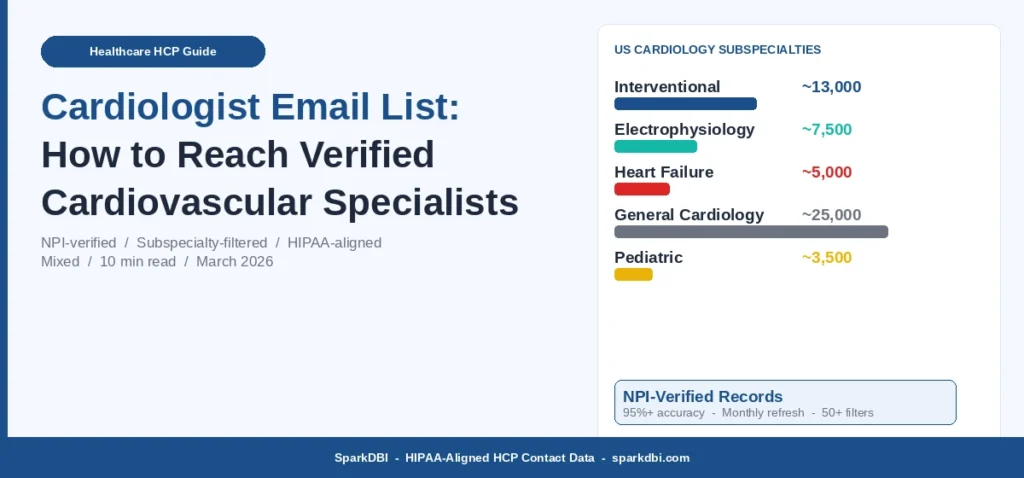
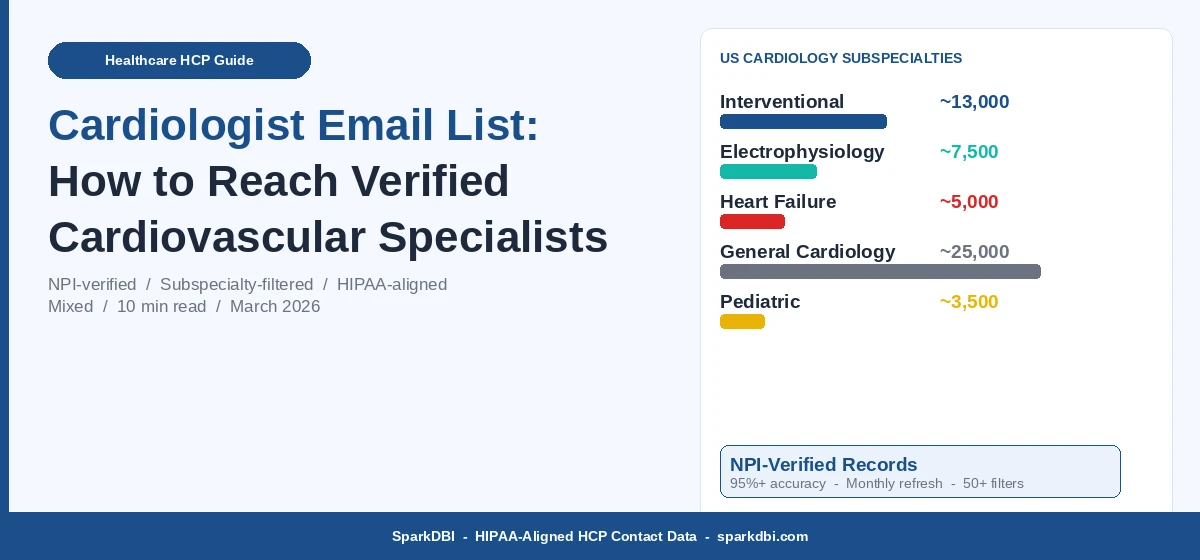
| Subspecialty | US Physicians (est.) | Most Relevant For |
|---|---|---|
| Interventional Cardiology | ~13,000 | Stents, balloons, structural heart devices, anticoagulants |
| Electrophysiology (EP) | ~7,500 | Pacemakers, ablation systems, antiarrhythmic drugs, AF therapies |
| Heart Failure / Advanced HF | ~5,000 | SGLT2 inhibitors, ARNIs, LVAD devices, transplant programs |
| General / Non-Invasive Cardiology | ~25,000 | Statins, antihypertensives, preventive cardiology programs |
| Pediatric Cardiology | ~3,500 | Congenital heart disease devices, pediatric cardiac drugs |
| Noninvasive Imaging | ~3,000 | Echo systems, nuclear cardiology agents, cardiac CT/MRI contrast |
Most pharma and device campaigns target one to three of these subspecialties, not the full universe of 57,000. A cardiovascular SGLT2 inhibitor launch needs general cardiologists and heart failure specialists. An ablation device launch needs electrophysiologists. A stent campaign needs interventional cardiologists almost exclusively.
When requesting cardiologist contact data from any provider, specify subspecialty, not just specialty. A list labeled “cardiology email list” without subspecialty segmentation is unlikely to give you the precision your campaign requires. SparkDBI’s healthcare email lists by specialty are filterable down to subspecialty level, using NPI taxonomy codes as the classification standard.
How Cardiologist Contact Data Is Sourced and Verified
The quality of any cardiologist email list traces back to its sourcing method and verification process. There are three primary data sourcing approaches, each with different accuracy profiles:
NPI Registry-Anchored Data
The National Provider Identifier (NPI) registry, maintained by the Centers for Medicare and Medicaid Services, is the most reliable foundation for cardiologist contact data. Every licensed US physician has a unique 10-digit NPI number, and the registry includes specialty taxonomy codes, practice address, and license status. Reputable HCP data providers anchor their records to NPI identifiers and cross-validate contact data against NPI registry entries.
NPI-anchored data answers two critical questions: is this physician still in active practice, and what is their verified specialty classification? It doesn’t provide email addresses directly – email addresses are sourced separately and appended to NPI-anchored records through licensed data partnerships.
Licensed Data Partner Networks
Professional medical societies, hospital credentialing bodies, CME registrars, and healthcare publication subscription databases all hold physician contact data. Quality HCP data providers aggregate these sources through licensing agreements – not scraping. The broader the licensed partner network, the more complete the email coverage for specialized physicians practicing in academic medical centers or hospital systems.
Active Verification Processes
Email addresses for cardiologists decay fast. Physicians change practices, switch to institutional email systems, or retire. Without regular active verification – SMTP-level inbox checks, bounce monitoring, and periodic re-validation against NPI status – a cardiologist email list that was 90% deliverable 18 months ago may be 65% deliverable today. Monthly HCP data refresh is the standard that serious HCP data providers maintain.
Why Most Cardiology Lists Go Stale
Cardiology has one of the highest hospital employment rates of any specialty. More than 60% of practicing cardiologists work in hospital-employed group practices rather than private practice. When a physician moves from a private group to a hospital system, their email address changes entirely – from a practice domain to an institutional one. Providers that don’t refresh against hospital credentialing data miss these transitions and deliver lists with a high percentage of defunct practice-domain addresses.
HIPAA and CAN-SPAM Compliance for Cardiologist Outreach
This is the question every pharma marketer asks before purchasing HCP contact data: is it legal to email cardiologists for marketing purposes? The answer is yes, under defined conditions. Understanding those conditions is not optional – it’s the difference between a compliant HCP engagement program and a regulatory problem.
HIPAA Does Not Prohibit Pharmaceutical Email Marketing to Physicians
HIPAA’s Privacy Rule governs the use and disclosure of Protected Health Information (PHI) – meaning patient data. It does not restrict pharmaceutical companies from contacting physicians for marketing purposes. A pharma company emailing a cardiologist about a new anticoagulant is not handling patient data. The physician is a healthcare professional, not a patient. HIPAA is not the compliance concern for this use case. HHS.gov’s HIPAA guidance confirms that marketing communications directed to HCPs fall outside the PHI framework.
The compliance concern that does apply is CAN-SPAM. The FTC’s CAN-SPAM Act governs commercial email in the US and applies to B2B email including pharmaceutical outreach to physicians. CAN-SPAM requirements for cardiologist email campaigns include:
- A clear, accurate “From” name and subject line – no deceptive headers
- A physical mailing address in every commercial email
- A functioning opt-out mechanism that processes unsubscribes within 10 business days
- No email after a physician has opted out – your data provider should offer opt-out list management
There is no prior consent requirement under CAN-SPAM for B2B commercial email to physicians. You do not need a cardiologist to opt in before you can email them about a cardiovascular drug. You do need to honor opt-outs immediately and maintain a compliant suppression list.
SparkDBI’s healthcare data license includes HIPAA-aligned sourcing documentation and opt-out management support, so your cardiologist outreach program operates within the compliance framework from day one. For a full breakdown of what this means for your campaign, the existing HCP email marketing compliance guide covers every requirement in detail.
What to Look for in a Cardiologist Email List Provider
Not all HCP data providers cover cardiology with the same depth. These are the questions to ask before purchasing or licensing cardiologist contact data from any vendor:
1. Can you filter by cardiology subspecialty?
If the answer is “we have a cardiology list” without subspecialty segmentation, the data is not precise enough for most pharmaceutical or device campaigns. You need to filter by interventional, EP, heart failure, general, and pediatric cardiology as distinct groups. Ask for record counts by subspecialty before purchasing.
2. Are records anchored to NPI identifiers?
NPI-anchored records are the industry standard for HCP data quality. Any provider who can’t confirm NPI validation as part of their process is sourcing data from scraped or unverified sources. NPI anchoring tells you the physician is real, actively licensed, and correctly classified by specialty.
3. How often is the data refreshed?
For cardiologists specifically, monthly refresh is the appropriate standard given the high rate of hospital employment transitions. Annual refresh on a specialty with high practice mobility is not sufficient. Ask the provider when the data was last validated – not when the list was last compiled.
4. What is the deliverability guarantee?
95% or above is the benchmark for a quality HCP email list. Providers who offer 80-85% deliverability are supplying data that will generate meaningful bounce rates in your first campaign send. Ask for a documented accuracy rate and whether there’s a replacement policy for records that bounce.
5. Can you request a sample before purchasing?
Reputable HCP data providers will provide a sample of verified cardiologist records before you commit to a purchase or license agreement. If a provider won’t give you 20-50 sample records to validate yourself, treat that as a red flag.
How SparkDBI’s Cardiologist Email List Works
SparkDBI is a global B2B and healthcare contact data provider with NPI-verified physician records covering all major US cardiology subspecialties. SparkDBI’s healthcare data infrastructure is built specifically for pharmaceutical and medical device marketing teams who need precise, compliant, regularly refreshed HCP contact data – not a static list compiled once and sold indefinitely.
Key elements of SparkDBI’s cardiologist data:
- NPI-verified records cross-referenced against CMS registry data for active license status and specialty taxonomy code
- 50+ HCP specialty filters including cardiology subspecialties: interventional, electrophysiology, heart failure, general/non-invasive, pediatric, imaging
- Monthly HCP data refresh to capture practice moves, hospital employment transitions, and email address changes
- HIPAA-aligned sourcing through 140+ licensed data partners – no scraped or unverified sources
- 95%+ accuracy rate across HCP records, backed by active inbox validation and multi-source confirmation
- Geographic and hospital affiliation filtering for territory-based or account-based campaign targeting
SparkDBI’s healthcare data live dashboard shows real-time record counts by specialty and geography, so you can verify coverage before requesting a sample. The data is available as a licensed flat file, API delivery, or direct CRM integration depending on your workflow.
If your campaign targets multiple cardiovascular specialties, SparkDBI can also provide a combined cardiologist and cardiovascular-adjacent HCP list – including cardiac surgeons, nurse practitioners in cardiology practices, and physician assistants working under cardiologist supervision. The complete range of specialty options is available on the healthcare email lists by specialty page.
Get 50 Free Verified Cardiologist Contacts for Your Target Subspecialty
NPI-verified. Monthly refresh. Filter by interventional, EP, heart failure, or general cardiology. State and hospital affiliation targeting available.Request Your Free Sample
Frequently Asked Questions
How do I find cardiologists to contact for marketing?
Finding cardiologists for marketing purposes requires a licensed HCP data provider with NPI-verified physician records. The CMS NPI registry is a public source for specialty and license verification, but it doesn’t provide email addresses. Pharmaceutical and device companies typically purchase or license a cardiologist email list from an HCP data provider like SparkDBI, which builds verified contact data through licensed partnerships with medical societies, hospital credentialing bodies, and CME registrars.
How many cardiologists are in the United States?
There are approximately 57,000 actively licensed cardiologists in the United States, according to AMA physician workforce data. This includes all cardiology subspecialties: interventional cardiology (~13,000), electrophysiology (~7,500), heart failure specialists (~5,000), general/non-invasive cardiologists (~25,000), pediatric cardiologists (~3,500), and noninvasive imaging specialists (~3,000). Most pharmaceutical and device marketing campaigns target a specific subset of 5,000 to 20,000 physicians based on subspecialty, geography, and prescribing or procedure relevance.
Is it legal to email cardiologists for pharmaceutical marketing?
Yes. Emailing cardiologists for pharmaceutical or medical device marketing is legal under US law. HIPAA does not restrict commercial communications directed to physicians – it governs patient health data, not professional outreach to HCPs. CAN-SPAM applies: every commercial email must include a physical mailing address, an honest subject line, and a functioning opt-out mechanism. No prior consent from the physician is required to initiate contact under CAN-SPAM. Opt-outs must be honored within 10 business days.
What data is in a cardiologist email list?
A quality cardiologist email list includes: verified email address, full name, NPI number, cardiology subspecialty, primary practice address, hospital affiliation (if applicable), phone number, geographic identifiers (state, county, metro), and license status. Advanced lists from HCP-specialized providers like SparkDBI also include prescribing volume indicators and DEA numbers for pharmaceutical marketing workflows.
How accurate are cardiologist email lists?
Accuracy varies significantly by provider and data freshness. Quality HCP data providers maintain 95%+ accuracy through monthly validation against NPI registry updates, active inbox verification, and licensed source networks. Generic list brokers who compile data annually from unverified sources often deliver 60-75% accuracy – meaning 25-40% of contacts either don’t exist, have changed employers, or have non-functional email addresses. Always request a sample and verify deliverability before purchasing a large cardiologist list.
Can I get a cardiologist email list filtered by state or hospital?
Yes. Most reputable HCP data providers, including SparkDBI, allow filtering by state, metro area, or hospital/health system affiliation. For medical device companies targeting specific health systems, hospital-level filtering is particularly valuable – it lets you match your sales territory structure to the data request and avoid purchasing contacts outside your reps’ coverage areas. Ask your data provider specifically about hospital affiliation as a filterable attribute before you order.
