 SparkDBi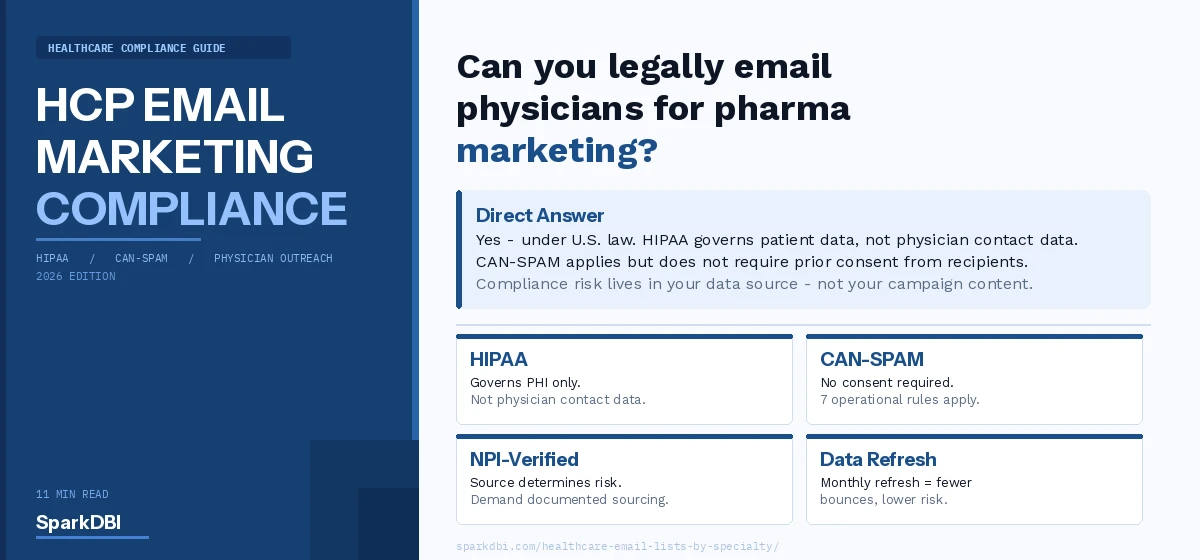
HCP email marketing compliance is one of the most misread areas in pharmaceutical marketing, and that misreading costs companies campaigns they could have legally run.
Most pharma marketers assume physician email outreach is either completely off-limits or completely unregulated. Both assumptions are wrong, and both cost companies money.
HCP email marketing compliance is the single most misunderstood area in pharmaceutical and medical device marketing. Compliance officers say one thing. Legal says another. Your agency says something else entirely. And meanwhile, your competitors are running physician email campaigns at scale.
This guide cuts through the confusion. It covers what HIPAA actually restricts in B2B pharma outreach, how CAN-SPAM applies to HCP campaigns, what “HIPAA-aligned” data sourcing really means, and what a legally defensible physician email campaign looks like in practice.
Direct answer: Emailing physicians for legitimate B2B healthcare marketing purposes is legal under U.S. law. HIPAA does not prohibit commercial email outreach to healthcare professionals; it governs patient health information, not physician contact data. CAN-SPAM does apply and requires specific compliance steps, but it does not require prior consent. The legal risk comes from using improperly sourced data or failing to follow CAN-SPAM’s operational requirements.
Table of Contents
- What Is HCP Email Marketing Compliance, and Why It Matters Now
- What HIPAA Actually Says About Emailing Physicians
- CAN-SPAM Rules for HCP Outreach: The Non-Negotiables
- HIPAA-Aligned HCP Data: What That Phrase Actually Means
- How to Build a Compliant HCP Email Outreach Campaign
- The Physician Email Compliance Checklist
- HCP Data Sourcing and Your Compliance Exposure
- SparkDBi’s Approach to HIPAA-Aligned Healthcare Data
- Frequently Asked Questions
What Is HCP Email Marketing Compliance, and Why It Matters Now
HCP email marketing compliance refers to the body of legal, regulatory, and operational rules governing how pharmaceutical companies, medical device manufacturers, healthcare technology firms, and their agencies can contact healthcare professionals via email.
The stakes got higher after 2020. Physician office visit rates for pharma reps dropped sharply as healthcare systems restricted access, a shift that accelerated the move toward digital HCP engagement. Email became the primary channel for reaching prescribers. That growth brought regulatory attention, vendor inconsistency, and a market full of data providers making compliance claims that range from well-founded to wishful.
Here’s what makes this genuinely complicated: the rules come from multiple overlapping frameworks. HIPAA sets data handling standards. CAN-SPAM sets email conduct standards. State privacy laws, especially in California and Virginia, add a third layer. And then there’s the question of how the data itself was sourced, which is where most compliance risk actually lives.
The good news is that navigating this is not as difficult as most legal memos suggest. It requires knowing which regulation applies to which part of your program, and working with HCP data providers who can document their sourcing practices.
What HIPAA Actually Says About Emailing Physicians
This is where more campaigns get killed unnecessarily than anywhere else. The misread of HIPAA is so common it deserves its own section.
HIPAA does not prohibit pharma companies from emailing physicians. Full stop.
HIPAA, the Health Insurance Portability and Accountability Act, was designed to protect patient health information. It governs how covered entities (hospitals, health plans, healthcare providers) and their business associates handle Protected Health Information, or PHI.
A pharma company emailing a cardiologist about a new drug’s clinical trial data is not handling PHI. The physician’s contact information, their name, specialty, NPI number, work email address, and practice location, is not Protected Health Information. It is professional contact data, the same category as a corporate email address on a business card.
The HHS Office for Civil Rights has been clear on this point: physician contact data sourced through professional channels, NPI registries, and licensed data agreements does not constitute PHI under HIPAA’s Privacy Rule. You are not accessing a patient record. You are contacting a licensed professional at their place of business.
Where HIPAA Does Become Relevant in HCP Outreach
There are three situations where HIPAA exposure enters the picture for pharma email marketing:
If your campaign content includes patient-specific information linked to that physician’s prescribing activity, prescription-level data tied to individual patients, that triggers PHI concerns.
And your data provider sourced physician contact information from patient records or clinical systems, that is a compliance problem regardless of whether you knew it at the time of purchase.
If you are a covered entity yourself and the campaign involves data systems shared with clinical operations, your legal team needs to review the workflow before launch.
The practical implication: your HCP data provider’s sourcing methodology matters more than your campaign content in most HIPAA analyses. A provider who sources physician data from NPI registries, professional directories, medical association records, and licensed data partners operates in a fundamentally different compliance posture than one who scrapes clinical systems or purchases data from hospital networks without proper agreements.
SparkDBi sources HCP data exclusively through HIPAA-aligned channels: NPI registry records from CMS, licensed data partner agreements with professional organizations, and publicly verifiable professional directories. No patient records. Not even clinical system access. No PHI at any point in the sourcing chain.
CAN-SPAM Rules for HCP Outreach: The Non-Negotiables
Unlike HIPAA, CAN-SPAM applies directly to your physician email campaigns. The CAN-SPAM Act covers all commercial email messages, including B2B outreach to healthcare professionals. The FTC enforces it.
The critical thing most marketers don’t realize: CAN-SPAM does not require prior consent for commercial email. This is a GDPR rule, not a CAN-SPAM rule. You do not need an opt-in list to legally email a physician under U.S. federal law. What you do need is full compliance with CAN-SPAM’s operational requirements.
The Seven CAN-SPAM Requirements That Apply to Every HCP Email Campaign
1. Identify the message as commercial.
The email’s nature must be clear. A pharma company or medical device manufacturer contacting a physician about a product is commercial. Don’t obscure this.
2. Don’t use deceptive subject lines.
Your subject line must accurately reflect what’s inside the email. “FDA Approval Update” when you’re promoting a product launch is a problem. “New data on [drug name] for your cardiology patients” is not.
3. Include a valid physical postal address.
Every HCP email must contain your company’s current street address, P.O. box, or registered agent address. This is one of the most frequently missed requirements in physician outreach campaigns.
4. Provide a functioning opt-out mechanism.
Every email must include a clear and conspicuous way for the recipient to opt out of future messages. That unsubscribe link must work, and must remain functional for at least 30 days after the email is sent.
5. Honor opt-out requests within 10 business days.
Once a physician opts out, you have 10 business days to remove them from your list. No follow-up emails in that window. No “one more message” to complete a sequence.
6. Monitor third parties acting on your behalf.
If you use an agency, a deployment partner, or a data provider, you are still responsible for compliance. “We didn’t know our vendor wasn’t suppression-managing” is not a defense under the Act.
7. Don’t sell or transfer opt-out lists.
Physicians who opt out of your campaigns cannot have their contact information transferred to other marketers, even within a parent company structure if entities operate under separate brand identities.
The FTC’s CAN-SPAM compliance guide covers each of these requirements in detail. Running an HCP email campaign without legal review of your opt-out workflow and suppression management process is a risk that’s entirely avoidable.
HIPAA-Aligned HCP Data: What That Phrase Actually Means
“HIPAA-compliant data” and “HIPAA-aligned data” get used interchangeably in vendor marketing. They mean very different things operationally.
Strict HIPAA compliance applies to covered entities and their business associates handling PHI. An HCP data provider who isn’t a covered entity and doesn’t handle PHI isn’t technically subject to HIPAA the way a hospital is. But that doesn’t mean all sourcing practices are equivalent, and it doesn’t mean your exposure is zero if their data was improperly sourced.
HIPAA-aligned sourcing means the data provider has built their collection, storage, and delivery processes to match the spirit and substance of HIPAA’s privacy protections, even where not legally required by the letter of the regulation. Specifically, this means:
- Physician data is sourced from professional channels, not clinical or patient records
- No PHI is collected, stored, or transmitted at any point in the data pipeline
- Data sharing agreements with downstream partners address healthcare data sensitivity explicitly
- The provider can document the source of each data type used to build their HCP records
Questions to Ask Any HCP Data Provider Before You Buy
- Where does your physician contact data originate? Name the primary sources.
- Do any of your data sources involve clinical systems, hospital networks, or patient record databases?
- What is your Business Associate Agreement (BAA) policy for clients in covered entity relationships?
- How do you handle NPI registry data, direct CMS pull or through an intermediary?
A provider who can’t answer these questions with specifics doesn’t have a defensible compliance posture, regardless of what their marketing materials say.
SparkDBi’s healthcare database is built from NPI-verified physician records, licensed data from professional medical organizations, specialty directory partnerships, and third-party licensed data agreements, all documented and auditable. The SparkDBi Healthcare Database Dashboard shows current record counts, specialty coverage, and refresh status for the full HCP dataset.
How to Build a Compliant HCP Email Outreach Campaign
Compliance isn’t a checkbox you run at the end. It’s built into the campaign architecture from the start. Here’s what a defensible HCP email campaign looks like in practice.
Step 1: Establish your legal basis for outreach.
Under CAN-SPAM, you don’t need a legal basis in the GDPR sense, but you do need to document that your data was lawfully obtained and that your commercial intent is transparent. Keep a sourcing record for your HCP data that includes the provider name, the data refresh date, and the fields used.
Step 2: Source HCP data from a provider with documented, HIPAA-aligned sourcing.
The source of your physician contact records determines your compliance exposure more than anything else in the program. Prioritize providers who can demonstrate NPI-verified data, professional directory sourcing, and explicit documentation of their data collection methodology.
SparkDBi’s verified HCP data by specialty covers 39+ medical specialties with NPI numbers included on all physician records, enabling verification against the CMS NPI registry before campaign deployment.
Step 3: Build and maintain a suppression list from day one.
Every physician who opts out goes onto your master suppression list immediately. That list must be checked against every send, not just for the specific campaign that generated the opt-out, but for all future outreach from your company. This is where pharma marketing teams most commonly fail CAN-SPAM audits.
Step 4: Include all CAN-SPAM required elements in your email template.
Physical address, unsubscribe link, accurate sender identification; these must be in the template before you deploy the first campaign, not added as an afterthought.
Step 5: Verify physician data accuracy before deployment.
Running a campaign to a list with 30% data decay means 30% of your sends go to invalid addresses, bounce, and damage your sender reputation. SparkDBi refreshes its HCP dataset monthly, a meaningful advantage over providers operating on quarterly or annual refresh cycles.
Step 6: Build monitoring for opt-out processing into your workflow.
Set up an internal process to check opt-out requests daily during active campaigns. The 10-business-day CAN-SPAM window sounds generous. It isn’t, if you’re running sequential email workflows and your suppression management is manual.
The Physician Email Compliance Checklist
Use this before every HCP email campaign goes live.
Data Sourcing
- HCP data sourced from a HIPAA-aligned provider with documented sourcing methodology
- NPI numbers verified against CMS registry for all physician records
- Data refresh date confirmed, no records older than 90 days for active campaign use
- Suppression list applied, all previous opt-outs removed before export
Email Content
- Subject line accurately describes the content of the email
- Sender name clearly identifies the company (not a generic from-name)
- Physical postal address included in the email footer
- Unsubscribe link is functional and clearly visible
- No patient-specific or PHI-adjacent data referenced in content
Campaign Setup
- Deployment platform configured to process opt-outs within 10 business days
- Suppression list shared with any agency or third-party deployment partner
- Bounce thresholds set to protect sender reputation (remove hard bounces immediately)
- All A/B test versions reviewed, both must meet CAN-SPAM requirements
Post-Campaign
- Opt-outs from this campaign added to master suppression list within 48 hours
- Hard bounce list reviewed and flagged for data quality action
- Campaign metrics documented for compliance records (send date, list source, opt-out count)
HCP Data Sourcing and Your Compliance Exposure
The single highest-risk decision in any HCP email program is where you get your data. Not how you write the email. Not what CRM you use. The data source.
Your liability under CAN-SPAM, HIPAA, and state privacy laws tracks with the provenance of the data, not just how you use it. A physician email address obtained through a clinical system or patient record database creates potential HIPAA exposure even if your campaign content is entirely appropriate. The data was wrong before it reached you.
The HCP data market has three broad tiers of sourcing quality:
Tier 1, NPI-verified, professionally sourced data.
Records built from CMS NPI registry data, professional medical directories, licensed medical association partnerships, and verified data agreements. Every record can be traced to a source. SparkDBi operates in this tier.
Tier 2, Aggregated data from mixed sources.
Records compiled from a combination of professional sources, public web data, and purchased third-party lists of unclear provenance. Some records are high quality. Some aren’t. The provider often can’t tell you which.
Tier 3, Scraped or recycled data.
Records assembled from web scraping, data broker resells, or outdated professional databases. High decay rates, no sourcing documentation, and real compliance exposure for any company that deploys them in regulated healthcare marketing.
Most data quality problems in HCP campaigns, high bounce rates, compliance incidents, deliverability failures, trace back to Tier 2 or Tier 3 sourcing. The price difference between tiers rarely reflects the compliance cost difference.
SparkDBi’s healthcare data license covers 304M+ verified contacts including NPI-verified physician records across 50+ HCP specialties, with monthly refreshes and full sourcing documentation available on request.
SparkDBi’s Approach to HIPAA-Aligned Healthcare Data
SparkDBi is a global B2B and healthcare contact data provider with 304M+ verified contacts, 140+ licensed data partners, and coverage across 200+ countries. The SparkDBi healthcare dataset covers physicians, nurse practitioners, physician assistants, and 50+ additional medical specialties, all sourced through HIPAA-aligned channels with no PHI involvement at any stage.
How SparkDBi Builds Its HCP Data
Every physician record in the SparkDBi healthcare database is anchored to NPI registry data from CMS, cross-referenced against specialty licensing boards, and validated through licensed data partnerships with professional medical organizations. No clinical records. No patient data touchpoints.
Records are refreshed monthly. For HCP data, this matters because physician contact information changes at a higher rate than general B2B data. Practice relocations, group practice changes, and specialty transitions make stale data both a compliance risk and a deliverability problem simultaneously.
For pharma and medical device teams who need specialty-specific targeting, cardiologists in a specific geography, oncologists affiliated with NCI-designated cancer centers, nurse practitioners with specific prescribing authority, SparkDBi’s specialty filtering across 50+ HCP categories allows precise segmentation without custom list-building lead times.
Explore current availability and record counts by specialty at SparkDBi Healthcare Email Lists by Specialty. Live database stats are available at the Healthcare Database Dashboard.
Frequently Asked Questions
Is it legal to email physicians for pharmaceutical marketing in the United States?
Yes. Emailing licensed physicians for legitimate B2B pharmaceutical or medical device marketing purposes is legal under U.S. federal law. HIPAA does not prohibit this type of outreach; it governs patient health information, not professional contact data. CAN-SPAM governs commercial email marketing and requires specific operational compliance steps, including a functioning opt-out mechanism and accurate sender identification, but it does not require prior consent from the recipient.
What does HIPAA actually restrict when it comes to pharma email outreach to HCPs?
HIPAA restricts the handling of Protected Health Information (PHI), patient-specific health data. A pharma company’s outreach to a physician using professional contact data (name, specialty, work email, NPI number) does not involve PHI. HIPAA compliance concerns arise in HCP marketing primarily around how your data was sourced, specifically, whether any physician contact data originated from clinical systems or patient records. The data provider’s sourcing methodology determines your HIPAA exposure more than your campaign content does.
Do I need physicians to opt in before sending marketing emails under CAN-SPAM?
No. CAN-SPAM does not require prior consent or opt-in from recipients for commercial email. This is a common misconception rooted in GDPR rules, which apply to EU recipients but not to U.S.-based physician outreach. Under CAN-SPAM, you must provide a functioning opt-out mechanism, honor opt-out requests within 10 business days, use accurate sender identification, and include a physical postal address in every email. You do not need an opt-in list.
What is the best way to reach oncologists by email for a product launch without compliance risk?
The safest approach combines three elements: a verified HCP data provider with documented HIPAA-aligned sourcing and NPI-verified records for the oncology specialty; a compliant email template that meets all seven CAN-SPAM requirements; and a suppression management process that processes opt-outs within the required timeframe. Specialty-filtered HCP data that includes NPI verification allows you to confirm physician identity and specialty before deployment, and monthly-refreshed data reduces bounce rates and sender reputation risk from stale records.
How do I verify that my HCP data provider includes NPI numbers in their physician records?
Ask the provider directly and request a sample file that includes the NPI field alongside contact data. A legitimate HCP data provider will include NPI numbers as a standard field, because NPI data comes from the publicly available CMS NPI registry and is the most reliable professional identifier for U.S. physicians. If a provider can’t include NPI numbers or can’t tell you where their physician data originates, that’s a meaningful gap in their sourcing documentation.
What is the average data decay rate for physician contact data?
Physician contact data decays faster than general B2B data because physicians change practice affiliations, move between health systems, and transition specialties at a higher rate than most corporate professionals. Industry estimates consistently place HCP data decay in the 25-30% annual range, though the rate varies by specialty and practice type. Hospital-affiliated physicians tend to show higher contact data turnover than independent practitioners. Monthly data refresh cycles are the standard for providers operating at a quality level appropriate for pharmaceutical and medical device marketing.
What is the difference between HCP data licensing and buying a physician email list?
Buying an email list typically means a one-time purchase of a static file that becomes outdated the moment you receive it. HCP data licensing means entering an ongoing agreement with a provider who maintains, refreshes, and guarantees the underlying dataset. Data licensing is generally preferable for pharma marketing because it provides access to updated records on a defined refresh schedule, includes usage rights covering multiple campaign deployments, and typically comes with compliance documentation for the sourcing methodology. SparkDBi’s data licensing model provides HCP and B2B data under a licensing framework with monthly refresh cycles and full sourcing documentation.
Key Takeaways
- Emailing physicians for legitimate pharma or medical device marketing is legal under U.S. law, HIPAA does not prohibit it, and CAN-SPAM does not require prior opt-in consent.
- CAN-SPAM requires seven specific compliance elements in every HCP email campaign, including a functioning opt-out mechanism honored within 10 business days.
- Your compliance exposure under HIPAA is primarily determined by your data provider’s sourcing methodology, not your campaign content.
- HIPAA-aligned HCP data means physician records sourced from NPI registries, professional directories, and licensed partner agreements, with no clinical system or patient data touchpoints at any stage.
- NPI-verified physician records allow you to confirm specialty and professional identity before campaign deployment.
- Monthly data refresh cycles matter in HCP outreach, 25-30% annual data decay means stale records directly translate to bounce rates and compliance risk.
Related reading: Pharmaceutical Email Marketing Guide Healthcare HCP Data Guide