 SparkDBi
Mixed (Educational + Commercial) | 10 min read
To segment a healthcare professional email list effectively, divide your contacts by at least three criteria: clinical role (MD, NP, PA, RN), specialty, and prescribing authority. Add practice setting, geography, and facility type for precision campaigns. A flat list of 500,000 HCPs with no segmentation produces the same result as mailing a consumer list: low open rates, high bounce rates, and campaigns that reach the wrong person with the wrong message.
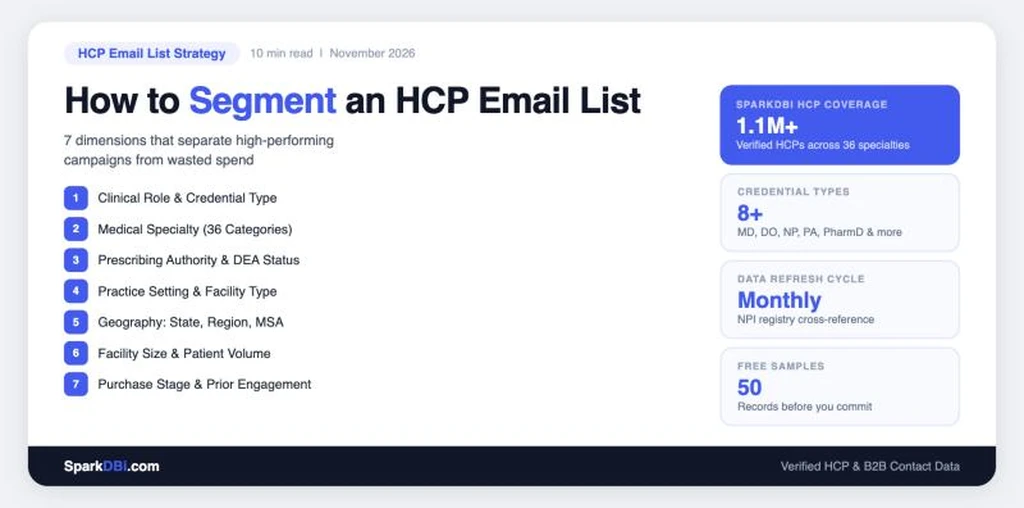
This guide covers the seven segmentation dimensions that matter for pharma, medical device, and health technology campaigns in 2026, with specific guidance on how to structure each layer and what SparkDBi’s dataset provides at every level.
Table of Contents
- Why Segmentation Is the Difference Between Response and Spam
- Dimension 1: Clinical Role and Credential Type
- Dimension 2: Medical Specialty
- Dimension 3: Prescribing Authority and DEA Registration
- Dimension 4: Practice Setting and Facility Type
- Dimension 5: Geography: State, Region, MSA
- Dimension 6: Facility Size and Patient Volume
- Dimension 7: Purchase Stage and Prior Engagement
- How SparkDBi Structures HCP Data for Segmented Campaigns
- Frequently Asked Questions
- Key Takeaways
Why Segmentation Is the Difference Between Response and Spam
Healthcare professionals receive a high volume of unsolicited outreach. Physicians in high-prescribing specialties are among the most heavily targeted professionals in any industry. That means your email is competing with outreach from pharmaceutical sales reps, device manufacturers, continuing education providers, software vendors, and staffing recruiters, all in the same inbox.
The campaigns that break through have one thing in common: relevance. A cardiologist running a private outpatient practice cares about different products, different clinical problems, and different ROI metrics than a hospitalist working a shift at a 400-bed health system. Sending the same message to both is not just inefficient; it signals that you don’t understand either of them.
Segmentation also protects your sender reputation. High-volume campaigns to unsegmented HCP lists generate complaint rates that damage deliverability across your entire sending domain. A well-segmented 15,000-contact campaign outperforms a flat 100,000-contact blast on every metric that matters: open rate, reply rate, conversion, and long-term domain health.
SparkDBi Data Point: SparkDBi’s HCP dataset covers more than 1.1 million verified healthcare professionals across 36 specialty categories, all filterable at the segment level before any list is delivered. The structure is built for segmented pulls, not bulk exports.
Dimension 1: Clinical Role and Credential Type
The most important segmentation cut is by clinical role. The HCP category includes dramatically different professionals: physicians, nurse practitioners, physician assistants, registered nurses, pharmacists, dentists, optometrists, chiropractors, and more. Each has different prescribing rights, different purchasing influence, different communication preferences, and different regulatory constraints on who can contact them and how.
How should I segment physicians from nurse practitioners and PAs?
Segment them from the start, not after the list is built. Physicians (MDs and DOs) in a given specialty are reached for brand-level clinical messaging. Nurse practitioners and physician assistants in the same specialty are often better targets for practice-efficiency messaging, formulary adoption, and device training. The clinical message resonates differently depending on who holds the ultimate prescribing authority in the practice.
Credentials to filter by in a quality HCP dataset:
- MD, DO (allopathic and osteopathic physicians)
- NP, APRN, FNP-C, PMHNP-BC (nurse practitioners by specialty credential)
- PA, PA-C (physician assistants)
- PharmD, RPh (pharmacists)
- DDS, DMD (dentists)
- OD (optometrists)
- RN, BSN, MSN (registered nurses, relevant for health system and device campaigns)
- DC (chiropractors)
SparkDBi structures its database by NPI-verified credential type, allowing targeted pulls by any credential category, with counts available before you commit to a list purchase.
Dimension 2: Medical Specialty
Specialty segmentation is where most HCP campaigns see the biggest lift. A dermatologist, a psychiatrist, and an oncologist all hold MD credentials, but their product focus, prescribing behavior, and clinical concerns have almost no overlap.
What specialties should I segment my HCP email list by?
Segment by the specialty that aligns with your product’s clinical indication or your software’s primary use case. For pharma campaigns, start with the specialty breakdown of your existing prescriber data. For device campaigns, start with the procedural specialties that perform the relevant procedure. For health tech, start with the specialties that have the highest administrative burden your product addresses.
SparkDBi covers 36 specialty categories with verified contact records. The highest-volume categories relevant to commercial healthcare campaigns include:
- Family Medicine and Primary Care
- Internal Medicine
- Cardiology
- Psychiatry and Behavioral Health
- Orthopedic Surgery
- Oncology and Hematology
- Neurology
- Gastroenterology
- Dermatology
- Pulmonology and Critical Care
- OB/GYN
- Urology
- Nephrology
- Rheumatology
- Endocrinology
For detailed counts and coverage per specialty, see SparkDBi’s full healthcare email lists hub, which breaks down availability for each specialty category with verified record counts.
Sub-specialty segmentation matters for high-value campaigns. A cardiology campaign that lumps interventional cardiologists with general cardiologists and electrophysiologists will produce mediocre results. If your product is catheter-based, your audience is interventional. If it’s a rhythm management device, your audience is electrophysiology. SparkDBi can filter by sub-specialty classification where NPI taxonomy data supports it.
Dimension 3: Prescribing Authority and DEA Registration
Not every HCP on a healthcare professional email list can prescribe medication. For pharmaceutical campaigns specifically, this is a hard requirement: you should only be marketing prescription products to professionals who can legally prescribe them in their state.
How do I filter a healthcare list by prescribing authority?
Prescribing authority is determined by credential type, state licensure, and DEA registration. Physicians have prescribing authority in all states. Nurse practitioners have full prescribing authority in 27 states and reduced authority in the remainder, with legislation expanding scope regularly. Physician assistants prescribe under varying levels of physician supervision depending on state law.
DEA registration is a separate layer: it indicates the HCP is authorized to prescribe Schedule II-V controlled substances. For campaigns promoting medications with controlled substance risk management programs, DEA filtering is not optional.
SparkDBi’s dataset includes DEA eligibility indicators and scope-of-practice status at the state level, allowing pharmaceutical companies to build campaigns that reach only verified prescribers. For more context on this, SparkDBi’s guide on nurse practitioner email lists covers prescribing authority filters in depth for the NP segment specifically.
Dimension 4: Practice Setting and Facility Type
Where an HCP practices shapes their decision-making authority and their receptivity to different types of outreach. A physician in private practice controls their own formulary and purchasing decisions. A physician employed by a large health system may have limited formulary flexibility but significant influence over procurement within their department.
What practice setting filters matter most for HCP email campaigns?
The most commercially significant practice settings to filter by:
- Independent private practice: High formulary flexibility, direct purchasing authority for devices and software. Ideal for conversion-focused campaigns.
- Hospital-employed: Longer sales cycles, committee-driven purchasing, but higher volume when converted. Better for awareness and clinical education campaigns.
- Academic medical center: Key influencer segment for pharmaceutical companies. HCPs at academic centers often drive formulary adoption nationally through publications and speaking roles.
- Retail clinic (urgent care, MinuteClinic): High patient volume, high throughput, different prescribing patterns from traditional office-based practice.
- Telehealth-only practice: Growing segment with specific platform needs and different regulatory constraints on prescribing.
- Ambulatory surgery center (ASC): Key segment for medical device companies. Device purchasing decisions at ASCs are often made by a small group of physician-owners.
SparkDBi includes practice setting classification at the contact level, allowing healthcare marketers to build facility-type-specific campaign segments without manual list cleaning.
Dimension 5: Geography: State, Region, MSA
Geographic segmentation serves two purposes for HCP campaigns: regulatory compliance and strategic targeting.
On the compliance side, state laws governing HCP outreach, pharmaceutical marketing, and data use vary. Some campaigns need to exclude specific states based on legal requirements or existing contract territory agreements. Geographic filtering at the state level is a minimum requirement for compliant list deployment.
On the strategy side, healthcare markets are highly local. Payer mix, formulary coverage, competition, and clinical practice patterns differ significantly between a dense urban market and a rural underserved region. Device companies targeting outpatient surgery should weight their campaigns toward MSAs with high ASC concentration. Pharma companies launching in a managed care market need to know which states have the highest commercial insurance penetration for their indication.
SparkDBi allows filtering by state, region, ZIP code, and metro area (MSA). For field sales alignment, geographic segmentation by sales territory is available as a custom filter overlay.
Dimension 6: Facility Size and Patient Volume
Facility size correlates directly with purchasing authority and campaign message type. A single-physician practice making a $2,000 software purchase decision moves fast. A health system procurement process for the same product involves an RFP, a committee, and a 6-9 month cycle.
Patient volume segmentation matters for pharmaceutical campaigns that use decile analysis. The top 20% of prescribers in any given specialty typically account for 60-70% of category prescriptions. High-prescribing HCPs warrant different outreach intensity, different messaging, and different follow-up cadence than low-prescribing contacts in the same specialty.
SparkDBi includes facility size indicators (bed count for inpatient facilities, provider group size for practice groups) and can support prescriber-tier segmentation for pharmaceutical clients who bring their own Rx data as a matching layer.
Dimension 7: Purchase Stage and Prior Engagement
The most sophisticated HCP campaigns layer behavioral segmentation on top of demographic segmentation. An HCP who has already attended a webinar on your product, downloaded a clinical white paper, or engaged with a prior campaign email is in a fundamentally different purchase stage than a cold contact who has never heard of your company.
How do I segment HCP lists by engagement and purchase stage?
Use your CRM and marketing automation data to tag contacts by engagement tier before every campaign. Contacts who have engaged previously should receive conversion-stage messaging (clinical outcomes data, trial offers, rep contact requests). Cold contacts should receive awareness-stage messaging (category education, clinical problem framing, credibility content).
When you acquire a new HCP list from SparkDBi or any data provider, the entire purchased list starts at the awareness stage. Run suppression to remove any contacts already in your CRM as known engaged or converted leads, then onboard the net new segment into an appropriate nurture track rather than a direct conversion email.
How SparkDBi Structures HCP Data for Segmented Campaigns
SparkDBi’s HCP dataset is built for segment-first delivery. Rather than generating a single bulk export and asking clients to clean and segment it themselves, SparkDBi structures its database so that segment filters are applied at the data request stage.
What that means in practice: when you request a campaign list, you define your target segment (specialty + credential + geography + practice setting + prescribing authority + facility type) upfront. SparkDBi returns a count of verified contacts matching those criteria before any list is generated. You can refine the segment until you have the right audience size, then confirm the list delivery.
All contacts are NPI-verified, with records cross-referenced against the CMS NPI registry on a monthly refresh cycle. Email deliverability is validated against active inboxes, not just syntax checks. The dataset covers 1.1 million verified HCPs across 36 specialty categories, with all segmentation dimensions described in this guide available as filters.
For teams running multi-specialty campaigns or building an ongoing HCP targeting strategy, SparkDBi offers data licensing arrangements that give ongoing access to the full segmented dataset with quarterly refreshes. For single-campaign use, targeted list pulls are available with full segmentation filtering.
Request 50 free sample records from your target specialty and geography before committing to a full list purchase.
Frequently Asked Questions
How granular should my HCP email list segmentation be?
Segment as granularly as your message requires. For a pharma campaign with a single-indication product, specialty plus prescribing authority is often enough. For a device campaign targeting a specific procedure type, you need specialty, sub-specialty, and practice setting. The rule is: if two contacts would receive different messages from you in a sales conversation, they belong in different segments.
Can I buy a pre-segmented HCP list or do I have to segment it myself?
Quality data providers apply segmentation filters at the time of list generation. SparkDBi builds segment criteria into the data request process, delivering a pre-filtered list rather than a bulk file you clean yourself. Avoid providers that deliver flat exports and ask you to filter them in a spreadsheet, as this introduces cleanup errors and misclassifications that hurt campaign performance.
What is the minimum viable segment size for an HCP email campaign?
There is no universal minimum, but most healthcare marketers find that segments below 500 contacts are better served by direct sales outreach than email campaigns. Email campaigns start to generate statistically meaningful performance data at around 1,000 contacts. For high-value specialties like interventional cardiology or transplant surgery, segments of 300-800 contacts are common and appropriate given the audience size.
How often does HCP segmentation data go stale?
HCP data decays faster than general B2B data. Healthcare professionals change practices, change specialties, retire, relocate, and change email addresses at higher rates than most professional categories. Industry benchmarks suggest 20-25% annual decay in raw HCP contact lists. A list that isn’t refreshed against an authoritative source like the CMS NPI registry at least annually will have significant accuracy problems. SparkDBi refreshes its dataset monthly against NPI registry data.
Should I segment by telehealth vs. in-person practice for HCP campaigns?
Yes, particularly for technology and platform vendors. Telehealth-only practitioners have specific needs around digital intake, e-prescribing, and remote patient monitoring that differ from in-person practices. For pharmaceutical campaigns, telehealth prescribing has specific regulatory constraints in some states. Filtering by practice modality ensures your messaging addresses the right operational context.
How does specialty segmentation work for campaigns targeting nurse practitioners?
Nurse practitioner specialty segmentation works the same way as physician specialty segmentation, with the additional layer of scope-of-practice filtering by state. An FNP in California with full practice authority is a different campaign target than an FNP in a restricted-practice state who requires physician oversight. SparkDBi’s NP dataset includes specialty classification and scope-of-practice status, as covered in detail in the nurse practitioner email list guide.
What data fields does SparkDBi include for HCP segmentation?
SparkDBi’s HCP records include: full name, credential type (MD/DO/NP/PA/PharmD/etc.), NPI number, verified professional email, primary specialty, sub-specialty where available, state of licensure, practice address, practice type, facility type, facility size, DEA eligibility, prescribing authority status (by state for APRNs and PAs), and phone number where available.
Key Takeaways
- Segment HCP lists by at minimum three criteria: credential type, specialty, and prescribing authority. Add practice setting, geography, and facility type for precision.
- Credential segmentation (MD vs. NP vs. PA vs. RN) determines message type, not just list size. Each role has different purchasing influence and clinical concerns.
- Specialty segmentation produces the highest lift in campaign performance. A dermatology campaign and an oncology campaign have no audience overlap despite both reaching physicians.
- DEA registration filtering is non-negotiable for controlled substance pharmaceutical campaigns.
- HCP data decays at 20-25% annually. Use a dataset refreshed against the CMS NPI registry to avoid bounce rate problems.
- SparkDBi covers 1.1 million verified HCPs across 36 specialty categories with all segmentation dimensions available as filters at the data request stage.