 SparkDBi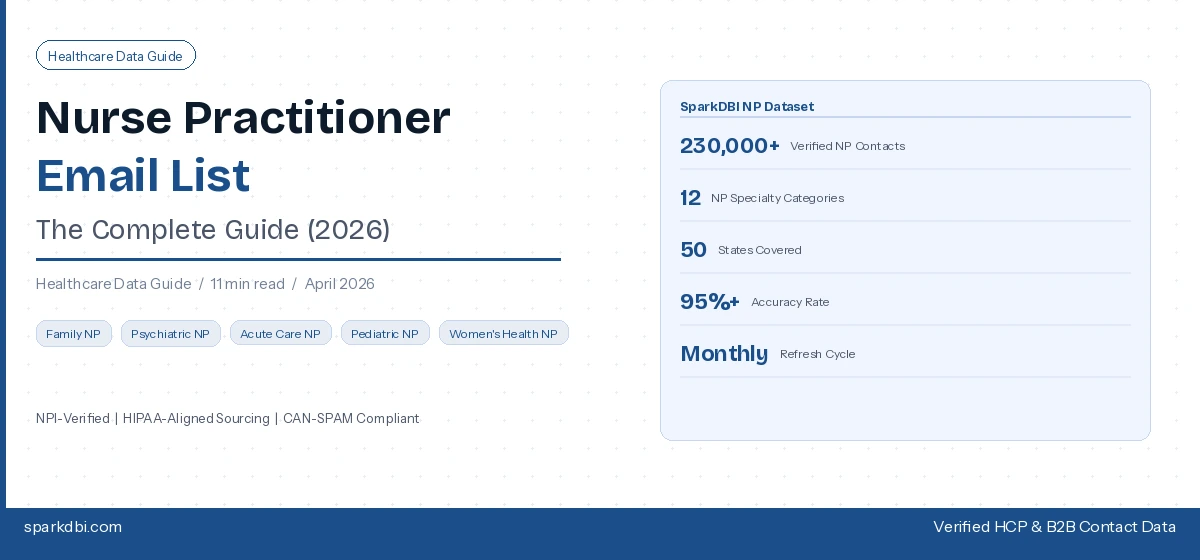
Mixed (Educational + Commercial) | 11 min read
There are more than 385,000 licensed Nurse Practitioners in the United States. In 27 states, they have full practice authority, meaning they diagnose, treat, and prescribe without physician oversight. For pharma, medical device, and healthcare technology companies, a verified nurse practitioner email list is no longer a supplementary tactic. It’s a primary targeting channel.
But most NP email lists on the market are built wrong. They’re pulled from outdated directories, carry no NPI verification, and include specialty classifications that haven’t been updated in 18 months. The result: bounce rates above 10%, campaigns that miss the prescriber segment entirely, and wasted spend on a high-value audience you could have reached correctly.
This guide covers what a properly built nurse practitioner email list contains, how to segment it by specialty and scope of practice, what compliance requirements apply to NP outreach, and how SparkDBi structures its NP dataset for healthcare marketers running pharma, device, and health tech campaigns.
Direct answer: A nurse practitioner email list is a verified database of professional contact information for licensed NPs and APRNs, including work email addresses, NPI numbers, medical specialty, state of licensure, and practice setting. SparkDBi maintains 926,426 verified NP contacts across all 50 states, filterable by specialty, scope of practice, facility type, and prescribing authority, refreshed monthly against the CMS NPI registry.
Table of Contents
- Why Nurse Practitioners Are a Tier-1 Prescriber Audience in 2026
- What a High-Quality Nurse Practitioner Email List Should Contain
- Segmentation by Specialty, Scope, and Setting
- Compliance for NP Email Outreach: HIPAA, CAN-SPAM, and State Rules
- Data Quality: Why Most NP Lists Fail Before You Hit Send
- Use Cases, What Healthcare Marketers Use NP Lists For
- How SparkDBi Builds Its Nurse Practitioner Dataset
- Frequently Asked Questions
- Key Takeaways
Why Nurse Practitioners Are a Tier-1 Prescriber Audience in 2026
The NP workforce has grown by over 40% in the past five years. That growth isn’t slowing. The Health Resources and Services Administration projects NP numbers will exceed 440,000 by 2030 as healthcare systems continue shifting care delivery toward advanced practice providers to address physician shortages in primary care and underserved markets.
What makes this commercially significant isn’t just headcount; it’s authority. NPs now hold independent prescribing rights in more than half of US states, with the remaining states expanding scope legislation faster than any previous cycle. In primary care, mental health, women’s health, urgent care, and pediatrics, NPs are often the treating clinician, not a referral step, not a second opinion. The prescribing decision sits with them.
For pharmaceutical companies, this means NP-focused outreach isn’t an add-on to your physician strategy. For diabetes therapies, antidepressants, hypertension medications, contraceptives, and vaccines, Nurse Practitioners write a meaningful share of prescriptions in their respective categories. Campaigns that exclude them are leaving a structural coverage gap.
For medical device companies targeting outpatient procedures and wound care, NPs often make the purchase recommendation. For healthcare SaaS companies selling EHR integrations or telehealth platforms, they’re frequently the departmental champion.
The question isn’t whether to include NPs in your targeting. It’s how to reach the right NPs, the right specialty, the right scope of practice, the right geography, with accurate contact data that won’t bounce.
SparkDBi Data Point
SparkDBi’s NP database includes 926,426 verified Nurse Practitioners and APRNs across all 50 US states, spanning 15 distinct NP specialty categories. Records include NPI numbers, specialty classifications, DEA eligibility indicators, practice setting, and prescribing authority status, refreshed monthly against the CMS NPI registry. Family NPs alone account for 139,130 of those contacts, the largest single NP specialty segment in the database.
What a High-Quality Nurse Practitioner Email List Should Contain
Most data providers sell NP lists as a name-and-email flat file. That’s the wrong starting point. A nurse practitioner email list that performs for healthcare marketing needs to be structured for segmentation from the start, because an FNP in primary care, a PMHNP running a psychiatric practice, and an ACNP in a hospital ICU have nothing in common except their advanced degree.
Here’s what separates a functional NP dataset from a bulk contact dump:
Core identification fields
- Full name and professional credentials (NP, APRN, FNP-C, PMHNP-BC, etc.)
- NPI number, the only reliable professional identifier for US practitioners
- Verified professional email address, active inbox validated, not syntax-checked
- Primary specialty classification
- State of licensure
- Practice address, city, state, ZIP
Advanced segmentation fields
- Practice type, independent, hospital-owned, group practice, retail clinic, telehealth
- Scope of practice, full practice authority, reduced practice, restricted practice
- DEA registration eligibility, critical for controlled substance prescribing campaigns
- Facility affiliation, hospital system, health network, community health center
- Years in practice
- Telehealth participation indicator
Without these fields, you’re sending the same message to a neonatal NP and a psychiatric NP and wondering why engagement is flat. Segmentation fields are what turn a contact list into a targeting tool.
SparkDBi’s NP healthcare data by specialty includes all core identification and advanced segmentation fields as standard, not as paid add-ons.
Segmentation by Specialty, Scope, and Setting
Nurse Practitioners are not a monolithic audience. The NP credential covers 12 distinct specialty populations, each with different clinical responsibilities, formulary influence, prescribing habits, and messaging needs. Treating them as one segment is the most common and most costly mistake in NP-focused marketing.
Segmentation by specialty
The major NP specialty categories and their commercial relevance:
| NP Specialty | Primary Clinical Focus | Relevant Campaigns |
|---|---|---|
| Family NP (FNP) | Primary care across lifespan | Chronic disease, vaccines, hypertension, diabetes |
| Psychiatric-Mental Health NP (PMHNP) | Mental health diagnosis and treatment | Antidepressants, antipsychotics, ADHD medications |
| Acute Care NP (ACNP) | Hospital and critical care settings | IV medications, device adoption, critical care protocols |
| Pediatric NP (PNP) | Pediatric primary and specialty care | Vaccines, pediatric devices, growth hormone therapies |
| Women’s Health NP (WHNP) | OB/GYN, reproductive, menopause | Contraceptives, HRT, fertility, prenatal vitamins |
| Adult-Gerontology NP (AGNP) | Adult and geriatric primary/acute care | Cardiovascular, Alzheimer’s, osteoporosis, pain management |
| Neonatal NP (NNP) | NICU and neonatal care | Neonatal devices, nutrition, respiratory therapies |
| Oncology NP | Cancer care and supportive oncology | Chemotherapy support, biosimilars, symptom management |
Segmentation by scope of practice
Scope of practice determines whether an NP can prescribe, refer, and practice independently, or whether a physician must co-sign orders. This is not a minor compliance consideration. It directly affects which NPs have autonomous prescribing authority and therefore which ones are the right target for a prescriber-focused campaign.
According to the US Department of Health and Human Services, 27 states plus DC now grant NPs full practice authority with no required physician collaboration. An additional 16 states allow reduced practice. The remaining states still require direct physician oversight for prescribing.
A campaign for a controlled substance, a Schedule II ADHD medication, for example, needs to target NPs with DEA registration, in states with full or reduced practice authority. Sending that campaign to all 385,000 NPs nationally is not just inefficient. It actively hurts deliverability by sending to practitioners who cannot prescribe the product.
Segmentation by practice setting
Practice setting affects purchasing authority, formulary influence, and messaging tone. An NP in an independent practice makes different decisions than one employed by a large health system. Key segments:
- Independent practices: highest formulary autonomy, direct purchasing decisions
- Hospital-owned outpatient centers: formulary committees matter, value message resonates
- Community health centers (FQHCs): formulary driven by cost and access, not brand preference
- Retail clinics: high patient volume, protocol-driven prescribing
- Telehealth networks: digital-first communication, high email engagement rates
Mid-article CTA: SparkDBi’s NP data is filterable by specialty, scope of practice, DEA eligibility, facility type, and geography. See SparkDBi’s NP data by specialty or request 50 free verified NP contacts for your target segment.
Compliance for NP Email Outreach: HIPAA, CAN-SPAM, and State Rules
The compliance question healthcare marketers ask most about NP outreach is whether HIPAA restricts it. The short answer is no, but the longer answer matters for how you source your data.
HIPAA and NP email marketing
HIPAA governs protected health information, patient-level clinical data. It does not regulate commercial outreach to licensed healthcare professionals in their professional capacity. Emailing a Family Nurse Practitioner about a diabetes medication is not a HIPAA-regulated activity, provided your NP data was sourced through professional channels rather than clinical records.
Where HIPAA exposure enters the picture is your data source. An NP contact list built from clinical system exports, hospital EHR data, or patient-linked prescribing records creates compliance risk regardless of your campaign content. The data provider’s sourcing methodology determines your exposure, not what you put in the subject line.
SparkDBi sources all NP data from HIPAA-aligned professional channels: the CMS NPI registry, state nursing licensing boards, professional nursing associations, CME registration data, and licensed data partner agreements. No clinical records. No patient data touchpoints at any stage of the sourcing chain.
CAN-SPAM requirements for NP outreach
CAN-SPAM applies to all commercial emails sent to US recipients, including Nurse Practitioners. It does not require prior consent, but it requires structural compliance on every send:
- A physical mailing address in every email
- A clear, functioning unsubscribe mechanism
- An accurate subject line that reflects the email content
- Opt-out requests honored within 10 business days
- No deceptive sender identification
State-level considerations
For NPs in California, your campaigns may also need to consider CCPA if you’re collecting or processing NP data for analytics or retargeting. Virginia, Colorado, and Connecticut have enacted similar state privacy frameworks. These don’t prohibit NP outreach, but they add requirements around data use transparency and opt-out rights beyond CAN-SPAM’s baseline.
Data Quality: Why Most NP Lists Fail Before You Hit Send
NP contact data decays faster than general B2B data. The NP workforce is highly mobile, practitioners change employers, move between states as scope legislation shifts, transition from employed to independent practice, and add telehealth affiliations throughout their careers. Industry data consistently puts HCP contact data decay at 25-30% per year. For NPs specifically, the rate is higher in rapidly expanding specialties like psychiatric-mental health, where practitioner numbers and practice settings are changing quickly.
A list that was 95% accurate when you bought it 12 months ago is likely sitting at 65-70% accuracy today if it hasn’t been refreshed. At 65% accuracy, your campaign has a bounce rate problem before it launches. At a hard bounce rate above 5%, inbox providers start flagging your sending domain.
What to check before using any NP email list
- Verify NPI numbers against the CMS registry: the NPI registry is publicly accessible and free to query. Any NP record without an NPI number, or with an NPI that doesn’t match the listed specialty, is either wrong or outdated.
- Run active inbox validation: not syntax checking, which only confirms an address is formatted correctly. Active inbox validation confirms the mailbox is live and accepting mail. Tools like NeverBounce or ZeroBounce can run this independently.
- Check the refresh date: ask your provider when the NP records in your sample were last verified. Monthly refresh is the standard for quality HCP data providers. Anything beyond 90 days is degraded for active outbound use.
- Cross-reference specialty classifications: NP specialties are classified by NPI taxonomy code. A provider who can’t tell you which taxonomy codes their specialty classifications map to is not building their data from NPI registry records.
SparkDBi refreshes its NP dataset monthly. Every email address passes active inbox validation before inclusion. NPI numbers are cross-referenced against CMS registry records, and specialty classifications map directly to NPI taxonomy codes, which means you can verify them independently before you deploy a campaign.
Benchmark: A high-quality NP email list should deliver under 2% hard bounce rate on first send when recently verified. Between 2% and 5% indicates list degradation. Above 5% signals data quality problems that will compound with each campaign send and damage your sending domain reputation.
Use Cases: What Healthcare Marketers Use NP Lists For
The commercial applications for a verified nurse practitioner email list span pharma, device, health tech, and professional services. Here’s how high-performing teams use them:
Pharmaceutical product launches
For drugs prescribed in primary care, psychiatry, or women’s health, categories where NPs write a significant share of new prescriptions, an NP-targeted email sequence supports formulary awareness and first-prescription adoption. FNPs and PMHNPs are particularly high-value for launches in diabetes, mental health, and contraception.
Medical device awareness and adoption
ACNPs and hospital-based NPs often influence device evaluation decisions in inpatient settings. NPs in outpatient wound care, dermatology, and orthopedics make direct device purchasing recommendations. A device campaign without NP targeting is missing a decision-maker segment.
CME and clinical education programs
NPs are required to complete continuing education for license renewal. CME-related outreach to NPs consistently outperforms general promotional campaigns in engagement metrics. An educational email series positions your brand before the prescribing conversation begins.
Healthcare technology and SaaS adoption
EHR integrations, telehealth platforms, e-prescribing tools, and clinical decision support software all need champion-level adoption from frontline practitioners. NPs in independent and group practices are often the person evaluating and advocating for new clinical tech, not the health system IT department.
Recruitment and workforce outreach
Healthcare staffing firms, hospital systems, and group practices use NP email data for targeted recruitment campaigns. The ability to filter by specialty, geography, and years of experience makes NP lists efficient for sourcing candidates in high-demand specialties.
How SparkDBi Builds Its Nurse Practitioner Dataset
SparkDBi is a global B2B and healthcare contact data provider with 304M+ verified contacts across 200+ countries and 140+ licensed data partners. The NP dataset sits within SparkDBi’s broader HCP database, which covers 10.4M+ healthcare providers across 39+ medical specialties, all sourced through HIPAA-aligned channels with no PHI involvement.
Sourcing methodology
Every NP record in SparkDBi’s database originates from one or more of the following verified professional sources:
- CMS NPI Registry, the definitive source for US practitioner identity, specialty, and license status
- State Board of Nursing licensing records across all 50 states
- Professional nursing associations, including the American Association of Nurse Practitioners (AANP) and specialty-specific organizations
- CME program registration data from accredited nursing education programs
- Licensed data partner agreements with healthcare publisher networks
No clinical records. Nor hospital EHR exports. And no patient-linked data at any point.
Verification and refresh
SparkDBi applies a four-layer verification process to every NP record: multi-source aggregation, active inbox validation, AI-driven and human quality review, and bi-monthly database refresh. NP records specifically are refreshed monthly, more frequently than the broader B2B dataset, because NP contact data changes faster than most professional segments.
Data delivery and integration
SparkDBi delivers NP data in CRM-ready formats including CSV flat files and direct integrations with Salesforce, HubSpot, Veeva CRM, Zoho, and Pipedrive. NPI numbers are included as standard on all US practitioner records, enabling verification against the CMS registry before campaign deployment.
Current NP record counts, specialty coverage, and refresh status are visible in real time on the SparkDBi Healthcare Database Dashboard.
For pharma and medical device teams who need specialty-specific targeting across multiple NP categories, family, psychiatric, acute care, pediatric, women’s health, SparkDBi provides filtered NP datasets with custom geographic overlays and scope-of-practice segmentation for each campaign.
Get 50 Free Verified NP Contacts for Your Target Specialty
Frequently Asked Questions
What is a nurse practitioner email list?
A nurse practitioner email list is a verified database of professional contact information for licensed Nurse Practitioners and APRNs, including work email addresses, NPI numbers, specialty classifications, state of licensure, and practice details. High-quality NP email lists include advanced segmentation fields, scope of practice, facility type, DEA eligibility, that allow healthcare marketers to target specific NP populations rather than the full NP workforce. SparkDBi maintains 926,426 verified NP contacts across all 50 states, spanning 15 specialty categories including 139,130 Family NPs, refreshed monthly.
How accurate are nurse practitioner email lists?
NP email list accuracy varies significantly by provider and refresh frequency. Quality providers who use active inbox validation and monthly refresh cycles should deliver 90-95% accuracy on verified records. NP contact data decays at approximately 25-30% annually, meaning any list older than 90 days without re-verification is likely carrying meaningful inaccuracy. Ask every provider for their current verified accuracy rate, their refresh schedule, and whether they use active inbox validation or only syntax checking. SparkDBi maintains 95%+ accuracy across its NP dataset through monthly refresh cycles.
Is it legal to email nurse practitioners for pharmaceutical marketing?
Yes. Emailing licensed Nurse Practitioners for legitimate pharmaceutical or medical device marketing is legal under US federal law. HIPAA does not prohibit this outreach; it governs patient health information, not professional contact data. CAN-SPAM applies and requires a working unsubscribe mechanism, a physical sender address, an accurate subject line, and opt-out processing within 10 business days. Prior consent is not required under CAN-SPAM. Compliance risk primarily comes from using improperly sourced data, NP contact information derived from clinical records or patient databases rather than professional channels like the CMS NPI registry.
What NP specialties should I target for a pharmaceutical campaign?
Target NP specialties based on the therapeutic category your campaign covers. Family Nurse Practitioners (FNPs) are the largest NP segment and relevant for primary care categories including diabetes, hypertension, lipids, and vaccines. Psychiatric-Mental Health NPs (PMHNPs) are the right segment for antidepressants, antipsychotics, and ADHD medications. Women’s Health NPs (WHNPs) are key for contraceptives, HRT, and reproductive health. Acute Care NPs (ACNPs) matter for hospital-administered medications and devices. Pediatric NPs (PNPs) for pediatric-specific therapies. Specialty alignment between the campaign and the NP category is the single most important factor in NP campaign performance.
How often should a nurse practitioner email list be refreshed?
NP email lists should be refreshed monthly for active outbound programs, and at minimum every 90 days for any B2B healthcare campaign. NP contact data decays at approximately 25-30% annually, roughly 2-3% per month, due to practice relocations, employer changes, and specialty transitions. A list refreshed quarterly is likely carrying 6-9% inaccuracy by the time you deploy it. For controlled substance campaigns specifically, DEA eligibility and scope of practice data must be verified against current state licensing board records, not annual snapshots. SparkDBi refreshes its NP records monthly.
What is the difference between buying an NP email list and licensing NP data?
Buying an NP email list means a one-time purchase of a static file. The data is accurate at delivery and degrades immediately, with no mechanism for updates, refresh, or ongoing accuracy maintenance. Licensing NP data means entering an ongoing agreement with a provider who refreshes the underlying dataset on a defined schedule and provides updated records throughout the contract term. For pharma and device companies running quarterly or annual campaign cycles against the same NP audience, licensing is more cost-effective than repurchasing static lists and provides documentation of sourcing methodology for compliance review. SparkDBi’s data licensing model covers NP and HCP data under monthly refresh agreements with full sourcing documentation.
Key Takeaways
- There are 385,000+ licensed Nurse Practitioners in the US, with 27 states granting full practice authority. NPs are a Tier-1 prescriber audience for pharma, device, and health tech campaigns, not a supplementary segment.
- A high-quality NP email list includes NPI numbers, specialty classification by NPI taxonomy code, scope of practice indicators, DEA eligibility, and practice setting, not just name and email.
- Segmentation by specialty is essential. FNPs, PMHNPs, ACNPs, PNPs, and WHNPs have different clinical responsibilities, prescribing patterns, and content needs. A single undifferentiated NP campaign performs poorly across all segments.
- HIPAA does not prohibit pharmaceutical or device outreach to NPs. CAN-SPAM applies and requires structural compliance on every send. Compliance risk comes from your data source, not your campaign content.
- NP contact data decays at 25-30% per year. Monthly refresh is the standard for quality HCP data providers. Any list older than 90 days without re-verification carries meaningful accuracy risk.
- SparkDBi maintains 926,426 verified NP contacts across all 50 states, filterable by specialty, scope of practice, DEA eligibility, and facility type, sourced exclusively from HIPAA-aligned professional channels and refreshed monthly.
Written by the SparkDBi Editorial Team
SparkDBi is a global B2B and healthcare contact data provider with 304M+ verified contacts across 200+ countries and 140+ licensed data partners. Our healthcare data team works directly with pharmaceutical, medical device, and health technology companies to deliver verified HCP contact data for compliant outreach campaigns. All practitioner statistics in this article reference current CMS NPI registry data and HRSA workforce projections as of Q1 2026. This article provides general guidance and does not constitute legal advice. Consult qualified legal counsel for your specific compliance situation.
See the complete guide to Family Nurse Practitioner email lists