 SparkDBi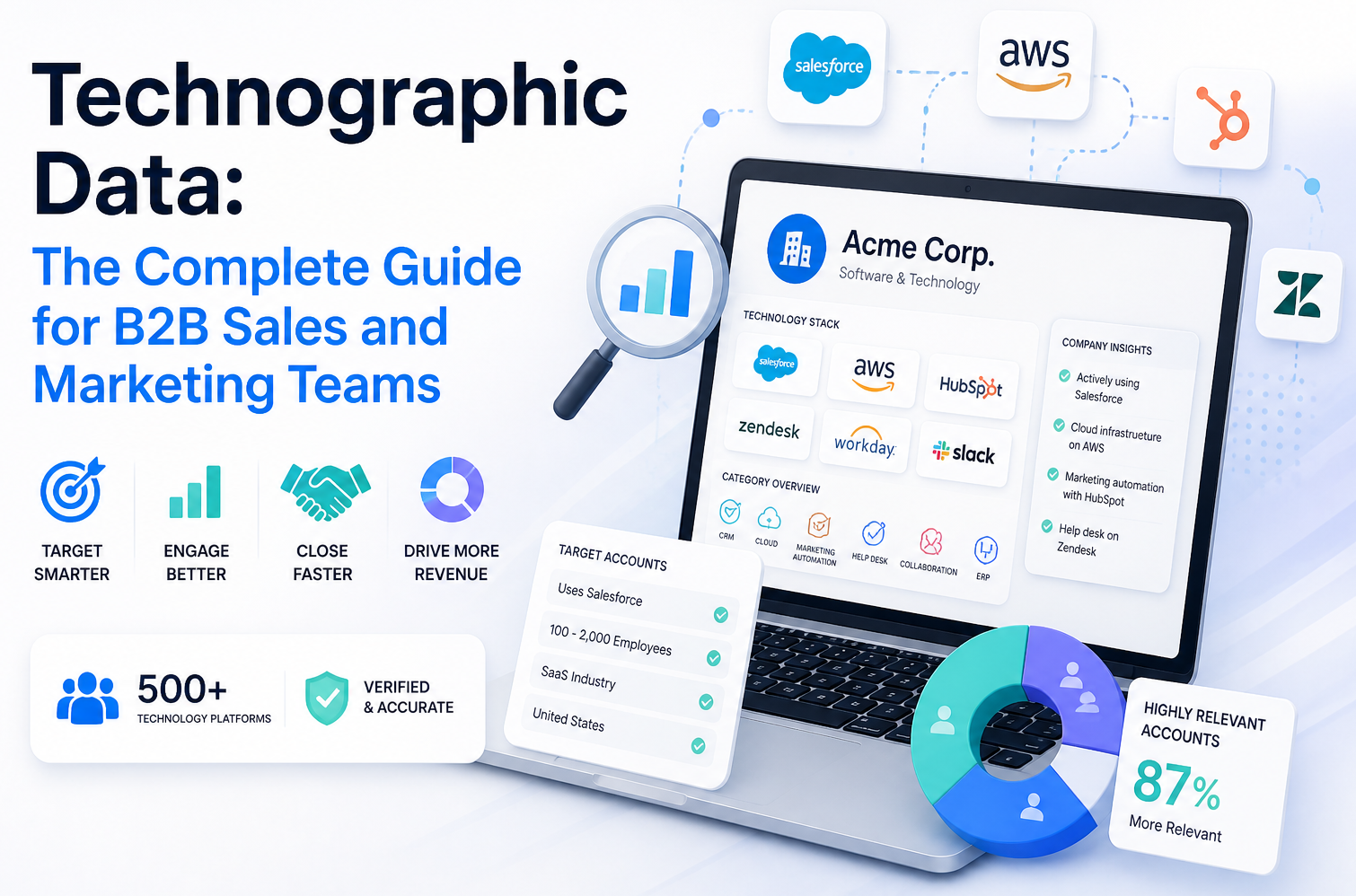
Technographic data is information about the technology stack a company uses – software platforms, cloud infrastructure, CRM and ERP systems, and hardware. B2B sales and marketing teams use technographic data to identify companies running competitor products, platforms that integrate with their own tool, or technology that signals a specific buying need. SparkDBi’s technology install base data covers 500+ platforms across 15+ categories with verified contact-level email lists delivered as CSV, no platform subscription required.
Most B2B outreach starts with the same filters. Industry. Company size. Job title. Geography. It’s the same ICP everyone else is running, and it produces the same overcrowded inboxes, the same generic messages, and the same declining reply rates.
Technographic data changes the approach. Instead of targeting who a company is, you target what technology they run. The difference sounds small. The impact on conversion rates is not.
What Is Technographic Data?
Technographic data is structured information about the technologies a company has installed and actively uses. Think of it as a company’s digital fingerprint. It tells you whether they run Salesforce or HubSpot as their CRM, whether their infrastructure sits on AWS or Azure, whether their e-commerce storefront runs on Shopify or Magento, and whether their ERP is SAP or Oracle.
This matters because technology choices reveal a lot. A company running Salesforce made a significant investment and has a specific ecosystem of integrations, workflows, and vendor relationships built around it. One running a legacy ERP from 2009 is almost certainly evaluating replacements. Meanwhile, a company that just adopted a new marketing automation platform is actively building out their stack and buying adjacent tools.
Every technology signal tells you something specific about the company’s current situation, their likely pain points, and what they’re probably buying in the next 6-12 months. That’s what makes technographic data valuable for B2B outreach. It replaces generic targeting with context.
Technographic Data vs Firmographic Data: The Key Difference
Firmographic data describes what a company is: industry, size, revenue, geography, structure. Technographic data describes what a company runs: its technology stack, software platforms, and infrastructure choices.
Both matter. Neither is enough on its own.
A firmographic filter of “B2B SaaS companies, 200-2,000 employees, US-based” produces a list of thousands of companies. Every one of them is a potential customer. None of them are differentiated. Add a technographic layer – “B2B SaaS companies, 200-2,000 employees, US-based, currently running Salesforce” – and you’ve identified companies that have already invested in CRM infrastructure, understand the value of sales tools, and represent a highly qualified audience for a complementary or replacement product.
Firmographics get you in the right market. Technographics get you in front of the right companies within that market. The combination is how sophisticated B2B teams build target account lists that actually convert.
Technographic Data vs Intent Data: Understanding the Difference
This question comes up constantly and the distinction matters for how you use each signal.
Intent data identifies companies actively researching a solution right now. It’s based on content consumption signals – employees reading review articles, visiting competitor websites, searching for specific product categories. Intent data tells you who is in buying mode today.
Technographic data identifies companies that already have a specific platform installed, regardless of whether they’re actively searching. It’s based on what a company currently runs, not what they’re researching this week. Technographic data tells you who is positioned to be a relevant prospect based on their current environment.
The most precise targeting combines both. A company running a legacy ERP that is also actively researching ERP modernisation is the highest-priority account you can find. For teams choosing between the two, technographic data produces larger addressable audiences and more stable targeting since technology stacks change on 2-5 year cycles, while intent signals can be weekly noise.
How Technographic Data Is Collected
Understanding how technographic data is sourced helps you evaluate provider quality. There are four main collection methods, each with different reliability:
Web signal detection. Providers scan company websites for technology fingerprints in HTML, JavaScript, and network requests. This identifies tools like Google Analytics, Salesforce tracking pixels, HubSpot forms, and Shopify infrastructure. Accurate for website-based technology but doesn’t capture internal software like ERP or backend infrastructure.
Job posting analysis. Companies hiring for specific technology skills reveal their stack indirectly. A job post requiring Salesforce experience confirms a Salesforce installation. Job signal analysis extends coverage beyond what’s detectable on public websites.
Vendor partnership data. Technology vendors share anonymised install base data with authorised partners. This produces the most accurate picture of enterprise software installations, particularly for platforms like SAP, Oracle, Workday, and ServiceNow that leave no public web footprint.
Multi-source licensed data aggregation. Enterprise technographic providers like SparkDBi aggregate data across 140+ licensed sources to build technology install records from multiple confirmation signals. According to Gartner’s data quality research, organisations that use multi-source data validation see significantly higher data accuracy rates than those relying on single-source providers. Multi-source confirmation is what separates reliable technographic data from single-signal guesswork. A platform confirmed by a single source is not added to the SparkDBi install base. Multi-source confirmation is the baseline requirement.
Three B2B Targeting Plays That Technographic Data Enables
Technographic data enables three distinct outbound strategies that firmographic targeting alone cannot support.
Competitive Displacement
Target companies running a competitor’s platform directly. Your prospect already understands the product category, has budgeted for this type of software, and is a confirmed buyer. The only question is whether they’re ready to switch. Your message can speak directly to the limitations of their current tool, your migration process, and the comparative cost – without needing to educate them on why they need the category at all.
For instance, an email list of companies using Salesforce gives a competing CRM vendor a ready-made audience of confirmed CRM buyers. Salesforce State of Sales research consistently shows that account-based outreach targeting companies by their existing tech stack outperforms generic firmographic campaigns by a significant margin. The same principle applies across every software category – from ERP to cybersecurity to marketing automation.
Integration Selling
Find companies already using platforms your product integrates with. A data enrichment tool that integrates with HubSpot can target companies using HubSpot specifically and lead with the integration angle: works natively with your existing HubSpot instance, no migration required. The pitch becomes compatibility rather than change management, which removes the biggest objection in B2B software sales.
As a result, technology install base data lets you build an email list of companies using HubSpot, SAP, Salesforce, or any of the 500+ platforms SparkDBi tracks, and pair it with verified decision-maker contacts filtered to the exact job titles you need. Browse the full range of technology users email lists from SparkDBi to check which platforms are available for your use case.
Technology Gap Targeting
Identify companies that have invested heavily in one part of their stack but are missing an adjacent layer you provide. A company running Salesforce CRM and HubSpot Marketing but no CPQ software is a strong prospect for a CPQ vendor. A company with modern cloud infrastructure but no endpoint security platform is a priority target for a cybersecurity vendor.
Technology gap targeting requires knowing not just what a company runs, but what’s missing relative to their size and vertical. In other words, this is where a comprehensive technology install base dataset becomes the foundation for a genuinely intelligent outbound motion.
Technographic Data Providers Compared: An Honest Breakdown
The market has several distinct tiers. Here’s what each actually delivers and what it costs.
Enterprise-Grade Providers
HG Insights is the depth leader for pure technographic intelligence. Coverage across 15 million companies with IT spend estimates and contract renewal signals alongside install data. Pricing runs $5,000-$20,000 per month. Delivery is through their platform and API. The limitation is cost – this is priced for large enterprise teams running full ABM programs, not for sales teams who need a list and want to get outbound moving this week.
ZoomInfo bundles technographics with their broader contact and intent data platform. Coverage is wide and CRM integrations are strong. Pricing is $10,000-$40,000 per year on custom contracts. The technographic depth isn’t as strong as specialist providers, and platform lock-in means your workflow depends on their interface and export limits.
6sense combines intent signals with technographic data in an ABM orchestration platform. Best for teams that want to run full account-based programs with predictive scoring. Enterprise-tier custom pricing. If you need raw technographic data delivered as a file you can work with directly, 6sense is not the right tool.
Mid-Market Options
BuiltWith specialises in website technology detection across 100,000+ technologies. Strong for CMS, analytics, advertising tech, and e-commerce platforms. Starts at $295 per month with CSV export. The gap: BuiltWith only captures what’s visible in the browser. It doesn’t detect internal ERP, HRMS, or backend infrastructure.
Datanyze operates as a Chrome extension with list-building capabilities from $29 per month. Useful for SMB prospecting where tech signals are web-visible. Not a fit for enterprise targeting or bulk list building.
Where SparkDBi Fits in the Market
SparkDBi sits in a category that none of the above fully occupy: technology install base data with verified contact-level email lists, delivered as a flat CSV file, with no platform subscription required.
Most technographic providers give you a list of companies. They confirm which organisations run Salesforce or SAP or Shopify. What they don’t give you is verified email addresses for the IT decision-makers, procurement managers, and department heads at those companies – because most technographic providers are data companies, not contact data companies.
Instead, SparkDBi combines both. The SparkDBi technology install base data cards cover 500+ platforms across 15+ categories including CRM, ERP, IT Security, E-Commerce, Cloud Hosting, Server Software, and Web Platforms. You select the platform, define your ICP filters, and SparkDBi builds a contact list where every email has been validated for active inbox and current employment.
Delivery is a CSV flat file. There is no platform login required. No monthly seat licence. No export limits built into a subscription you can’t cancel. You get the data, you own it, you run your campaign.
Request 50 free sample contacts for your target technology category.
Tell SparkDBi which platform you want to target and receive 50 verified contacts with active inbox validation before committing to a full order. Request your free samples here.
SparkDBi vs Enterprise Technographic Providers: Side-by-Side
| Provider | Tech Coverage | Contact Emails | Delivery | Pricing | Accuracy |
|---|---|---|---|---|---|
| SparkDBi | 500+ platforms, 15+ categories | Yes – inbox verified | CSV flat file | From $999, no subscription | 95% – 30-day refund |
| HG Insights | Deep enterprise IT stack | No | Platform + API | $5K-$20K/month | Not stated |
| ZoomInfo | Broad, bundled with contacts | Platform only | Platform + CRM sync | $10K-$40K/year | ~90% reported |
| 6sense | 30K technologies + intent | Within platform only | ABM platform | $20K+/year | Not stated |
| BuiltWith | Web tech only, 100K+ tools | No | UI + CSV | $295/month | None stated |
| Datanyze | Web tech, SMB focus | Limited | Chrome extension + lists | $29/month | None stated |
Technology Categories Available Through SparkDBi
SparkDBi’s technology install base data tracks 500+ platforms across 15+ categories. The most requested technology users email lists cover:
CRM Platforms: Email lists of companies using Salesforce, HubSpot, Microsoft Dynamics, Zoho CRM, and Pipedrive. Ideal for sales technology vendors, revenue operations tools, and data enrichment companies targeting CRM users.
Enterprise Applications (ERP): Companies running SAP, Oracle, NetSuite, Microsoft Dynamics 365, Infor, and Epicor. These signal significant IT budgets and complex vendor relationships. Ideal for systems integrators, implementation consultants, and complementary enterprise software vendors.
E-Commerce Platforms: Companies using Shopify, Magento, WooCommerce, and BigCommerce. Ideal for e-commerce services, logistics software, and retail analytics tools targeting platform-specific users.
IT Security: Companies using CrowdStrike, Palo Alto Networks, and Fortinet. Ideal for cybersecurity vendors, managed security providers, and compliance platforms.
Cloud Infrastructure: Companies on AWS, Azure, or Google Cloud. Ideal for cloud management, optimisation, and security tools.
IT Management: Companies using ServiceNow and Atlassian platforms. Ideal for ITSM vendors and development platform companies.
Check current company counts and request counts for your specific target in the live B2B data dashboard. Then build your full verified contact list through SparkDBi’s technology users email lists service.
How to Evaluate Any Technographic Data Provider
Before you spend money on technographic data, four questions will separate providers worth working with from those who won’t deliver.
Do they include verified contact emails, or just company data? First, most technographic providers stop at the company level. Knowing that Company X uses Salesforce doesn’t help you reach anyone there. Ask specifically whether verified, active-inbox-validated email contacts are included for the decision-makers you need to reach.
How is the technology signal confirmed? Second, single-source detection (web scraping only) produces lower accuracy than multi-source confirmation. Ask whether the provider cross-references technology signals across multiple data sources before adding a record to their database.
What is the refresh cadence? Third, technology stacks change. A CRM migration takes 3-6 months. A company that switched from Salesforce to HubSpot nine months ago should not appear on a Salesforce users list today. Ask specifically how frequently the install base data is updated and whether stale records are actively removed.
What is the accuracy guarantee and what does it actually cover? Finally, “High accuracy” is not a guarantee. A pro-rated refund on records that bounce or fail validation is a guarantee. Ask what percentage is guaranteed, what the measurement period is, and whether you receive a credit or an actual refund when records fail.
Key Takeaways
- Technographic data tells you what technology a company runs, not just who they are. It adds a dimension to firmographic targeting that turns generic outreach into context-specific conversations that convert at higher rates.
- The three most effective technographic plays are competitive displacement, integration selling, and technology gap targeting. Each needs a different message and a different list specification.
- Technographic data and intent data answer different questions. Intent data tells you who is buying now. Technographic data tells you who is positioned to be a relevant prospect based on their current environment. The best ABM programs use both.
- Most technographic providers give you company data only, not contact emails. SparkDBi combines technology install base data with verified decision-maker email contacts, delivered as a CSV without a platform subscription or annual contract.
- Refresh cadence matters as much as coverage. SparkDBi refreshes its technology install base data quarterly across all 500+ tracked platforms, minimising the risk of targeting companies that have already migrated away from your focus platform.
- Always request sample contacts before buying. Verify a portion of returned emails independently and confirm technology signals match your expectation. SparkDBi provides 50 free sample contacts for any technology category before you commit.
- Pricing ranges from $29/month for entry tools to $20,000+/month for enterprise platforms. SparkDBi’s per-order model gives teams verified technographic email contacts without a subscription, at a cost structure that works whether you need 500 records or 50,000.
Frequently Asked Questions
What is technographic data?
Technographic data is structured information about the technology a company uses, including software platforms, cloud infrastructure, CRM systems, ERP, IT security tools, and hardware. B2B sales and marketing teams use technographic data to build target account lists based on technology signals rather than firmographics alone, enabling competitive displacement, integration selling, and technology gap targeting strategies.
How does technographic data differ from intent data?
Technographic data identifies what technology a company currently has installed. Intent data identifies companies actively researching a product category right now. Technographic data is more stable and produces larger addressable audiences since technology stacks change on 2-5 year cycles. Intent data produces smaller, more urgent audiences but with higher signal volatility. The most effective B2B targeting combines both.
Can I get an email list of companies using a specific software like Salesforce or SAP?
Yes. SparkDBi builds technology users email lists filtered to any specific platform across 500+ tracked technologies. You can request an email list of companies using Salesforce, SAP, Oracle, HubSpot, Shopify, NetSuite, or any other tracked platform, with verified decision-maker contacts filtered to your target job titles and geography. Counts and 50 sample contacts are provided before a full order is confirmed.
How accurate is technographic data from SparkDBi?
SparkDBi backs its technology install base data with a 95% accuracy guarantee on contact email delivery. Technology signals are confirmed through multi-source validation across 140+ licensed data partners. Contact emails are validated for active inbox status and current employment before delivery. A 30-day pro-rated refund applies to any records that fail to meet the 95% accuracy standard.
What is the difference between a technographic email list and a standard B2B email list?
A standard B2B email list is filtered by firmographic attributes: industry, company size, geography, and job title. A technographic email list adds the company’s technology stack as a filter. You can target companies specifically because they use a particular CRM, ERP, or cloud platform. This produces smaller, higher-relevance lists that outperform generic firmographic lists in reply rates because your message speaks directly to the prospect’s current technology environment.
How often is SparkDBi’s technology install base data refreshed?
SparkDBi refreshes its technology install base data on a quarterly cycle across all 500+ tracked platforms. The technology signals underlying any list are no more than 90 days old at the point of delivery. Many technographic providers update data annually or on an unspecified rolling basis, meaning a significant percentage of their install data reflects technology decisions that may have changed months ago.
What technology categories does SparkDBi cover?
SparkDBi tracks 500+ platforms across 15+ technology categories including CRM Platforms, Enterprise Applications (ERP), E-Commerce, IT Security, Cloud Infrastructure, Server Software, Web Platforms, and IT Management tools. Browse the full list and current company counts in the SparkDBi technology install base data cards before placing an order.