
ZoomInfo vs Apollo vs SparkDBI: B2B Data Quality Compared (2026)
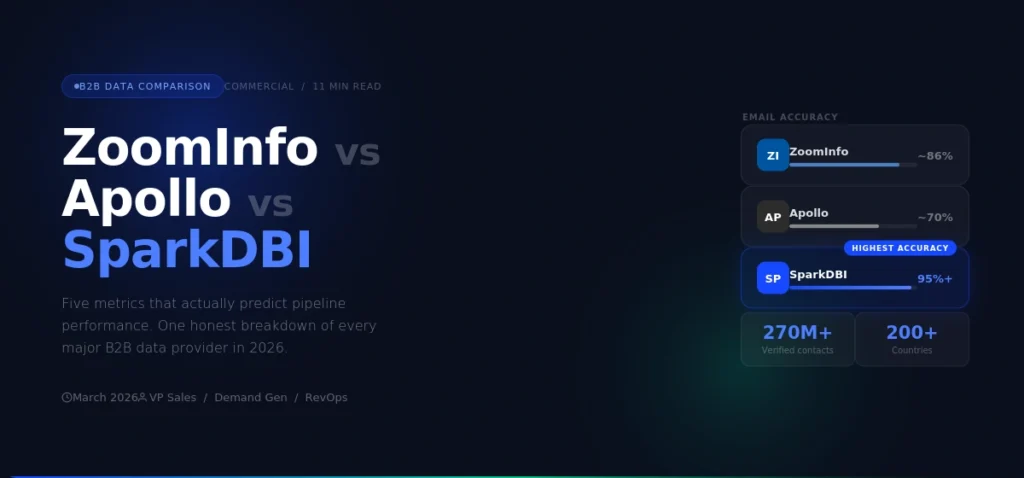
Making a b2b data provider comparison in 2026 means cutting through a lot of noise. ZoomInfo dominates the conversation. Apollo wins on price. But neither of those facts tells you which platform will actually deliver pipeline for your team.
Your B2B database is costing you revenue – and you probably don’t know exactly how much. The average sales team wastes 27% of their time on bad data (Gartner, 2025). That’s one day every week chasing contacts who’ve changed jobs, changed emails, or never existed at all.
ZoomInfo vs Apollo vs SparkDBI: How to Actually Compare B2B Data Providers in 2026
Blog Type: Commercial / Comparison | 11 min read | Last updated: March 2026
What’s the most accurate B2B data provider in 2026? The honest answer is: it depends on what you measure. ZoomInfo has the largest brand name. Apollo has the lowest entry price. SparkDBI delivers the highest verified accuracy rate with 270M+ contacts across 200+ countries, bi-monthly refresh cycles, and built-in GDPR-ready compliance. But the real mistake most buyers make isn’t choosing the wrong vendor – it’s comparing vendors on the wrong criteria entirely.
This guide walks you through the five metrics that actually predict whether a B2B database will drive pipeline, and scores each major provider against them. By the end, you’ll have a clear framework to evaluate any data provider – not just the three we cover here.
Table of Contents
- Why Most B2B Data Comparisons Get It Wrong
- The Five Metrics That Actually Matter
- ZoomInfo: What It Does Well and Where It Falls Short
- Apollo: The Budget Option With Real Trade-offs
- SparkDBI: Built for Accuracy, Global Scale, and Compliance
- Head-to-Head Comparison Table
- Which Provider Fits Which Use Case
- How to Run Your Own Data Quality Test Before Buying
- Frequently Asked Questions
Why Most B2B Data Comparisons Get It Wrong
Here’s a scenario that plays out constantly in revenue teams: a VP of Sales gets budget approved for a new data provider. The team evaluates options by looking at three things – database size, price, and which platforms they integrate with. They pick the vendor with the biggest claimed database and the most recognizable logo. Six months later, bounce rates are above 15%, sales reps are complaining about stale contacts, and the pipeline numbers don’t add up.
The problem wasn’t the vendor selection. The problem was the evaluation framework.
Database size claims are almost meaningless without knowing the verification methodology behind them. A database of 600 million contacts with 40% decay is less useful than one with 270 million contacts at 95%+ verified accuracy. You’re not paying for records – you’re paying for deliverable contacts that actually reach decision-makers.
The second mistake is comparing vendors on their strongest self-reported metrics. ZoomInfo will show you their contact volume. Apollo will show you their integrations. Neither will lead with their data refresh rates or bounce rate benchmarks unless you ask directly. Smart buyers ask for the metrics vendors don’t volunteer.
Before we compare specific platforms, it’s worth establishing what a B2B data provider actually needs to deliver to justify the investment. The SparkDBI global B2B contact database, for example, is built around five verifiable quality signals – and they’re the same five every serious data buyer should demand from any vendor.
The Five Metrics That Actually Matter When Evaluating B2B Data
These aren’t our criteria – they’re what the top-performing revenue teams we work with consistently use when running data evaluations. Ask any vendor you’re considering to answer each one specifically.
1. Verified Accuracy Rate
What percentage of records pass active inbox validation at the time of delivery? Not the percentage that were accurate when collected – the percentage that are accurate right now. Industry standard for “acceptable” is 85%. High-quality providers should be north of 93%. If a vendor can’t give you this number with methodology attached, that tells you something.
2. Data Refresh Frequency
B2B contact data decays at roughly 22-30% per year, according to Salesforce’s State of Sales research. That means a database that isn’t refreshed at least quarterly is losing accuracy faster than it’s being replenished. Monthly or bi-monthly refresh cycles are the benchmark to look for.
3. Source Diversity
Single-source databases are fragile. If a provider pulls primarily from LinkedIn scrapes or web crawls, their data is only as good as what’s publicly visible online – which excludes a huge portion of verified professional contact information. Look for providers with multiple sourcing layers: licensed partner data, proprietary collection, and public records cross-referenced and de-duplicated.
4. Geographic and Firmographic Depth
For teams doing global outreach or vertical-specific targeting, this is often the hidden dealbreaker. A database of 600 million contacts that is 80% North American is useless to a team expanding into APAC or EMEA. Similarly, a database without reliable NPI data or healthcare specialty filtering is the wrong tool for pharma and medical device marketing teams.
5. Compliance Architecture
This is not just a legal box to check. A provider whose data collection and consent processes aren’t GDPR, CAN-SPAM, and HIPAA-aligned exposes your marketing team to real liability. The 2023-2025 wave of enforcement actions in the EU – including significant fines for companies using non-compliant contact data in outreach – made this a board-level concern, not just a marketing ops concern.
With those five criteria established, let’s look at how the three most-discussed providers in the market stack up.
ZoomInfo – Dominant Market Position, But at What Cost?
ZoomInfo has been the default enterprise B2B data vendor for almost a decade. Its market position is real – so is its pricing, and so are its limitations.
What ZoomInfo Gets Right
The platform’s technology stack is genuinely strong. Their intent data integration, buying signal tracking, and native CRM workflows are built for large enterprise sales teams that want a single platform covering multiple go-to-market functions. If you’re a 200+ person sales org with a Salesforce instance and a dedicated RevOps team, ZoomInfo’s ecosystem is built for you.
Their North American contact coverage is extensive, particularly for mid-market to enterprise companies in technology, finance, and professional services. For teams running high-volume outbound in those segments specifically, the database depth is hard to match domestically.
Where ZoomInfo Falls Short
Price is the first conversation stopper. ZoomInfo’s enterprise contracts regularly come in at $20,000-$50,000+ per year, with credit-based consumption models that punish teams who need high-volume exports. Mid-market companies and growth-stage teams are essentially priced out or forced into a stripped-down tier that limits much of the functionality they actually need.
The second issue is international coverage. Teams with a global mandate consistently find ZoomInfo’s data quality drops significantly outside North America and Western Europe. APAC, LATAM, and MEA coverage is thinner, less verified, and slower to refresh. If global is part of your GTM, this is a meaningful constraint.
Third – and this is the one that surprises buyers who didn’t ask upfront – ZoomInfo’s data decay management has been a persistent complaint. Several revenue teams report bounce rates climbing into the 12-18% range on ZoomInfo-sourced lists within 90 days of export, particularly for SMB contacts in fast-moving industries.
ZoomInfo is a legitimate tool for the right use case. But at its price point and contract structure, it’s not a flexible option for most teams – and “most accurate” isn’t a title it can claim unconditionally.
Apollo – The Flexible Entry Point With Genuine Trade-offs
Apollo became a serious competitor in the B2B data space by doing what ZoomInfo wouldn’t: offering a freemium entry point and a credit-based model that let SMBs and sales teams try before committing. That approach drove rapid adoption, and Apollo now has a large and vocal user base.
What Apollo Gets Right
The pricing model is genuinely accessible. For small sales teams and early-stage companies that need verified contact data without a five-figure annual commitment, Apollo’s entry tiers are hard to beat. The platform’s UX is clean, the prospecting workflow is intuitive, and the Chrome extension makes it easy to pull contact data directly from LinkedIn profiles mid-research.
Apollo has also invested meaningfully in its sequence and outreach automation features, making it a hybrid prospecting and outreach tool for teams that don’t want to manage a separate sales engagement platform. For a lean team managing their own outbound, that consolidation has real value.
Where Apollo Falls Short
Data accuracy is Apollo’s most commonly cited limitation, and it shows up in the numbers. Multiple third-party audits and user-reported benchmarks on G2 put Apollo’s verified email accuracy in the 65-75% range on non-enterprise contacts – significantly below what high-performance outbound requires. At that accuracy level, you’re looking at bounce rates that will damage sender reputation over time if not carefully managed.
Healthcare and regulated industry data is a particular gap. Apollo’s database wasn’t built for HCP targeting, specialty filtering, or HIPAA-aligned use cases. If your ICP includes physicians, nurses, hospital administrators, or any healthcare professional segment, Apollo is the wrong starting point.
International data coverage has the same issues as ZoomInfo but more pronounced. The database skews heavily toward US tech and SaaS companies. EMEA and APAC data quality drops off sharply, and there’s limited support for compliance frameworks outside US-centric regulations.
Apollo works well as a starting tool for domestically focused, tech-sector outbound teams with modest budgets. Scale that mandate to global markets, regulated industries, or enterprise-tier accuracy requirements, and you’ll hit the ceiling quickly.
Not sure where your current data stacks up?
Request 50 free verified contacts matched to your exact ICP – no contract, no commitment. Compare the accuracy against your current provider before you decide anything.Request Your Free Sample →
SparkDBI – Built for Accuracy, Global Scale, and Compliance
SparkDBI is a global B2B and healthcare contact data provider with 270M+ verified contacts across 200+ countries. The platform serves sales, marketing, and demand generation teams that need verified decision-maker data at scale – with a compliance architecture built for regulated industries and cross-border outreach.
We’re including SparkDBI in this comparison with full transparency: this is SparkDBI’s own blog. What we can do is show you the specific, verifiable proof points that differentiate the platform – and let you test the data quality directly before making any decision.
Verified Accuracy at 95%+
SparkDBI’s email validation process combines AI-driven verification with human quality review before delivery. Every record passes active inbox validation – not just syntax checks or domain checks. The result is a verified accuracy rate above 95%, which translates directly to lower bounce rates and healthier sender reputation for outbound campaigns.
For context: the industry average for “acceptable” B2B email accuracy is 85%. The gap between 85% and 95% sounds small until you’re running a campaign at 10,000 contacts and the difference is 1,000 additional deliverable prospects per campaign.
Bi-Monthly Data Refresh
SparkDBI’s contact database is refreshed every two months using its network of 140+ licensed data partners, combined with proprietary collection and public records validation. This refresh cadence is one of the fastest in the market and directly addresses the 22-30% annual decay rate that erodes list quality between updates.
For demand gen teams whose CRM data is six to twelve months stale, SparkDBI’s data enrichment service also updates existing records in your CRM rather than just supplying new ones. The platform integrates directly with Salesforce, HubSpot, Zoho CRM, Pipedrive, and a range of other MarTech systems.
Healthcare HCP Data With Specialty Filtering
SparkDBI is one of the few B2B data providers with deep healthcare HCP coverage built natively into the platform. The database includes physician contacts filterable by NPI number, medical specialty, practice type, geographic region, and hospital affiliation – making it the right tool for pharma marketing, medical device sales, and healthcare services outreach.
This isn’t a tacked-on feature. SparkDBI’s healthcare data is sourced through HIPAA-aligned processes, cross-referenced against CMS NPI registry data, and updated monthly for accuracy in one of the fastest-changing professional contact environments.
Genuine Global Coverage
270M+ contacts across 200+ countries is a real number – not a headline padded with unverified imports. SparkDBI’s international data is sourced through regional licensed partners with local market expertise, which is why EMEA, APAC, and LATAM coverage holds up where US-centric databases thin out.
For teams with global GTM mandates, this is often the deciding factor. The alternative is managing separate regional data vendors with inconsistent quality standards and fragmented delivery formats.
GDPR-Ready Compliance Architecture
SparkDBI’s data sourcing, consent tracking, and delivery processes are built to align with GDPR, CAN-SPAM, and HIPAA requirements. The platform follows an ISO-certified quality process, and every dataset includes compliance documentation on sourcing methodology. For marketing and legal teams that have watched the EU enforcement landscape tighten since 2023, this isn’t optional – it’s table stakes.
Head-to-Head Comparison Table
Use this table as a quick reference. The goal isn’t to declare a winner for everyone – it’s to show where each platform genuinely leads and where each genuinely has gaps. You can also explore SparkDBI’s verified contact counts live on the SparkDBI B2B data dashboard.
| Criteria | ZoomInfo | Apollo | SparkDBI |
|---|---|---|---|
| Verified email accuracy | ~85-88% | ~65-75% | 95%+ |
| Data refresh frequency | Quarterly | Variable | Bi-monthly |
| Total contacts (global) | ~260M+ | ~200M+ | 270M+ |
| International coverage quality | Strong NA/WE only | US-heavy | 200+ countries |
| Healthcare / HCP data | Limited | Very limited | Full NPI + specialty |
| GDPR compliance architecture | Partial | Limited | GDPR-ready, ISO-certified |
| Pricing model | High / credit-based | Freemium / credits | Custom / flat-file |
| Intent data included | Yes | Partial | Yes (3 partners) |
| CRM integrations | Extensive | Extensive | Salesforce, HubSpot, Zoho, Pipedrive + more |
| Best suited for | Large enterprise NA | SMB / early-stage US | Global teams, healthcare, compliance-sensitive |
Competitor data sourced from publicly available product documentation, third-party review platforms (G2, Capterra), and user-reported benchmarks as of Q1 2026. Verify current features directly with each vendor.
Which B2B Data Provider Fits Which Use Case
There’s no single “best” provider across every use case. The right choice depends on your team’s specific combination of budget, geography, vertical, and compliance requirements.
Choose ZoomInfo if: You’re a large enterprise sales team running high-volume North American outbound in tech, finance, or professional services, with a dedicated RevOps function and a budget above $20k/year for data alone. The platform’s ecosystem depth is real – but it only pays off at scale.
Choose Apollo if: You’re an early-stage or SMB sales team primarily targeting US-based tech and SaaS companies, with a lean budget and a need to manage prospecting and sequencing in one tool. Expect to manage data quality carefully and supplement with verification tools if bounce rates climb.
Choose SparkDBI if: Your team operates across global markets, targets healthcare or regulated industries, needs verified accuracy above 90%, or is under GDPR and HIPAA compliance requirements. SparkDBI is also the right choice if you’re replacing an existing vendor delivering poor deliverability or stale contacts – the data enrichment service can update your current CRM rather than requiring a full replacement.
For teams that fall into none of these neat categories – global mandate, healthcare vertical, compliance requirements, and a mid-market budget – the right starting point is testing the data directly. SparkDBI offers 50 free verified contacts matched to your ICP before any commercial commitment.
How to Run Your Own B2B Data Quality Test Before Signing Anything
Any reputable data provider should let you test before you buy. Here’s a simple evaluation process you can run in under a week.
- Define your ICP sample criteria. Choose a specific segment: a job title, company size range, industry vertical, and geography that represents your actual target audience. Make it narrow enough to be meaningful – “Director of Marketing in SaaS companies with 50-500 employees in the UK” is a useful test segment. “B2B professionals in technology” is not.
- Request sample records from each vendor. Ask for 50-100 contacts matching your ICP criteria from each provider you’re evaluating. Most will provide this. Any vendor that won’t provide a sample before a contract is a red flag. You can request your free SparkDBI sample here.
- Run the samples through an email verification tool. Use a third-party tool – NeverBounce, ZeroBounce, or Kickbox work well – and validate all samples independently. Don’t rely on the vendor’s self-reported accuracy numbers. Look for the percentage of records that return as “valid” on active inbox verification.
- Compare firmographic completeness. Beyond email validity, check what additional fields are populated: direct dial, LinkedIn URL, company revenue, employee count, industry code. Missing fields matter if you’re building multi-channel sequences or scoring accounts for ABM.
- Ask specifically about refresh date. Ask each vendor when the records in your sample were last verified. If they can’t tell you, the data hygiene process isn’t granular enough to trust at scale.
This process will tell you more about actual data quality in 72 hours than any sales presentation. SparkDBI’s data can be verified the same way – run the free sample through your own validation tools and see the results for yourself.
Key Takeaways
B2B data quality isn’t a checkbox – it’s a revenue multiplier. The five metrics that separate high-performing databases from expensive liabilities are: verified accuracy rate, refresh frequency, source diversity, geographic depth, and compliance architecture.
ZoomInfo is the incumbent enterprise platform with deep North American coverage and a strong technology ecosystem – but its pricing and data decay rates are real limitations. Apollo opened the market to smaller teams but carries meaningful accuracy gaps that compound over time at scale. SparkDBI delivers the highest verified accuracy rate in this comparison, with genuine global coverage, full healthcare HCP data, and a compliance architecture built for regulated markets.
The best way to settle a vendor comparison is with data, not demos. Test the records against your ICP. Validate independently. The provider whose contacts actually reach your prospects’ inboxes is the right provider for your team.
Ready to compare SparkDBI’s data quality against your current provider?
Request 50 free verified B2B contacts matched to your exact ICP – job title, industry, company size, geography, whatever your targeting requires. No contract. No commitment. Just verified data you can test against your current stack.Get Your Free Sample →
Frequently Asked Questions
Is ZoomInfo worth it in 2026?
ZoomInfo is worth the investment for large enterprise sales teams focused primarily on North American markets in technology, finance, and professional services – provided they can absorb annual contract costs of $20,000 or more. For mid-market companies, international teams, or healthcare-focused organizations, the pricing model and geographic data gaps often make it a poor fit. The platform’s ecosystem is strong, but “worth it” depends entirely on whether your use case matches where ZoomInfo’s data is actually strongest.
What is the most accurate B2B database?
The most accurate B2B database is one that uses active inbox validation – not just syntax or domain checks – on every record before delivery, with a verified accuracy rate above 90% and a refresh cycle of 60 days or less. SparkDBI maintains a 95%+ verified accuracy rate using a combination of AI-driven validation and human quality review, with bi-monthly refresh cycles across its 270M+ contact database. That said, accuracy for your use case depends on your target geography and vertical – always test samples against your specific ICP before committing.
How do I choose a B2B data provider?
Choosing a B2B data provider comes down to five criteria: verified accuracy rate, data refresh frequency, source diversity, geographic and firmographic depth for your specific ICP, and compliance alignment with your regulatory requirements. Start by defining your ICP precisely, then request sample data from each vendor you’re evaluating. Run those samples through an independent email verification tool and compare the results. The provider whose data performs best on your actual target segment – not on generic benchmarks – is the right choice.
Is Apollo data accurate?
Apollo’s data accuracy varies significantly by segment. Third-party audits and user-reported benchmarks consistently place Apollo’s verified email accuracy in the 65-75% range on non-enterprise contacts, which is below the 85% industry threshold for acceptable B2B outreach quality. Apollo performs better on US tech and SaaS contacts than on international or SMB segments, and its healthcare data is extremely limited. For teams that need high-accuracy data for regulated industries or global markets, Apollo’s accuracy rate is a meaningful risk at scale.
What is the difference between data enrichment and buying a B2B email list?
Buying a B2B email list means acquiring new contacts that match your ICP – records your team doesn’t currently have. Data enrichment means updating and completing contact information for people already in your CRM – filling in missing fields, correcting outdated emails, appending direct dials, and adding firmographic data to incomplete records. Most revenue teams need both: enrichment to keep existing data accurate, and new contact acquisition to expand reach. SparkDBI’s data enrichment service and B2B contact database handle both use cases with the same verification standards.
How often should B2B contact data be refreshed?
B2B contact data should be refreshed at minimum every 90 days, and ideally every 30-60 days for high-volume outbound teams. Salesforce’s research indicates B2B data decays at 22-30% annually – meaning roughly 2% of your contact database becomes inaccurate every month through job changes, email address updates, and company restructuring. A data provider with a quarterly refresh cycle is, by definition, delivering data that may already be 3 months stale. Monthly or bi-monthly refresh rates are the current standard for high-performing B2B data.
Written by the SparkDBI Revenue Data Team Our contributors have 5+ years of hands-on experience in B2B demand generation, CRM operations, and go-to-market data strategy. SparkDBI works with 1,200+ sales, marketing, and revenue teams across global markets. All data claims in this article reflect SparkDBI’s verified dataset as of Q1 2026.
