
Family Nurse Practitioner Email List: Verified FNP Contacts for Pharma and HCP Marketing
Mixed (Educational + Commercial) | 9 min read | Last updated: April 2026
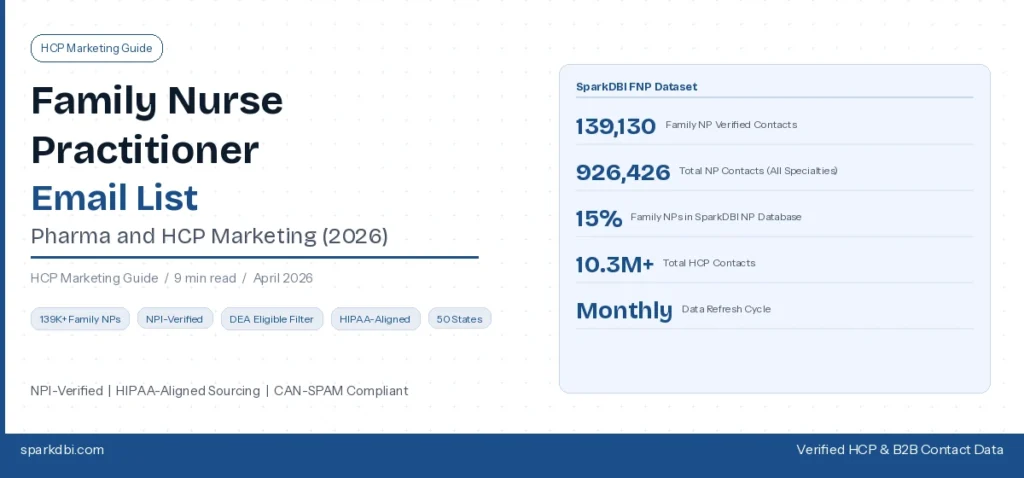
Family Nurse Practitioners are the single largest NP specialty in the United States — and the most commercially important for pharmaceutical companies, medical device manufacturers, and healthcare technology firms targeting primary care prescribers. SparkDBI’s healthcare database includes 139,130 verified Family NP contacts across all 50 states, making it the most precisely segmented FNP dataset available for HCP marketing campaigns.
But most FNP email lists sold in the market are built wrong. They aggregate all NP specialties into a single undifferentiated file — mixing Family NPs with psychiatric NPs, acute care NPs, and neonatal NPs who have nothing in common clinically. The result is campaigns sent to practitioners who cannot prescribe the relevant therapy, high bounce rates, and wasted spend on an audience you could have reached correctly with specialty-filtered data.
This guide explains what a properly built family nurse practitioner email list contains, why FNPs are a distinct and high-value prescriber segment for primary care-focused campaigns, and how to evaluate the accuracy of any FNP dataset before you deploy it.
Direct answer: A family nurse practitioner email list is a verified database of professional contact information for FNP-certified nurse practitioners — including work email addresses, NPI numbers, prescribing authority status, DEA eligibility, practice setting, and geographic location. SparkDBI maintains 139,130 verified Family NP contacts within a total NP database of 926,426 practitioners across all 50 US states, segmented by specialty, scope of practice, and facility type, refreshed monthly against the CMS NPI registry.
Table of Contents
- Why Family Nurse Practitioners Are a Tier-1 Prescriber Audience
- FNP vs Other NP Specialties: Why Targeted Lists Outperform Generic NP Files
- What a High-Quality FNP Email List Should Contain
- Pharma and HCP Marketing Use Cases for FNP Lists
- Data Quality: What to Verify Before Using Any FNP Email List
- Compliance for FNP Email Outreach
- How SparkDBI Builds Its FNP Dataset
- Frequently Asked Questions
- Key Takeaways
Why Family Nurse Practitioners Are a Tier-1 Prescriber Audience
FNPs are primary care providers for patients of all ages — newborns through seniors. They diagnose acute and chronic conditions, order and interpret diagnostic tests, manage treatment plans, and prescribe medications. In 34 states plus Washington DC, FNPs now hold full practice authority, meaning they prescribe independently without physician oversight or a collaborative agreement.
That scope matters commercially. An FNP with full practice authority in a primary care clinic writes prescriptions the same way a family medicine physician does. For drugs in diabetes management, hypertension, hyperlipidemia, contraception, depression, asthma, obesity management, and adult vaccines — FNPs are active prescribers at the point of care, not referral intermediaries.
Three structural factors are driving FNP prescribing volume higher year over year:
- Primary care physician shortages — rural and underserved markets are increasingly reliant on FNPs as the primary or sole provider. The Bureau of Labor Statistics projects NP employment to grow significantly faster than the average for all occupations through 2030, with FNPs driving the largest share of that growth.
- Full practice authority expansion — 34 states plus DC now grant full practice authority to NPs, up from 22 states five years ago. The legislative trend is accelerating as states respond to access gaps in primary care.
- Telehealth integration — FNPs are among the most active HCPs on telehealth platforms, extending their prescribing reach beyond a single geographic location and increasing digital channel engagement rates.
SparkDBI Data Point
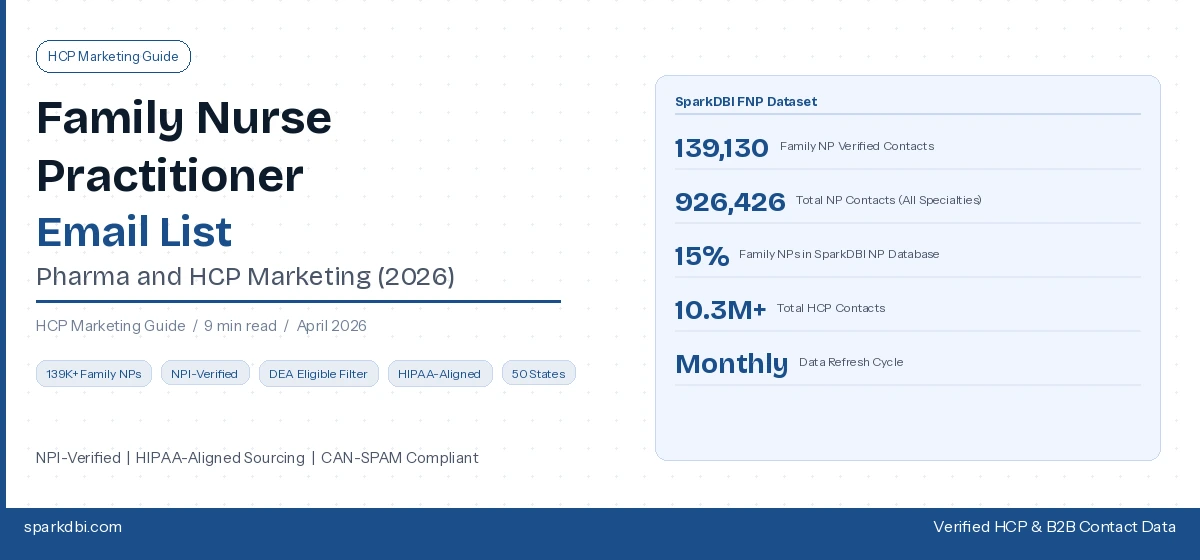
SparkDBI’s healthcare database includes 139,130 verified Family NP contacts — the largest single NP specialty segment in the database — within a total NP universe of 926,426 practitioners across all 50 US states. Family NPs represent 15% of all NP contacts in the SparkDBI dataset, reflecting their dominant position in the US NP workforce.
FNP vs Other NP Specialties: Why Targeted Lists Outperform Generic NP Files
Buying a broad nurse practitioner email list and running a primary care drug campaign on it is the same mistake as buying a physician list without filtering by specialty. Family NPs, psychiatric NPs, acute care NPs, neonatal NPs, and pediatric NPs have entirely different clinical responsibilities, formulary influence, and prescribing patterns. A generic NP list treats all of them as the same prescriber audience.
Here is how SparkDBI’s verified NP contacts break down by specialty — and what each segment is actually useful for in HCP marketing:
| NP Specialty | SparkDBI Contacts | Primary Prescribing Focus | Best Campaign Fit |
|---|---|---|---|
| Family NP (FNP) | 139,130 | Diabetes, HTN, lipids, vaccines, contraception, depression | Primary care drugs, preventive care, chronic disease |
| Adult Health NP | 10,707 | Adult chronic conditions, geriatric care | Cardiovascular, metabolic, osteoporosis therapies |
| Psych/Mental Health NP (PMHNP) | 9,804 | Antidepressants, antipsychotics, ADHD medications | CNS and psychiatric drug launches |
| Pediatric NP | 6,687 | Vaccines, pediatric antibiotics, growth therapies | Pediatric drug and device campaigns |
| Gerontologist NP | 3,104 | Alzheimer’s, osteoporosis, cardiovascular in elderly | Geriatric and long-term care therapies |
| Primary Care NP | 1,899 | Broad primary care prescribing | General primary care drug launches |
| Acute Care NP (ACNP) | 1,528 | Hospital-administered medications, critical care | Inpatient drugs and device adoption |
| Neonatal NP | 1,408 | NICU medications, neonatal nutrition | Neonatal devices and specialty nutrition |
| OB/GYN NP | 1,303 | Contraceptives, prenatal care, reproductive health | Women’s health therapeutics |
| Women’s Health NP | 2,725 | HRT, contraception, menopause management | Women’s health and reproductive campaigns |
| Total NP Database | 926,426 | All NP specialties across all 50 US states | |
The commercial implication is clear: if you’re launching a primary care drug — diabetes, hypertension, cholesterol, or depression — the 139,130 Family NPs in SparkDBI’s database are the correct NP target. Sending that campaign to a PMHNP or a neonatal NP generates impressions but no prescribing response, because those practitioners don’t write the relevant scripts. Specialty filtering is what turns an NP list from a volume play into a precision prescriber campaign.
Target the right FNPs for your campaign. SparkDBI’s 139,130 Family NP contacts are filterable by scope of practice, DEA eligibility, facility type, and geography. See SparkDBI’s NP data by specialty or request 50 free verified FNP contacts for your target geography.
What a High-Quality FNP Email List Should Contain
A family nurse practitioner email list built for HCP marketing needs more than a name and email address. The fields that determine whether a campaign performs — or wastes budget reaching practitioners who can’t act on it — are the prescriber-critical data points that most list vendors don’t include as standard.
Core identification fields
- Full name and professional credentials (FNP-C, FNP-BC, APRN)
- NPI number — the federally assigned, publicly verifiable identifier for every US practitioner, cross-referenced against the CMS registry
- Verified professional email address — active inbox validated, not syntax-checked
- Primary specialty classification mapped to NPI taxonomy code 363LF0000X (Family NP)
- State of licensure
- Practice address, city, state, ZIP
Prescriber-critical fields
- Scope of practice — full practice authority, reduced practice, or restricted practice by state. An FNP in a full-practice state prescribes independently. An FNP in a restricted state requires physician co-signature. This field determines which FNPs are the right target for autonomous prescribing campaigns.
- DEA registration status — required for Schedule II-V controlled substance prescribing. Not all FNPs carry DEA numbers. For any controlled substance campaign — ADHD medications, opioid alternatives, benzodiazepines — DEA eligibility filtering is mandatory, not optional.
- Practice setting — independent clinic, hospital-owned outpatient, community health center, retail clinic, telehealth network. This determines purchasing autonomy and formulary influence.
- Hospital or health system affiliation — for device campaigns targeting FNPs who influence formulary or procurement decisions.
- Years in practice — useful for segmenting established prescribers from newly credentialed FNPs who may be in employed settings with more restricted formulary access.
Without the prescriber-critical fields, you cannot distinguish between an independent FNP with full practice authority and a recently credentialed FNP in a restricted-practice state working under a collaborative agreement. Those two practitioners have fundamentally different commercial profiles — and the same campaign message will land very differently with each.
Pharma and HCP Marketing Use Cases for FNP Lists
FNP-targeted email lists support specific, high-value campaign types for pharmaceutical, medical device, and health technology teams. Here is how high-performing marketing organisations use them:
Primary care drug launches
FNPs are frontline prescribers for the most commercially significant primary care categories. For a Type 2 diabetes launch, a hypertension therapy introduction, or a new lipid-lowering agent, Family NPs with full practice authority write prescriptions independently — the same commercial opportunity as a primary care physician, at a fraction of the contact acquisition cost. SparkDBI’s 139,130 Family NP contacts give pharma teams direct access to this prescriber segment without the overlap and waste of a generic NP list.
Chronic disease management and adherence programs
FNPs managing long-term patients in diabetes, cardiovascular disease, asthma, and mental health are active consumers of clinical education content about therapy optimisation, dosing protocols, and patient adherence tools. Email sequences that lead with clinical data before transitioning to product messaging see consistently stronger engagement from FNPs than cold promotional campaigns — because the educational framing matches how they approach their CME and clinical updating needs.
Vaccine and preventive care outreach
FNPs in primary care settings administer and recommend adult and pediatric vaccines as a core function of their clinical role. For manufacturers of shingles vaccines, flu vaccines, pneumococcal vaccines, RSV vaccines, and emerging mRNA preventive therapies, Family NPs are among the highest-volume recommenders and administrators in outpatient settings.
Medical device adoption in outpatient settings
FNPs in independent and group practice settings make direct device purchasing recommendations for wound care products, point-of-care diagnostic devices, dermatological tools, and continuous glucose monitoring systems. For devices sold into outpatient primary care, FNPs are frequently the evaluation champion — not the hospital procurement committee. A targeted FNP list reaches this decision-maker segment directly.
Healthcare technology and EHR-adjacent tools
FNPs in independent and small group practices are often the primary decision-maker for clinical software adoption — e-prescribing tools, telehealth platforms, remote patient monitoring, and practice management systems. Digital-first outreach to FNPs through verified email consistently outperforms cold calling for health tech sales cycles targeting the independent primary care segment.
CME and clinical education programs
FNP recertification requires ongoing continuing education. CME-focused outreach — content that leads with clinical value rather than product promotion — consistently outperforms cold promotional campaigns in open rate and downstream conversion. A verified FNP email list used for CME engagement builds brand recognition before the prescribing conversation begins.
Data Quality: What to Verify Before Using Any FNP Email List
FNP contact data decays at approximately 25-30% annually, driven by practice relocations, employer changes, state licensing updates, and specialty reclassifications. A list purchased 12 months ago without re-verification is carrying meaningful inaccuracy — which translates directly to bounce rates and sender reputation damage before your first campaign sends.
Run through this four-point verification checklist before using any FNP email list:
- Verify NPI numbers against the CMS registry
The CMS NPI registry is publicly accessible at npiregistry.cms.hhs.gov. Any FNP record without an NPI number — or with an NPI that doesn’t match NPI taxonomy code 363LF0000X for Family NP — is either wrong or outdated. This check takes under an hour on a sample and eliminates the worst-quality records before you commit to a full list purchase. - Run active inbox validation independently
Don’t rely on the vendor’s self-reported accuracy rate. Run a sample through an independent tool — NeverBounce, ZeroBounce, or Kickbox. Look for “valid” results specifically. A quality FNP list from a monthly-refresh provider should return 90%+ valid on a fresh sample. Below 85% signals problems that compound with each campaign send. - Confirm the data refresh date
Ask when the records in your sample were last verified. Monthly refresh is the correct standard for HCP data used in active outbound programs. Quarterly refresh means records could already be 90 days stale at the point of delivery. Annual refresh — common among low-cost list brokers — means paying for data that may already be 25-30% inaccurate at purchase. - Confirm DEA eligibility data is included if your campaign requires it
For any controlled substance campaign — Schedule II ADHD medications, Schedule III-V therapies — DEA registration status must be confirmed separately from NPI verification. Not every FNP carries a DEA number. A list that can’t filter by DEA eligibility is not an appropriate data source for controlled substance outreach.
Accuracy benchmark: A high-quality FNP email list should deliver under 2% hard bounce rate on the first send when recently verified. Between 2-5% indicates list degradation. Above 5% signals data quality problems that will damage your sending domain reputation and reduce inbox placement across your entire outbound program — including your good contacts.
Compliance for FNP Email Outreach
Two frameworks govern FNP email outreach for pharmaceutical and device companies: HIPAA and CAN-SPAM. Understanding what each actually requires — rather than what is commonly assumed — is what separates compliant campaigns from risky ones.
HIPAA and FNP marketing
The HIPAA rule does not prohibit commercial email outreach to Family Nurse Practitioners. HIPAA governs protected health information – patient-level clinical data. A pharmaceutical company emailing an FNP about a diabetes therapy using professional contact data (name, NPI, work email, practice address) is not handling PHI. The communication involves the FNP in their professional capacity, using professional contact information sourced through professional channels — not patient records.
Where HIPAA exposure enters the picture is your data provider’s sourcing methodology. FNP contact data derived from clinical systems, hospital EHR exports, or patient-linked prescribing records creates compliance risk regardless of your campaign content. SparkDBI sources all FNP data from HIPAA-aligned professional channels: the CMS NPI registry, state nursing licensing boards, professional nursing associations, and licensed data partner agreements — no clinical records or PHI at any stage.
CAN-SPAM requirements for FNP outreach
CAN-SPAM applies to all commercial emails sent to US recipients, including Family Nurse Practitioners. It does not require prior consent, but it mandates structural compliance on every send:
- A physical mailing address in every email
- A clear, functioning one-click unsubscribe mechanism
- An accurate subject line that reflects the email content
- Opt-out requests honored within 10 business days
- No deceptive sender identification
Suppression list management is particularly important for FNP campaigns. Practitioners who opt out of one campaign must be excluded from all subsequent outreach — not just the specific sequence that generated the opt-out. Failing this step is the most common CAN-SPAM compliance gap in HCP outreach programs.
How SparkDBI Builds Its FNP Dataset
SparkDBI is a global B2B and healthcare contact data provider with over 10.3 million verified HCP contacts across 39 specialty groups, 140+ licensed data partners, and sourcing coverage across 200+ countries. The Family NP dataset sits within SparkDBI’s broader nursing database of 2,786,120 verified nurse contacts — the largest single specialty group in the database — sourced exclusively through HIPAA-aligned professional channels.
Sourcing methodology
Every Family NP record in SparkDBI’s database originates from one or more of the following verified professional sources:
- CMS NPI Registry — the federal source of record for US practitioner identity, specialty taxonomy, and license status
- State Board of Nursing licensing records across all 50 states
- Professional nursing associations, including the American Association of Nurse Practitioners and specialty-specific bodies
- CME program registration data from accredited nursing education providers
- Licensed data partner agreements with healthcare publisher networks and professional directory operators
No clinical records. Nor hospital EHR exports. And no patient-linked data at any point in the sourcing chain.
Verification and refresh
SparkDBI applies a four-layer verification process to every FNP record: multi-source aggregation and cross-referencing, active inbox validation (not syntax checking), AI-driven quality review with human verification for edge cases, and monthly refresh cycles. The monthly refresh cadence for NP records specifically is faster than SparkDBI’s broader B2B dataset — because NP contact data changes at a higher rate than most professional segments due to workforce mobility and scope of practice updates.
What’s included in SparkDBI’s FNP data
SparkDBI’s 139,130 Family NP contacts are delivered with all core identification and prescriber-critical fields included as standard: NPI number, verified work email, specialty taxonomy code, state of licensure, scope of practice indicator, practice address, and facility type. DEA eligibility data is available as a filterable field for controlled substance campaigns. Records are delivered in CRM-ready CSV format with direct integrations available for Salesforce, HubSpot, Veeva CRM, Zoho, and Pipedrive.
Current FNP record counts by state and scope-of-practice category are available on the SparkDBI Healthcare Database Dashboard. For pharma teams running territory-level FNP campaigns, SparkDBI can apply geographic overlays down to ZIP code level across the full 139,130 Family NP dataset.
For teams evaluating SparkDBI’s data quality before committing, the standard starting point is a free 50-contact FNP sample matched to your target specialty, geography, and scope of practice criteria — verified through any independent inbox validation tool of your choice.
Get 50 Free Verified FNP Contacts for Your Target Geography
Frequently Asked Questions
What is a family nurse practitioner email list?
A family nurse practitioner email list is a verified database of professional contact information for FNP-certified nurse practitioners — licensed advanced practice providers who deliver primary care across the full patient lifespan. A quality FNP email list includes verified work email addresses, NPI numbers mapped to taxonomy code 363LF0000X, scope of practice classification by state, DEA registration status, and practice setting. SparkDBI maintains 139,130 verified Family NP contacts within a total NP database of 926,426 practitioners, segmented by specialty, geography, and prescribing authority status.
How many family nurse practitioners are in the SparkDBI database?
SparkDBI’s healthcare database includes 139,130 verified Family Nurse Practitioner contacts across all 50 US states. Family NPs represent 15% of SparkDBI’s total NP database of 926,426 practitioners — consistent with the FNP specialty’s position as the largest single NP certification category in the US workforce. All FNP records include NPI numbers cross-referenced against the CMS registry, and the dataset is refreshed monthly to reflect active practitioners in current practice settings.
Is it legal to email family nurse practitioners for pharmaceutical marketing?
Yes. Emailing licensed Family Nurse Practitioners for legitimate pharmaceutical or medical device marketing is legal under US federal law. HIPAA does not prohibit this outreach — it governs patient health information, not professional contact data. CAN-SPAM applies and requires a working unsubscribe mechanism, a physical sender address, an accurate subject line, and opt-out processing within 10 business days. Prior consent is not required under CAN-SPAM. The compliance risk in FNP outreach comes from your data source — specifically, whether the FNP contact data was sourced from clinical records or patient databases rather than professional channels like the CMS NPI registry.
What therapeutic categories should I target FNPs for?
Family Nurse Practitioners are most commercially relevant for therapeutic categories where primary care is the point of prescribing: Type 2 diabetes management, hypertension, hyperlipidemia, depression and anxiety, obesity management, smoking cessation, adult vaccines, contraception, and thyroid disorders. For controlled substance campaigns in ADHD or pain management, FNP targeting requires DEA registration filtering — not all FNPs carry DEA numbers, and prescribing authority for Schedule II substances varies by state. SparkDBI’s FNP dataset includes DEA eligibility as a filterable field for campaigns requiring controlled substance prescriber targeting.
What is the difference between a Family NP list and a general NP list?
A general NP list aggregates all nurse practitioner specialties into a single file — mixing Family NPs, psychiatric NPs, acute care NPs, neonatal NPs, women’s health NPs, and others. For a primary care drug campaign, that means a significant portion of the list consists of practitioners who don’t prescribe in the relevant therapeutic category. A Family NP list filters specifically to practitioners certified in family medicine primary care, ensuring campaign relevance matches prescriber scope. SparkDBI’s NP database of 926,426 contacts is segmented into 15 distinct subspecialty categories — allowing precise targeting of the 139,130 Family NPs rather than deploying budget across the full NP population.
How accurate is SparkDBI’s Family NP email data?
SparkDBI maintains a 95%+ verified accuracy rate across its HCP dataset through active inbox validation on every record before inclusion, monthly refresh cycles against the CMS NPI registry and state licensing board records, and a four-layer verification process combining automated AI validation with human quality review. For the FNP dataset specifically, monthly refresh is critical because FNP contact data changes at a higher rate than general B2B data — practice relocations, employer changes, and scope of practice updates all affect contact validity. SparkDBI’s accuracy guarantee includes a 30-day pro-rated refund for any records that fail independent third-party validation.
Key Takeaways
- SparkDBI’s healthcare database includes 139,130 verified Family NP contacts — 15% of a total NP database of 926,426 practitioners across all 50 US states, segmented by specialty, scope of practice, DEA eligibility, and facility type.
- Family NPs are primary care prescribers for diabetes, hypertension, hyperlipidemia, depression, vaccines, and contraception. In 34 states plus DC, they prescribe independently without physician oversight — the same commercial opportunity as a family medicine physician.
- A generic NP list wastes campaign budget on practitioners who cannot prescribe in your therapeutic category. Specialty filtering to the 139,130 Family NPs aligns your outreach with the practitioners who actually write the relevant scripts.
- A high-quality FNP list includes NPI numbers, active inbox validation, scope of practice by state, and DEA registration status. Without these fields, campaigns for controlled substances or state-specific prescribing programs cannot be correctly targeted.
- HIPAA does not prohibit FNP outreach. CAN-SPAM applies and requires structural compliance. The compliance risk in FNP marketing comes from your data source — not your campaign content.
- FNP contact data decays at 25-30% annually. Monthly refresh is the correct standard. Any FNP list older than 90 days without re-verification carries meaningful accuracy risk before the first send.
Written by the SparkDBI Editorial Team
SparkDBI is a global B2B and healthcare contact data provider with over 10.3 million verified HCP contacts across 39 specialty groups and 140+ licensed data partners. All contact counts cited in this article reflect SparkDBI’s verified healthcare database as of Q1 2026 and are sourced exclusively from HIPAA-aligned professional channels including the CMS NPI registry, state licensing boards, and licensed data partner agreements. This article provides general guidance and does not constitute legal advice. Consult qualified legal counsel for your specific compliance situation.
Related reading: The Complete Guide to Nurse Practitioner Email Lists (2026) | HCP Email Marketing Compliance: HIPAA, CAN-SPAM, and Physician Outreach
