 SparkDBi
Mixed (Educational + Commercial) | 11 min read
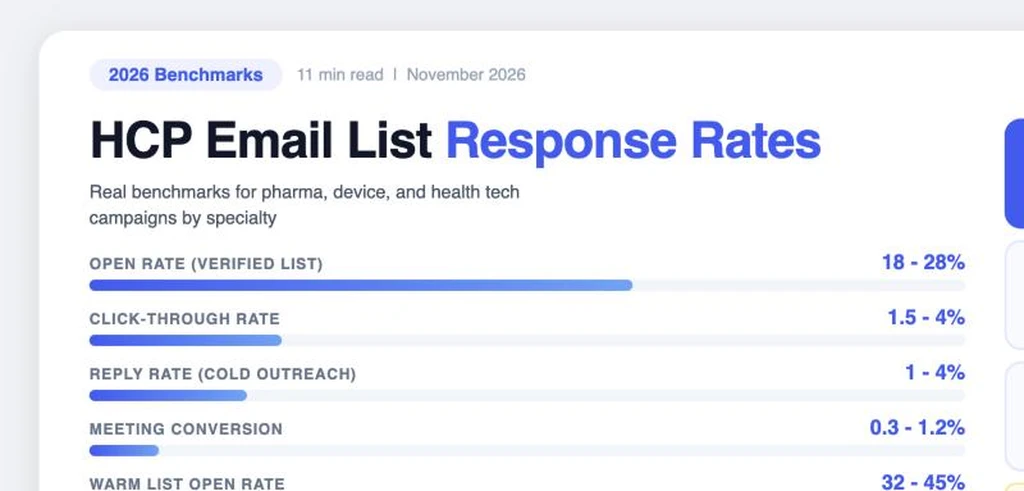
Average open rates for verified, segmented healthcare professional email campaigns run 18-28%. Reply rates for cold HCP outreach land between 1% and 4%. Conversion rates (booked meetings, demo requests, rep contacts) range from 0.3% to 1.2% depending on specialty, offer type, and list quality. If your numbers are significantly below these ranges, the problem is almost always list quality or lack of segmentation, not the message itself.
This guide covers what response rates to realistically expect from HCP email campaigns in 2026, broken down by campaign type, specialty, and the variables that move the numbers most. It also covers what distinguishes high-performing campaigns from ones that land in spam or generate a single-digit open rate.
Table of Contents
- Baseline Benchmarks: Open Rate, Click Rate, Reply Rate, Conversion
- How Do Response Rates Vary by Medical Specialty?
- Response Rates by Campaign Type: Pharma, Device, Health Tech
- Why List Quality Is the Biggest Response Rate Variable
- What Kills HCP Email Response Rates
- What Lifts HCP Email Response Rates
- What ROI Can You Expect from an HCP Email Campaign?
- How SparkDBi Data Affects Campaign Performance
- Frequently Asked Questions
- Key Takeaways
Baseline Benchmarks: Open Rate, Click Rate, Reply Rate, Conversion
Healthcare professional email benchmarks vary significantly by data source, campaign structure, and how "response" is defined. The ranges below reflect campaigns sent to verified, segmented HCP lists with compliant messaging, not bulk-blasted generic outreach.
HCP email open rates
Verified HCP list, single specialty, cold outreach: 18-28%. Warm list (prior engagement, event attendee, existing customer): 32-45%. Low-quality unverified list: 8-14%.
Open rates across all industries have shifted upward since Apple Mail Privacy Protection inflated measured opens in 2021. For HCP campaigns, treat open rate as a signal, not a primary metric. It tells you that the subject line worked and the email reached an active inbox. It doesn’t tell you that the recipient read it.
HCP email click-through rates
Cold HCP campaigns with a single clear CTA: 1.5-4%. Campaigns with multiple links and no primary CTA: 0.4-1.2%. Educational content campaigns (white papers, clinical summaries): 2-6% when the content matches the specialty and clinical concern.
HCP email reply rates
Direct reply to cold outreach: 1-4%. This is the metric that pharma and device commercial teams track most closely, because a reply from a physician or NP signals genuine interest. Personalized single-contact outreach sequences (3-4 touches) can reach 4-8% reply rates in well-segmented specialty campaigns.
Meeting or demo conversion rates
From cold HCP email to booked meeting or rep contact: 0.3-1.2%. For high-value device or software categories with a strong value proposition for the target specialty, 1-2% is achievable with well-structured sequences. These numbers mean a 10,000-contact verified campaign should generate 30-120 qualified meetings, which is consistent with what well-run HCP campaigns actually deliver.
How Do Response Rates Vary by Medical Specialty?
Specialty is one of the biggest drivers of HCP campaign response variability. Some specialties are heavily targeted and have developed significant fatigue toward commercial email. Others are undercommunicated and show above-average engagement when outreach is relevant.
Which specialties have the highest HCP email response rates?
Higher engagement specialties (above-average open and reply rates):
- Psychiatry and behavioral health: consistently above average, particularly for pharmaceutical outreach tied to treatment-resistant conditions and new mechanisms of action
- Oncology: high engagement for clinical data, below average for general outreach
- Nephrology: smaller specialty pool, less saturated with outreach, higher reply rates
- Rheumatology: targeted biologic campaigns produce strong engagement
- Nurse practitioners (all specialties): typically show 20-30% higher open rates than equivalent physician campaigns in the same specialty, partly because NPs receive fewer targeted commercial emails
Lower engagement specialties (more saturated, higher list fatigue):
- Cardiology: extremely high commercial outreach volume, more selective engagement
- Primary care and family medicine: highest-volume specialty, most saturated with pharma outreach
- Internal medicine: similar saturation to primary care for general pharmaceutical campaigns
Specialty engagement is relative to outreach volume in that category. A primary care campaign with highly relevant messaging and strong segmentation can outperform a less-saturated specialty campaign that lacks targeting precision.
SparkDBi covers all major specialty categories with verified contacts. For specialty-specific data counts and coverage, see the full healthcare email lists by specialty breakdown.
Response Rates by Campaign Type: Pharma, Device, Health Tech
The nature of your offer shapes what a good response rate looks like. These categories have different baseline expectations:
Pharmaceutical commercial campaigns
Pharma campaigns to HCPs typically aim for open rates of 20-25% and reply or rep-contact rates of 0.5-1.5%. The goal is usually not a direct reply but a downstream action: a rep visit request, a sample request, or a CME registration. Pharma campaigns benefit significantly from territory segmentation (reaching HCPs in specific sales rep coverage areas) and from using the right clinical credential filter (prescribers only, with DEA registration for controlled substances).
Medical device campaigns
Device campaigns targeting procedural specialists show wider response rate ranges because the audience is smaller and the value proposition is more specific. Well-targeted campaigns to orthopedic surgeons, interventional cardiologists, or general surgeons for a relevant device category can achieve reply rates of 2-5% because the pool is narrower and the message is directly relevant to their procedural practice. Campaigns to the wrong subspecialty (cardiology when you need interventional cardiology) fall below 1% regardless of messaging quality.
Health technology and SaaS campaigns
Health tech campaigns to HCPs typically see lower reply rates (0.5-2%) because the buying decision is rarely made by the HCP alone. A clinical software platform requires buy-in from practice managers, IT, and administration. The most effective health tech campaigns to HCPs position the product as solving a clinical problem the HCP experiences directly (reducing documentation time, improving care coordination) and ask for a clinical champion introduction rather than a full demo.
Why List Quality Is the Biggest Response Rate Variable
The single factor that moves HCP email response rates more than any other is list quality. This is not a close call. A well-written campaign to a low-quality list will consistently underperform a mediocre campaign to a verified, segmented list.
What does list quality mean for HCP campaigns?
Three dimensions define list quality for healthcare professional outreach:
1. Email deliverability validation. An HCP email list built from directory scraping or outdated licensing data will contain 15-30% invalid or defunct email addresses. Those addresses generate hard bounces that damage your sender domain reputation. After two or three campaigns, your bounce rate accumulates to the point where your domain is flagged, and even valid addresses stop receiving your mail. A properly built HCP dataset validates email addresses against active inboxes, not just syntax checks.
2. NPI verification. HCPs change employers, retire, relocate, and change their primary practice address at significant rates. A list that isn’t cross-referenced against the CMS NPI registry on a regular cycle will include practitioners who are no longer practicing at the listed address or who have changed specialties. Sending to inactive or relocated practitioners wastes spend and inflates your complaint rate.
3. Segmentation accuracy. A list that claims to contain 50,000 cardiologists but actually contains 50,000 contacts with any cardiovascular-related taxonomy code (including cardiac nurses, cardiovascular technologists, and cardiology billing staff) is not a cardiologist list. Specialty classification accuracy is a core quality dimension.
SparkDBi validates all three dimensions: inbox-active email verification, monthly NPI registry refresh, and specialty classification tied directly to NPI taxonomy codes rather than self-reported categories.
What Kills HCP Email Response Rates
Understanding what depresses response rates is as useful as knowing what lifts them:
- High bounce rates from unvalidated lists: Any campaign with over 2% bounce rate is damaging your sender reputation. HCP lists from directory scraping or bulk data resellers typically produce 10-25% bounce rates on the first send.
- Wrong credential targeting: Sending a prescribing-focused pharma message to a contact list that includes non-prescribing HCPs (nurses, medical assistants, billing staff) wastes budget and generates complaints from people who have no use for the message.
- Subject lines that trigger spam filters: Pharmaceutical product names, claims language, and certain compliance-adjacent terms activate spam filters at major email providers. Healthcare commercial email requires careful subject line construction.
- No personalization above the specialty level: "Dear Doctor" with a generic clinical reference performs worse than a message that names the specific clinical problem relevant to the recipient’s specialty and practice type.
- Too many CTAs: HCP emails with three or more competing calls to action consistently underperform emails with a single clear action. HCPs have limited time. One ask, clearly stated, outperforms a menu of options.
- Sending at the wrong time: HCPs have predictable email checking windows. Early morning (6-8am) and late evening (8-10pm) outperform mid-day sends for many HCP segments, particularly physicians in clinical settings who check email outside of patient hours.
What Lifts HCP Email Response Rates
- Verified, segmented lists: The foundational lift. A campaign built on a list where every contact is the right credential, the right specialty, and has a valid email address starts 10-15 percentage points ahead on open rate alone.
- Personalization by specialty and practice type: Messages that reference the clinical context specific to the recipient’s specialty (not just their name) consistently outperform generic outreach. An orthopedic surgeon email that opens with a reference to revision surgery rates or implant selection criteria will out-open one that opens with generic language about “improving patient outcomes.”
- Multi-touch sequences with appropriate spacing: Single-email campaigns to cold HCP lists consistently underperform 3-4 touch sequences. Healthcare professionals are busy; a second email sent 5-7 days after the first to contacts who didn’t open the first message regularly adds 20-40% to total campaign engagement.
- Clinical evidence as the hook: HCPs respond to clinical data. A subject line that references a specific clinical outcome metric or a recent study finding outperforms promotional language for pharmaceutical and device campaigns.
- Relevant internal links and landing pages: Campaign emails that link to specialty-specific landing pages with relevant clinical content (rather than a generic homepage) produce 2-3x higher conversion rates from click to form completion.
What ROI Can You Expect from an HCP Email Campaign?
ROI calculation for HCP email campaigns depends heavily on the product category and the value of a converted customer. Here is a framework:
Campaign parameters: 10,000 verified, segmented HCP contacts. Total cost including list acquisition and campaign execution: $8,000-15,000 depending on list source and campaign structure.
Expected outcomes at mid-range benchmarks:
- Open rate 22%: 2,200 opens
- Click rate 2.5%: 250 clicks
- Conversion to booked meeting or rep contact 0.6%: 60 qualified leads
If the product generates $5,000 in annual contract value and your close rate on a qualified HCP meeting is 20%, 60 qualified leads produce 12 new customers worth $60,000 in ACV. That is a 4-7x ROI on campaign cost, before any account expansion or renewal value.
The math changes dramatically with list quality. A low-quality unverified list at the same cost produces 8-12% open rates, 50% fewer clicks, and 50% fewer conversions, turning a profitable campaign into a breakeven or negative one while also damaging your sender domain for future campaigns.
The investment in a verified, segmented list is not a premium - it is the variable that determines whether the campaign works at all.
How SparkDBi Data Affects Campaign Performance
SparkDBi’s HCP dataset is built to the specifications that produce above-benchmark campaign performance: NPI-verified contacts, monthly registry refresh, inbox-validated email addresses, and specialty classification tied to NPI taxonomy codes.
When clients run campaigns using SparkDBi data against comparable campaigns using unvalidated list sources, the difference in deliverability and open rate is typically 8-15 percentage points. For a 10,000-contact campaign, that gap translates to 800-1,500 additional opens from the same number of sends.
SparkDBi covers 1.1 million verified HCPs across 36 specialty categories. All segmentation dimensions described in this guide are available as filters at the data request stage. For specialty-specific list options, the HCP email list segmentation guide covers each segmentation layer in detail.
Request 50 free sample records from your target specialty before committing to a full campaign list.
Frequently Asked Questions
What open rate should I expect from a healthcare professional email list?
Verified, segmented HCP campaigns typically see 18-28% open rates for cold outreach. Warm lists (prior engagement, existing customers, event attendees) run 32-45%. If your open rate is below 12%, the most likely causes are list quality problems (high bounce rate damaging sender reputation) or subject line issues.
What is a good reply rate for HCP cold email outreach?
A 1-4% reply rate is a healthy range for cold HCP outreach to a verified, segmented list. Well-structured 3-4 touch sequences targeting a highly relevant specialty with a specific clinical value proposition can reach 4-8%. If you are below 1%, the issue is usually credential mismatch (messaging sent to non-target HCP types), specialty mismatch, or a value proposition that isn’t relevant to the clinical problems the recipient actually faces.
Why are my HCP email campaigns performing below benchmarks?
The most common causes, in order of frequency: (1) list quality issues - unvalidated emails, outdated contacts, or poor specialty classification; (2) sending to the wrong credential type for your message; (3) subject lines that trigger spam filters; (4) generic messaging not tailored to the specific clinical context of the target specialty; (5) sending frequency that is too high or too low.
How many emails should I send in an HCP outreach sequence?
Three to four emails over 2-3 weeks is the standard for cold HCP outreach. Email 1 introduces the clinical problem or product. Email 2 (sent to non-openers of Email 1 with a different subject line) reinforces the core message. Email 3 or 4 offers a different format or angle. Sequences longer than 4 emails to cold HCP contacts generate diminishing returns and elevated complaint rates.
Do nurse practitioners respond to email differently than physicians?
Nurse practitioners typically show 20-30% higher open rates than physicians in equivalent specialty campaigns, primarily because NPs receive fewer targeted commercial emails. Reply rates are roughly comparable once list quality and segmentation are controlled for. For NP-specific campaign guidance, see SparkDBi’s nurse practitioner email list guide.
What response rate should I use to calculate ROI before buying an HCP list?
Use conservative mid-range benchmarks for planning: 20% open rate, 2% click rate, 0.5% conversion to qualified lead. For a 10,000-contact campaign that is a reasonable floor: 2,000 opens, 200 clicks, 50 qualified leads. Build your ROI case on those numbers. If the campaign works at 50 qualified leads given your product’s close rate and ACV, the actual result at 60-80 qualified leads will exceed your model.
How much does list quality affect HCP campaign performance?
List quality is the single biggest driver of HCP campaign performance, more than subject line, messaging, or send time combined. A campaign on a verified, segmented list typically sees 10-15 percentage points higher open rates than the same campaign on an unvalidated list, and avoids the sender reputation damage that makes future campaigns progressively less effective.
Key Takeaways
- Healthy benchmarks for verified HCP lists: 18-28% open rate, 1.5-4% click rate, 1-4% reply rate, 0.3-1.2% conversion to qualified lead.
- Nurse practitioners show 20-30% higher open rates than equivalent physician campaigns because they receive less commercial email volume.
- List quality is the dominant variable. A low-quality unverified HCP list typically produces 8-14% open rates and accumulates domain-damaging bounce rates.
- Specialty match and credential accuracy matter more than message quality. The right message to the wrong HCP type produces the same result as the wrong message.
- 3-4 touch sequences outperform single-email campaigns by 20-40% in total engagement for cold HCP outreach.
- A 10,000-contact verified campaign at mid-range benchmarks should generate 50-80 qualified leads. Build your ROI model on the low end of that range.