 SparkDBi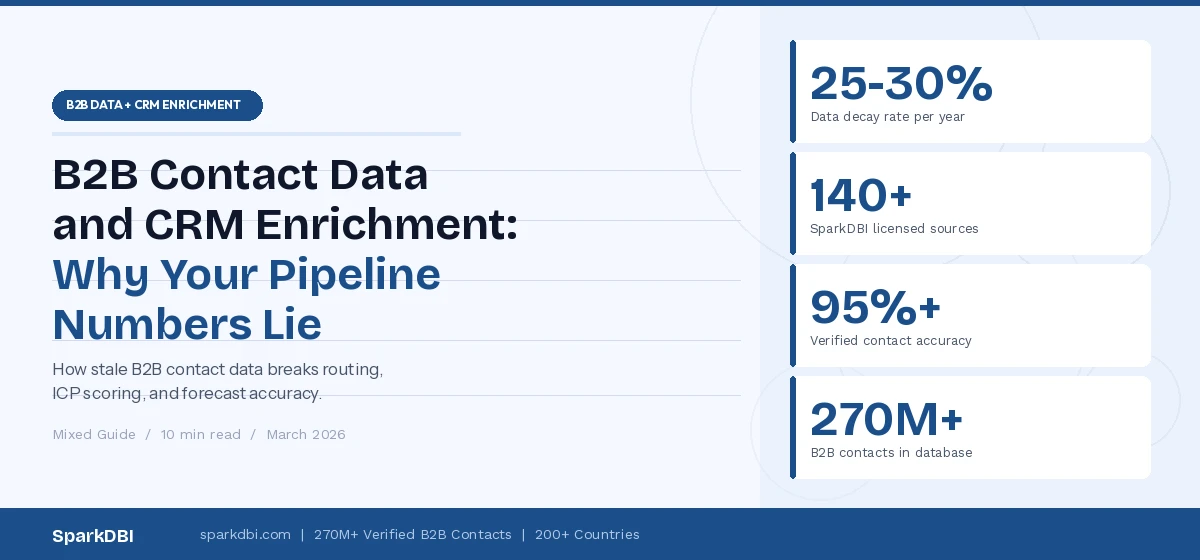
B2B contact data is the structured set of company, role, and firmographic records that powers every CRM-driven decision: routing, scoring, ICP qualification, and outbound targeting. When that data decays without structured CRM enrichment, revenue quietly erodes even as pipeline dashboards remain full. Teams make confident calls based on records that are no longer true.
Picture this: a RevOps manager at a 200-person SaaS company pulls a Q3 pipeline report. It looks healthy on paper. But the VP of Sales keeps flagging missed targets. SDRs complain about bad lead quality. Marketing increases send volume to compensate.
Nobody thinks to check when the CRM data was last refreshed. The honest answer, when they finally dig in? Six months ago. And B2B contact data, left untouched, decays at roughly 25 to 30 percent per year according to Salesforce Research. That’s a quarter of the database becoming unreliable within 12 months.
This is not a data vendor problem. Rather, it is a data management problem. And it is far more common than most revenue teams admit. CRM data enrichment is not a nice-to-have feature on a data vendor contract. It is an operational workflow that either runs continuously or silently undermines everything built on top of it.
In This Guide
- What B2B contact data actually includes
- Why B2B contact data decays faster than you expect
- What CRM enrichment actually means
- How stale data breaks lead routing
- ICP scoring with bad firmographics
- Static data vs. continuously enriched data
- How to build a B2B data hygiene workflow
- What to look for in a B2B contact data provider
- Frequently asked questions
What B2B Contact Data Actually Includes
Most teams think of B2B contact data as a name, email, and phone number. That is the surface layer. The records that actually drive CRM outcomes run deeper than that.
At a minimum, accurate B2B contact data includes:
- Firmographic fields: Company headcount range, revenue tier, industry vertical and sub-category, year founded, corporate structure
- Geographic fields: HQ country and region, subsidiary locations, territory alignment
- Contact-level fields: Full name, verified work email, direct dial, LinkedIn URL, seniority tier, functional department
- Buying signals: Technology install data, funding stage, recent hiring activity, intent indicators
- Compliance fields: Opt-out flags, GDPR lawful basis status, suppression list membership
Each of these fields feeds a downstream workflow. A wrong headcount range reroutes an enterprise lead to an SMB rep. An outdated job title means a campaign targets a decision-maker who left six months ago. A missing opt-out flag creates a compliance risk your legal team will eventually find.
One incorrect field does not just affect one record. It corrupts the outputs of every automation, score, and report built on top of it. That compounding effect is what makes B2B contact data quality a revenue operations issue, not just a data hygiene issue.
See What Your Target ICP Actually Looks Like
SparkDBi maintains 304M+ verified B2B contacts across 200+ countries, refreshed bi-monthly with 95%+ accuracy.Request 50 Free Verified Contacts
Why B2B Contact Data Decays Faster Than You Expect
B2B contact data does not degrade on a schedule. It decays because the real world changes constantly, and no CRM record updates itself automatically.
The most common decay drivers are:
- Employees change roles or leave companies (the U.S. Bureau of Labor Statistics reports median job tenure in professional services at around 4.1 years, which means role changes happen far more frequently than most teams expect)
- Companies scale headcount or downsize, shifting from one ICP tier to another
- Offices open or close, realigning geographic territory assignments
- Corporate structures change via acquisition or merger, making domain-level targeting obsolete
- Decision-makers shift departments, making their buying authority irrelevant to your offer
The technology and SaaS sectors see the fastest turnover. A CRM built on contact data enriched 12 months ago and never refreshed is, conservatively, 25 to 30 percent unreliable. At a 10,000-record database, that is 2,500 to 3,000 records actively working against your pipeline accuracy.
The troubling part is that decaying records do not disappear. They stay populated, they pass validation checks, and they keep routing through automation like legitimate contacts. Until they don’t convert. And then everyone wonders why.
What CRM Enrichment Actually Means (and What It Does Not)
Here is where most teams get it wrong: buying access to a B2B data provider does not mean your CRM is enriched. It means you have a source to pull from. Enrichment only produces value when your team operationalizes it as a workflow, not a one-time import.
CRM enrichment, done correctly, involves five things happening continuously:
- Enrichment at capture: SparkDBi enriches new contacts entering via form, integration, or import immediately against a verified data source before they touch any automation.
- Pre-campaign refresh: Before any outbound sequence launches, the target list is re-verified. A contact who was valid three months ago may have changed roles since then.
- Scheduled firmographic updates: Refresh company-level fields like headcount, revenue range, and industry classification on a quarterly cycle at minimum.
- Confidence scoring: Each key field carries a confidence indicator so downstream teams know which records are high-trust versus which need human validation.
- Suppression and deduplication: Suppress records that fail repeated validation checks rather than leaving them in the active pool to distort scoring and routing.
Without cadence and clear ownership, enrichment becomes cosmetic. You run a one-time import, data looks clean, and then 90 days later the decay has resumed. Assigning RevOps or SalesOps accountability for data quality is not optional. Data without an owner always degrades.
SparkDBi’s data enrichment service integrates directly with Salesforce, HubSpot, and Zoho to automate the enrichment workflow at capture and at scheduled intervals, so the operational burden does not fall on your RevOps team to manage manually.
How Stale B2B Contact Data Silently Breaks Lead Routing
Routing rules depend on firmographic truth. The logic is usually straightforward: companies above 1,000 employees go to enterprise reps, SMB accounts stay in a separate queue, international leads route by region. Simple enough.
But the moment those firmographic values drift from reality, routing breaks in ways that rarely trigger alerts. The system keeps routing. It just routes wrong.
Common routing failures caused by stale B2B contact data:
- An enterprise-tier prospect (now 1,200 employees) still carries a 200-employee headcount from a 2023 import, routing to the SMB queue instead of enterprise. The follow-up takes three times longer. The deal might never even reach the right rep.
- A UK-based contact whose company opened a U.S. office routes to North America coverage, but the actual decision-making authority is still in London.
- A high-intent inbound lead from a target account waits 47 hours because they routed to a rep on annual leave whose territory wasn’t updated.
Routing errors are silent. They do not generate error logs. They show up later as lower conversion rates, longer sales cycles, and vague post-mortems about “poor lead quality.” The diagnosis rarely points back to data. It should.
We see this pattern repeatedly with B2B organizations that onboarded a data source but never implemented a refresh cycle. The first quarter looks fine. By month six, conversion rates begin slipping without an obvious cause.
Why ICP Scoring Breaks When Firmographics Are Wrong
Engagement is not the same as fit. This is one of the clearest distinctions separating mature revenue teams from ones still chasing activity metrics.
A junior employee clicking three emails in a week does not outweigh a VP of Procurement at a qualified account who opened one. But most lead scoring models weight engagement signals heavily, which means they depend entirely on the accuracy of the underlying role and seniority data to contextualize those signals correctly.
When firmographic inputs are stale, ICP scoring produces noise:
- A contact listed as “Director of Operations” who is now an individual contributor still scores as a high-authority target
- A company listed in the 500-to-1,000 headcount range that downsized to 80 employees still scores as an enterprise ICP fit
- A prospect in a non-target industry, flagged correctly when imported, has since pivoted into your core vertical but the industry field hasn’t updated
The scoring model runs correctly based on the inputs it receives. The problem is that the inputs are wrong. SDRs end up prioritizing contacts that look qualified on paper but don’t convert. Marketing increases volume to compensate. And the root cause stays invisible until someone runs a data quality audit.
Accurate ICP scoring requires two things: a well-designed scoring model and verified, continuously refreshed B2B contact data feeding it. One without the other is a half-built system. You can explore SparkDBi’s live B2B database dashboard to see the depth of verified records available for ICP targeting across industries, regions, and seniority tiers.
Static CRM Data vs. Continuously Enriched Data: The Operational Gap
This comparison is not theoretical. The operational gap between a CRM running on static import data and one with continuous B2B contact data enrichment shows up in measurable outcomes.
| CRM Function | Static Data (One-Time Import) | Continuously Enriched Data |
|---|---|---|
| Lead Routing Accuracy | Declines month-over-month as records drift | Remains consistent as firmographics update |
| ICP Scoring Reliability | Inflated scores based on outdated role/size data | Scores reflect genuine buying potential |
| SDR Efficiency | Low, due to high proportion of invalid contacts | High, SDRs work verified, routed-correctly leads |
| Forecast Confidence | False stability, looks right until deals don’t close | Grounded accuracy with lower variance |
| Email Deliverability | Bounce rates increase as contacts move | Inbox placement rates stay healthy |
| Team Trust in Data | Blame-driven; teams question the CRM constantly | Shared confidence; teams act on the data |
The two-scenario illustration: one growth team enriched their CRM during onboarding and ran no subsequent refresh. Six months later, titles no longer matched roles, headcount tiers were outdated, and region assignments were misaligned with actual territory coverage. SDRs blamed lead quality. Marketing doubled send volume. Conversion fell further.
A comparable team refreshed data before every outbound campaign and quarterly for firmographics. Lead volume was lower. But close rates were measurably better and forecast variance shrank. Fewer leads produced more revenue. The difference was not effort or strategy. It was data hygiene executed as an operational standard rather than a quarterly afterthought.
How to Build a B2B Contact Data Hygiene Workflow That Actually Holds
The workflow below is not aspirational. Instead, it is the minimum operating standard for any revenue team running CRM-based outbound at volume.
The Seven-Step Enrichment Workflow
- Define your ICP-critical fields. Identify three to five firmographic and contact-level fields that gate ICP qualification for your business. These fields get enrichment priority and the strictest validation standards.
- Enrich all inbound contacts at capture. No new contact enters your CRM unvalidated. Use an enrichment integration or API to append and verify records the moment they’re created.
- Re-enrich before every outbound sequence. Pull and validate the target list against your data source before the campaign launches. Not once a month, every time.
- Refresh firmographics on a quarterly cycle. Company-level data decays more slowly than contact-level data, but it still decays. Headcount, funding stage, and industry classification should be re-pulled quarterly.
- Apply confidence scores to key fields. Flag records where enrichment confidence falls below threshold. These records go into a validation queue, not the active outbound pool.
- Suppress records that fail repeated checks. A contact that fails validation twice in a row should be suppressed from active outreach. Sending to invalid contacts damages sender reputation and distorts campaign analytics.
- Assign explicit ownership to data quality. RevOps or SalesOps owns the enrichment workflow. Without a named owner and a clear SLA, the workflow degrades within 60 days.
SparkDBi’s email append and enrichment services are built to slot into this workflow at the capture and refresh stages, with CRM integrations that automate the hand-off without requiring manual exports.
What to look for in a B2B Contact Data Provider for CRM Enrichment?
And how to validate them?
Not all B2B data providers are built to support ongoing enrichment. In fact, many are optimized for one-time list purchases, not recurring CRM integration. Here are the questions that separate providers built for enrichment use cases from those that are not.
Refresh cadence: How often does the provider update its core database? Monthly is the minimum for contact-level data. Quarterly is acceptable only for firmographic fields. Any provider operating on an annual refresh cycle should not be trusted for active outbound enrichment.
Source depth: How many independent data sources does the provider validate against? Single-source providers carry single-source error rates. SparkDBi validates contact data across 140+ licensed data partners before any record enters the verified pool. That multi-source approach is what sustains the 95%+ accuracy rate on delivered records.
How to Validate a Provider Before You Sign
Integration capability: Can the provider enrich directly into your CRM via API or native connector, or does it require manual CSV exports? For enrichment to happen continuously, it must happen automatically. Manual workflows fail.
Coverage for your ICP: Global B2B contact data quality varies dramatically by region. If your ICP includes contacts in Southeast Asia, the Middle East, or Central and Eastern Europe, test the provider’s coverage there specifically before committing. SparkDBi covers 200+ countries with verified contact data, but coverage depth should always be validated against your specific ICP segments.
Compliance posture: Does the provider document lawful basis for data collection and processing under GDPR, CAN-SPAM, and relevant regional regulations? A provider without a clear compliance framework creates liability exposure for any team using the data for outreach. Review SparkDBi’s privacy and data handling policy as a reference for what compliance documentation should look like at minimum.
The B2B data market has dozens of vendors claiming high accuracy. Few publish verifiable methodology. The SparkDBi live B2B data dashboard lets you see verified contact counts by country, industry, and seniority tier in real time, rather than taking a sales deck’s word for it.
Ready to Enrich Your CRM With Verified B2B Contact Data?
Talk to a SparkDBi data specialist about your ICP, your current CRM setup, and the enrichment workflow that fits your outbound motion.Talk to a Data SpecialistSee Data Enrichment Service
Key Takeaways
- B2B contact data includes firmographics, contact-level fields, buying signals, and compliance flags, not just names and emails
- B2B data decays at 25 to 30 percent per year; a 10,000-record CRM accumulates 2,500+ unreliable records within 12 months
- CRM enrichment is a continuous operational workflow, not a one-time data purchase
- Stale data breaks routing, inflates ICP scores, and distorts pipeline forecasting without triggering alerts
- Effective enrichment workflows run at capture, before campaigns, and on a quarterly firmographic refresh cycle
- Multi-source validation (SparkDBi uses 140+ licensed partners) is what separates reliable enrichment from single-source guesswork
Frequently Asked Questions About B2B Contact Data and CRM Enrichment
What is B2B contact data?
B2B contact data is the structured set of company and buyer information stored in CRM systems. It includes firmographic fields like headcount, revenue range, and industry vertical; contact-level fields like verified email, direct dial, job title, and seniority; and behavioral signals like technology installs and buying intent indicators. This data controls qualification logic, routing rules, lead scoring models, and outbound targeting decisions.
Why does B2B contact data decay so quickly?
B2B contact data decays because the business world changes faster than most CRM maintenance schedules. Employees change roles, get promoted, or leave companies. Businesses scale, restructure, or get acquired. Office locations open and close. According to Salesforce Research, B2B contact data decays at approximately 25 to 30 percent per year. In high-turnover sectors like technology and professional services, the rate can be higher. Without regular CRM enrichment, those changes accumulate silently inside your database until they affect revenue outcomes.
What is CRM data enrichment?
CRM data enrichment is the process of automatically appending, verifying, and updating contact and company records in your CRM using a third-party data source. Enrichment can add missing fields, correct outdated values, and flag records that no longer meet quality thresholds. Done correctly, it runs as a continuous workflow: enriching new contacts at capture, refreshing firmographics quarterly, and re-verifying campaign lists before outbound sequences launch, not as a one-time import.
How does stale B2B contact data affect lead routing?
Routing rules depend on firmographic truth. When that data is outdated, routing executes on false assumptions. Enterprise-tier accounts land in SMB queues. International leads route to the wrong regional rep. High-intent inbound contacts wait too long because territory assignments haven’t been updated. These errors rarely surface as system alerts. They appear later as longer sales cycles, lower conversion rates, and forecasts that consistently miss. The root cause is almost never identified as a data problem in those post-mortems.
How often should B2B contact data be refreshed?
Contact-level fields (email, phone, job title) should be validated before every outbound campaign and fully re-enriched on a monthly basis at minimum. Firmographic fields (headcount, revenue tier, industry) should be refreshed quarterly. Any provider that enriches your CRM on an annual cycle is not adequate for teams running active outbound programs. The standard for high-performance B2B operations is continuous enrichment at capture, combined with a scheduled quarterly firmographic refresh.
What is the difference between data enrichment and data cleansing?
Data cleansing removes duplicates, corrects formatting errors, and standardizes field values. It is a maintenance function. Data enrichment adds missing information and updates outdated values against a verified external source. Cleansing makes data consistent; enrichment makes it complete and current. Most CRM operations need both, running in parallel. Cleansing without enrichment leaves you with well-formatted but still-outdated records. Enrichment without cleansing creates duplicate-inflated databases where enriched and stale records coexist.
How does SparkDBi maintain 95%+ accuracy on B2B contact data?
SparkDBi validates every record across 140+ licensed data partners before it enters the verified pool. The verification process combines AI-driven pattern matching with human review for records where confidence scores fall below threshold. The database undergoes a bi-monthly refresh cycle on contact-level data and monthly updates on the healthcare and HCP segments. Records that fail two consecutive validation cycles are removed from the active pool rather than left to decay invisibly inside client CRMs.
SparkDBi Editorial Team
B2B Data and Revenue Operations Research
The SparkDBi editorial team works with B2B revenue teams to document best practices in data enrichment workflows, ICP targeting frameworks, and outbound deliverability strategy. SparkDBi is a global B2B and healthcare contact data provider with 304M+ verified contacts across 200+ countries, refreshed bi-monthly at 95%+ accuracy.
Related reading: The Real Cost of Skipping Data Enrichment B2B Email List Accuracy Guide
Related reading: B2B Lead Routing Guide